




Science Behind Auriculotherapy: What It May Treat and What Evidence Shows
Updated: 10 hours ago
What if ear seeds are best understood not as a cure, but as one possible companion to medical care? They’re small seeds or pellets taped to points on the outer ear to provide gentle stimulation. The science behind auriculotherapy explores how those points may interact with the nervous system, but evidence for ear seeds themselves remains very limited.
It’s understandable to want clear answers before trying a treatment, especially when pain or stress is already taking a toll. Auriculotherapy has been used alongside care for concerns such as pain, sleep, and addiction recovery, but the strength of evidence varies by condition and method. Its potential is best considered with both openness and discernment.
Here, you’ll learn how ear seeds work, which conditions auricular acupuncture has been studied for, and what research on chronic pain has found. We’ll also explore how ear stimulation may connect with nervous system pathways and how auriculotherapy can complement, rather than replace, conventional medical care.
Table of Contents
What conditions can be treated with auricular acupuncture?
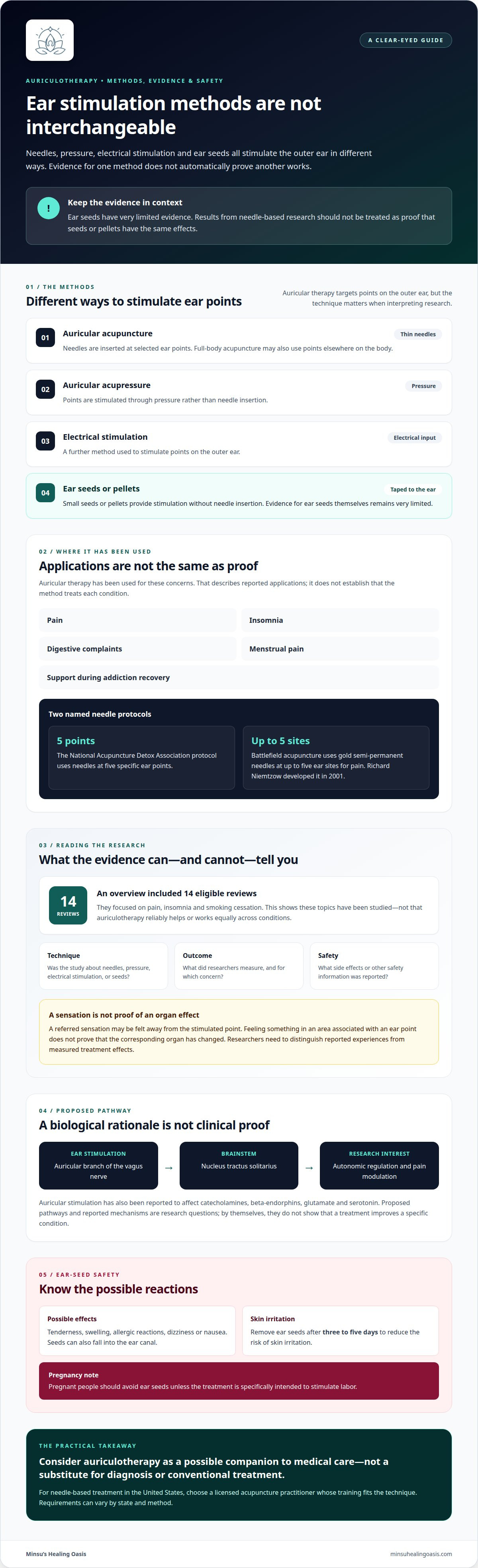
Auriculotherapy stimulates points on the outer ear, or auricle, using needles, pressure, electrical stimulation, seeds, or pellets. In the traditional Chinese medicine model, the ear is mapped to body areas and organs. In an inverted-foetus map, the earlobe represents the head, while the antihelix represents the spine. Auricular acupuncture uses ear points; full-body acupuncture may also use points elsewhere.
French neurologist Paul Nogier brought modern attention to auricular acupuncture in the 1950s and presented his findings to the French Acupuncture Society in 1956. The method differs from auricular acupressure: acupuncture uses thin needles, while acupressure stimulates points through pressure. Seeds or small pellets taped to the ear offer another form of stimulation without needle insertion.
Auricular therapy has been used for concerns including pain, insomnia, digestive complaints, menstrual pain, and support during addiction recovery. The National Acupuncture Detox Association’s protocol uses needles at five specific ear points. Battlefield acupuncture, developed by Richard Niemtzow in 2001, uses gold semi-permanent needles at up to five ear sites for pain. These uses describe applications, not proof that the method treats every condition.
For needle-based auricular acupuncture in the United States, choose a licensed acupuncture practitioner whose training fits the technique; requirements can vary by state and method. Auriculotherapy pricing depends on the treatment approach and care involved, with a price provided after a quote request. Insurance coverage depends on the plan and billed service, so review your benefits for the specific treatment.
A session typically begins with a discussion of health and goals, followed by ear cleaning and point mapping, needle placement, a rest period, and needle removal with aftercare. Needles may remain in place during a 10-to-45-minute relaxation period. There’s no standard session count: the treatment course is shaped around the concern and the person’s response.
Auriculotherapy evidence and effectiveness
Research on auriculotherapy examines possible effects as well as the limits of current evidence. The stimulation method matters: findings about needles don’t automatically establish the effects of ear seeds or acupressure.
Evidence for Pain Relief
Evidence for pain relief includes systematic reviews, but their findings don’t establish that every ear acupuncture method works. An overview included 14 eligible reviews focused on pain, insomnia, and smoking cessation. For pain, this shows that researchers have studied auriculotherapy, not that it reliably relieves pain or works equally across conditions. Ear seeding itself has very limited evidence, so results from needle-based studies shouldn’t be treated as proof for seeds.
Placebo Effects and Referred Sensations
A placebo effect is a change associated with treatment expectations and context, rather than the treatment’s specific physical action. A referred sensation is felt somewhere other than the point being stimulated. These concepts matter because feeling a sensation in an area associated with an ear point doesn’t prove that the corresponding organ has changed. Researchers need to distinguish reported experiences from measured treatment effects.
Proposed biological pathways are questions for research, not settled explanations. The auricular branch of the vagus nerve connects with the nucleus tractus solitarius in the brainstem, which is involved in autonomic regulation and pain modulation. Auricular stimulation has also been reported to affect catecholamines, beta-endorphins, glutamate, and serotonin. These reported mechanisms don’t, by themselves, show that a treatment improves a specific condition.
Possible Side Effects and Safety
Reported side effects of auriculotherapy are usually mild and can include ear soreness, irritation, or slight discomfort. Ear seeds may also cause tenderness, swelling, allergic reactions, dizziness, or nausea, and can fall into the ear canal. Remove seeds after three to five days to reduce skin irritation. Pregnant people should avoid ear seeds unless treatment is specifically intended to stimulate labor.
To assess a study carefully, distinguish its technique, measured outcome, and safety information. A finding about needles for pain, for example, doesn’t establish the effects of pellets for sleep. This distinction helps separate promising biological explanations from evidence of meaningful benefit for a particular person or condition.
Controlled research on chronic pain
A controlled crossover study tested auriculotherapy in 36 patients with chronic pain. Its findings offer a specific test of pain relief, rather than a general answer for every condition.
Pain Management and Modulation
Pain modulation is the nervous system’s adjustment of pain signals, while pain management aims to reduce their effect on daily life. Auriculotherapy has been studied for chronic lower back pain, headaches, postoperative pain, and musculoskeletal discomfort. But a proposed effect on pain signaling doesn’t establish reliable therapeutic relief. When weighing options, look at the results of controlled studies rather than claims based only on a treatment’s proposed purpose.
Proposed Links to the Nervous System
One proposed mechanism connects stimulation of the ear’s auricular branch of the vagus nerve with the nucleus tractus solitarius in the brainstem. This region is involved in autonomic regulation and pain modulation. The pathway provides a biological rationale for studying ear stimulation in pain management, but doesn’t demonstrate clinical relief on its own. It is a research rationale, not proof that chronic pain improves.
In the controlled crossover study, 36 patients took part in two experiments. Researchers found no difference between those experiments, and the study concluded auriculotherapy wasn’t an effective therapeutic procedure for chronic pain. That finding is direct and relevant: the tested approach did not show a difference in this study. It doesn’t establish outcomes for every pain condition or every form of ear stimulation.
Interpret results in light of the question each study tested. Evidence about chronic pain shouldn’t automatically be applied to insomnia, smoking cessation, or other concerns. Nor does a proposed pain-modulation pathway establish that ear seeds, needles, or acupressure have the same effects. The technique, condition, and measured outcome all matter when considering whether auriculotherapy belongs in a pain-management plan.
Integration with modern medical treatment
Auriculotherapy is best considered a complementary practice, not a replacement for medical treatment. A traditional Chinese medicine framework and clinical evidence for a specific use are different things.
In traditional Chinese medicine, qi is described as moving through the body along meridians. Modern explanations instead examine whether ear stimulation sends signals through nerves involved in regulation and pain modulation. These are different ways of understanding treatment. Neither makes auriculotherapy a diagnostic tool: it can’t identify disease or replace medical tests.
Vagus nerve stimulation offers a useful comparison, with an important limit. Auricular stimulation and implantable vagus nerve stimulation act on some of the same neural pathways, but an ear treatment isn’t the same procedure as an implanted device. The U.S. Food and Drug Administration approved implantable vagus nerve stimulation for refractory depression in 2005. That approval applies to the implantable treatment, not auriculotherapy for depression.
For practical integration, keep the roles of care clear. A medical professional evaluates symptoms, orders tests when needed, and guides conventional treatment. Auriculotherapy may be considered alongside that plan, with the method and goal discussed openly. For example, someone receiving care for persistent pain shouldn’t use ear stimulation as a reason to delay assessment or change prescribed treatment. This approach respects personal preferences as well as clinical needs.
The takeaway is straightforward: traditional Chinese medicine can inform why practitioners select ear points, while clinical decisions depend on the condition and evidence for the chosen method. Ear seeds are intended as complementary care, not a substitute for medicine. They also can’t confirm what’s happening in internal organs. Keep diagnosis and treatment decisions grounded in medical evaluation, and consider auriculotherapy an additional approach rather than a stand-alone answer. Whether exploring complementary therapies like ear seeds for stress or looking into specialized natural wellness products like Transfemme for gender affirmation, doing your research and consulting healthcare professionals ensures you make safe, informed choices for your body.
If you’re considering a complementary approach alongside medical care, explore integrative support as part of a thoughtful care plan.
Minsu’s Healing Oasis: Auriculotherapy
Minsu’s Healing Oasis offers auriculotherapy as a complementary option for people exploring ear-based stimulation as part of their wellness care. It may suit you if you’re curious about this approach and want to consider it alongside broader support, rather than as a replacement for medical evaluation or treatment.
Care can also include physical and manual therapies or myofascial release, depending on the support you’re seeking. These services address different needs, so a conversation about your goals can help you consider how auriculotherapy fits into your care. If you’re managing a medical condition, continue working with your healthcare professional on diagnosis and treatment decisions.
If you’d like to explore auriculotherapy, contact Minsu’s Healing Oasis.
Choose a Thoughtful Next Step for Your Well-Being
Understanding the science behind auriculotherapy can help you approach it with curiosity and clear expectations. A useful next step is to discuss what you hope to address, what care you already receive, and whether auriculotherapy may complement it. A grounded plan makes room for clinical guidance and your own sense of what supports you.
Minsu’s Healing Oasis offers a broader whole-person approach, including Physiotherapy and Manual Therapy, Energy Healing and Alternative Therapies, and Myofascial release. These services can support different needs, from physical function to a more integrative wellness practice. The right focus begins with your goals, not a promise of a particular result.
If you’re ready to explore your options, contact Minsu’s Healing Oasis to start a thoughtful conversation. You deserve care that respects your experience, supports informed choices, and leaves room for steady progress.
Frequently Asked Questions
What Are Ear Seeds and What Do They Do?
Ear seeds are tiny seeds, commonly from the Vaccaria plant, or small metal pellets attached to the ear with adhesive. They apply pressure to selected points without inserting a needle. For example, a person may gently press a seed to stimulate its point. Seeds can irritate the skin or cause tenderness, so remove them after three to five days.
What Conditions Is It Used For?
Auriculotherapy has been used for pain, insomnia, digestive complaints, menstrual pain, and as support in addiction recovery. The intended use depends on the method and concern being addressed. For example, an addiction-recovery protocol stimulates specific ear points. These examples describe how the practice is used; they don’t prove that auriculotherapy treats or cures these conditions.
What Is Auriculotherapy?
Auriculotherapy is a practice that stimulates points on the outer ear using methods such as needles, pressure, electrical stimulation, or adhesive seeds and pellets. Practitioners use an ear map in which points are believed to correspond with areas of the body. It’s useful to distinguish the broad term from auricular acupuncture, which specifically involves needles at ear points.
What is auriculotherapy and how is it thought to work?
Auriculotherapy is thought to work by activating sensory nerves in the ear, which may send signals into the nervous system. One proposed pathway involves the auricular branch of the vagus nerve, connected to brainstem processes involved in autonomic regulation and pain modulation. This explanation helps frame the science behind auriculotherapy, but a proposed mechanism alone doesn’t establish clinical benefit.
What do systematic reviews and clinical trials say about auriculotherapy's effectiveness?
Reviews and trials offer a mixed picture, not proof of consistent effectiveness across conditions. Reviews have examined uses including pain, insomnia, and smoking cessation, while individual trials test specific methods and outcomes. The key is to distinguish evidence for a particular technique and concern from broader claims about auriculotherapy as a whole.
How does auriculotherapy compare with acupuncture, acupressure, and sham treatment?
Auriculotherapy focuses stimulation on the ear, while acupuncture can involve needles at points elsewhere on the body. Auricular acupuncture uses needles at ear points; acupressure applies manual pressure instead. A sham treatment is designed as a comparison in research, but its exact method can vary. Findings from one technique or control design don’t automatically apply to another.



Comments