




Root Cause Healing Therapy: Look Beyond Symptoms, Without Overpromising
What if recurring symptoms aren’t a puzzle with one hidden answer, but a reason to look more carefully at the whole picture? If you’ve tried different approaches and still feel unsure what may be contributing, it makes sense to want care that listens beyond the symptom. The phrase root cause healing therapy can sound like a clearly defined treatment, but it isn’t a standardized medical approach, and no single explanation or method fits everyone.
A thoughtful whole-person perspective can make room to explore physical patterns, emotional well-being, and daily habits without assuming any one factor is the cause. It can also be difficult to distinguish supportive care from claims that promise too much. A grounded approach respects your experience, explains what a therapy is intended to support, and keeps appropriate healthcare involved.
In this article, you’ll learn what root cause healing therapy may mean, how contributing factors can be explored responsibly, and where evidence-informed care fits. We’ll also compare physiotherapy, manual therapy, and complementary modalities, and explain why supportive therapies should complement rather than replace medical assessment or treatment.
Table of Contents
What Does Root Cause Healing Therapy Mean Beyond Symptom Relief?
How Root Cause Healing Therapy Explores the Whole-Person Picture
Root Cause Healing Therapy: Evidence, Limits, and Common Misconceptions
How to Prepare for Root Cause Healing Therapy and Track Your Experience
How Minsu’s Healing Oasis Brings Root Cause Healing Into Integrative Care
What Does Root Cause Healing Therapy Mean Beyond Symptom Relief?
If a symptom eases and then returns, it’s understandable to wonder whether something else deserves attention. Looking beyond short-term relief doesn’t mean there’s one hidden explanation waiting to be found. Symptoms can have several possible contributors, and sometimes a clear cause isn’t identified.
The phrase root cause healing therapy generally describes an approach that explores possible contributing factors alongside a person’s immediate concerns. That exploration may include discussing symptom patterns, movement, routines, stress, and personal goals. These are useful topics for conversation, not proof that any one factor caused a symptom.
In brief: “Root cause healing therapy is a broad, supportive approach to exploring possible contributors to a person’s concerns; it isn’t, by itself, a medical diagnosis or standardized treatment.”
The term can overlap with ideas described as complementary and alternative medicine, but people use the language in different ways. To understand an approach, ask what it involves, what it is intended to support, and what it can reasonably claim to do.
How Is Root Cause Exploration Different From Treating a Symptom?
Addressing a symptom focuses on the concern in front of you, such as managing discomfort or supporting movement. Broader exploration asks whether patterns or circumstances may also be relevant. These aims can sit alongside each other. Support for comfort and function may help you manage daily activities while a qualified clinician assesses concerns and considers possible contributing factors.
Imagine someone notices neck stiffness after long days at a desk. A conversation might consider when it appears, what activities affect it, and whether it changes with rest. That information can guide further discussion, but it doesn’t establish the cause. Another person with a similar symptom may have a different experience and need a different assessment.
Is Root Cause Healing a Standardized Medical Treatment?
No single, universally standardized protocol defines this phrase. It may describe a whole-person philosophy, a clinical approach, or a complementary wellness practice. These aren’t interchangeable: assessment by an appropriately licensed healthcare professional has a different role from a complementary modality, which shouldn’t be presented as diagnosing or curing a condition.
Supportive care can be considered alongside appropriate medical care, not as a replacement for it. Don’t delay medical assessment for symptoms that are new, severe, or getting worse. A careful approach leaves room for questions and personal goals while respecting the limits of what any therapy can establish.
How Root Cause Healing Therapy Explores the Whole-Person Picture
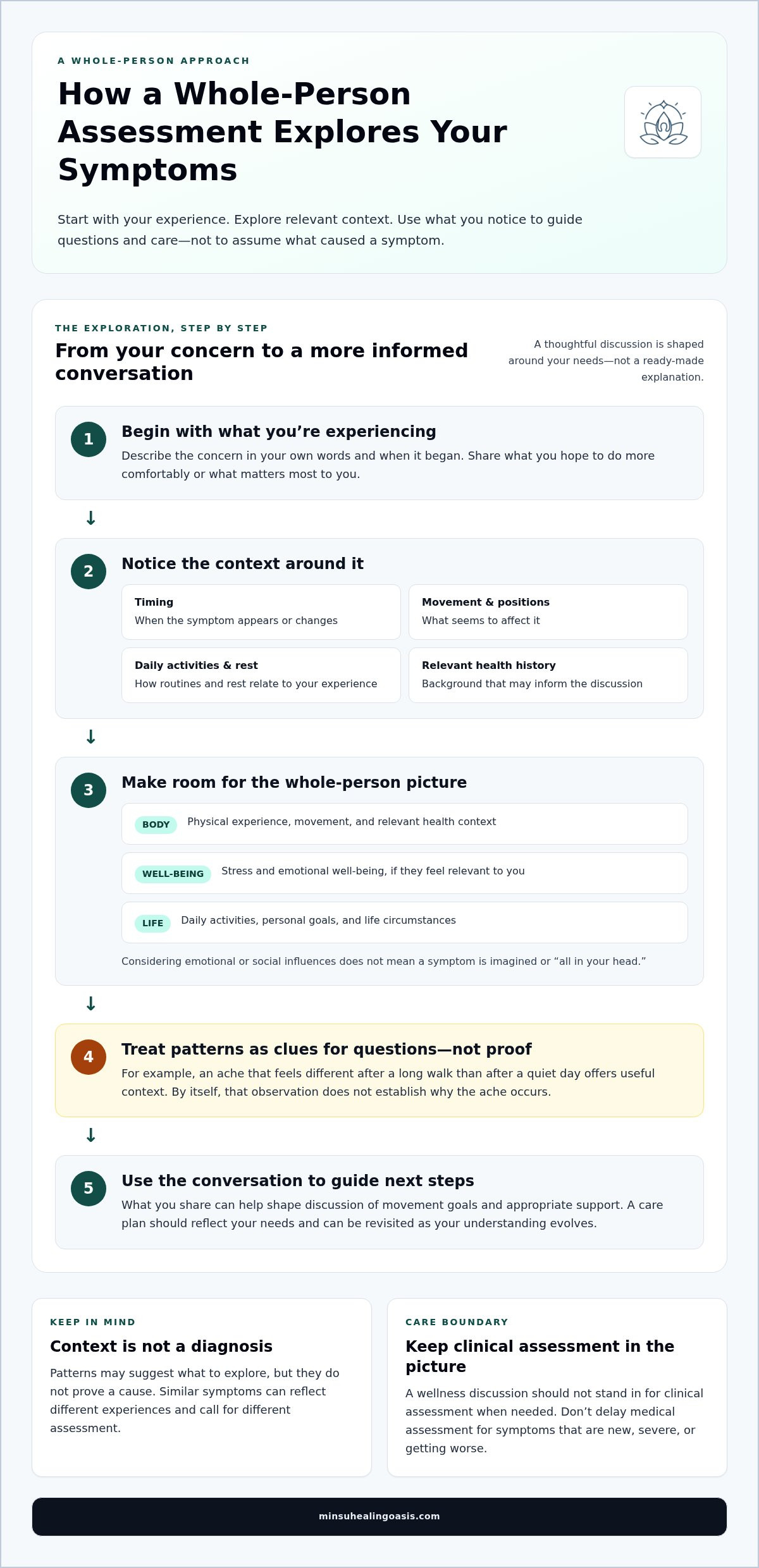
A useful conversation starts with your experience, not a ready-made explanation. A practitioner may ask when a concern began, what tends to change it, how it affects movement or daily activities, and what you hope to do more comfortably. The aim is to understand the context around your symptoms and shape the discussion to your needs, rather than assume everyone follows the same pattern.
A whole-person assessment considers the circumstances around a symptom to guide questions and care, not to prove what caused it. Patterns can suggest what to explore, but they don’t establish a diagnosis. The Cleveland Clinic describes functional medicine as an approach that focuses on the underlying cause. That description belongs to its specific approach and doesn’t mean every use of “root cause” refers to the same process.
What Factors Might a Practitioner Explore?
Depending on your concern, the conversation might include symptom timing, movements or positions that affect it, daily activities, rest, and relevant health history. You might notice that a recurring ache feels different after a long walk than after a quiet day. That observation is useful context, not evidence on its own of why the ache occurs.
Stress and emotional well-being may also be part of the conversation if they feel relevant to you. Acknowledging them doesn’t mean a symptom is imagined or “all in your head.” It simply makes room for your lived experience. Appropriate medical evaluation remains part of the wider picture; a wellness discussion shouldn’t stand in for clinical assessment when that’s needed.
How Do Physical and Emotional Factors Fit Together?
The biopsychosocial model offers a way to consider how biological, psychological, and social influences may interact with health. In everyday terms, it invites questions about the body, emotional well-being, and life circumstances without reducing a concern to any one of them. A stressful period occurring alongside discomfort, for instance, doesn’t prove that stress caused the discomfort. It’s one part of the story to consider carefully.
In a whole-person approach, what you share can guide the next conversation: which movement goals matter, what patterns you’ve noticed, and what kind of support feels appropriate. A care plan should reflect your needs and can be revisited as your understanding evolves. Options may include integrative physiotherapy or manual therapy, which have distinct purposes. No single modality can identify every cause or guarantee an outcome.
If you’re curious about how physical and holistic perspectives can be brought together, explore integrative care at Minsu’s Healing Oasis.
Root Cause Healing Therapy: Evidence, Limits, and Common Misconceptions
Could there be one hidden cause behind every recurring symptom? Sometimes a clear contributor is identified; sometimes symptoms have several influences, or the cause remains uncertain. Asking what might be contributing can be useful. Treating a possibility as a conclusion without adequate assessment is not. Understanding may change over time as symptoms, clinical findings, and personal goals become clearer.
Does Root Cause Healing Mean There Is One Hidden Cause?
No. “Root cause” language can encourage curiosity, but it doesn’t establish that every concern has one discoverable source. A whole-person perspective is most responsible when it leaves room for uncertainty and more than one explanation. If you’re already receiving care, this approach needn’t invalidate it; it can help you discuss your questions while keeping appropriate medical evaluation in view.
How Should Readers Think About Evidence for Different Therapies?
Evidence for a clinical assessment is different from evidence about a particular therapy. An assessment may help a qualified healthcare professional evaluate a concern and decide what next steps are appropriate. A supportive modality has a different purpose. Its use doesn’t show that it can diagnose a condition or identify the cause of symptoms. Consider claims for each therapy in relation to the specific concern.
Myofascial release and cranial sacral therapy are hands-on approaches, while Quantum Healing and Red Light Therapy are different modalities. Describing them clearly helps you understand what is being offered without implying they have the same purpose or evidence. To learn about one distinct approach, explore this Quantum Healing guide.
With root cause healing therapy, a balanced question isn’t “Which treatment fixes everything?” but “What is this approach intended to support, what can it reasonably tell me, and how does it fit alongside my healthcare?” That keeps curiosity alive without asking any single therapy to promise more than it can deliver.
How to Prepare for Root Cause Healing Therapy and Track Your Experience
A little preparation can help you make the most of an initial conversation. You don’t need to arrive with a diagnosis or a complete explanation. Focus on what you’ve noticed, what matters in your daily life, and what you hope to understand or do more comfortably. For root cause healing therapy, these details help keep the conversation grounded in your experience rather than assumptions.
What Should You Share Before a Session?
Start with the basics: when the concern began, how it varies, what seems to affect it, and which everyday activities feel easier or harder. Share relevant diagnoses, medications, previous care, and personal goals. If you’re unsure whether a detail matters, mention it and invite discussion. You can also ask what an approach involves and share comfort preferences, including anything you’d rather avoid.
A useful first-conversation checklist:
When the concern began and any changes you’ve noticed
Movements, activities, or rest that seem to affect it
How it influences comfort, daily function, or participation
Relevant health history, diagnoses, medications, and prior care
Your goals, questions, and preferences for care
How Can You Notice Progress Without Expecting a Cure?
Choose a small number of goals that feel meaningful to you, such as completing a daily activity with greater ease or taking part in something you value. Revisit them in conversation instead of relying only on a general impression of whether you feel “better.” Change may be gradual or variable. Tracking observations can help you discuss what’s happening without assuming that a short-term shift proves a cause or a therapy’s effectiveness.
A simple note about activity, comfort, and relevant circumstances can reveal patterns worth discussing. Keep the record manageable and consistent; it’s a tool for reflection, not a test you have to pass. New, worsening, or concerning symptoms deserve discussion with an appropriate healthcare professional.
If you’re considering Red Light Therapy as a complementary modality, read this guide to Red Light Therapy for more context about that specific approach. To explore individualized integrative care, learn about care at Minsu’s Healing Oasis.
How Minsu’s Healing Oasis Brings Root Cause Healing Into Integrative Care
Looking beyond a symptom can mean making space for both your immediate concern and the broader context of your well-being. At Minsu’s Healing Oasis, this whole-person perspective brings attentive exploration together with individualized therapeutic options. The aim isn’t to assume one hidden cause or promise a particular result. It’s to consider what support may fit your concerns and goals while respecting the role of appropriate healthcare.
What Can an Integrative Session Include?
Minsu’s Healing Oasis offers integrative physiotherapy and manual therapy. Manual therapy options include myofascial release and cranial sacral therapy. These are distinct forms of supportive care, not methods for diagnosing a condition or guaranteeing an outcome.
Other offerings, including Quantum Healing and Red Light Therapy, are separate complementary modalities. They aren’t interchangeable with physiotherapy or manual therapy, and they shouldn’t be treated as substitutes for medical assessment or treatment. Understanding each option’s purpose can help you make thoughtful, informed choices about what feels appropriate for your care.
How Can Whole-Person Care Support Your Next Step?
Start with a clear conversation about what you’re experiencing, what you hope to address, and which approaches align with your preferences. Your goals can help shape the discussion, while your healthcare needs remain central. If a concern requires medical assessment, supportive therapies should sit alongside that care rather than take its place.
For readers exploring root cause healing therapy, an integrative setting can offer room to consider physical and broader well-being perspectives without suggesting that one modality explains or resolves every symptom. You’re in control of what you share and which options you choose to explore. Take your time, ask questions, and focus on care that respects both your experience and the limits of what a therapy can claim.
To learn more about the available approaches, explore Minsu’s Healing Oasis and its integrative care options.
Take a Thoughtful Next Step Toward Whole-Person Care
Exploring root cause healing therapy doesn’t mean assuming every symptom has one hidden explanation. It means making room to discuss possible contributing factors, understand the limits of different approaches, and keep appropriate medical care involved. Tracking changes in daily comfort and function can help you reflect on what matters without treating a pattern as proof.
At Minsu’s Healing Oasis, integrative physiotherapy and manual therapy offer physical perspectives, including myofascial release and cranial sacral therapy. Quantum Healing and Red Light Therapy are separate complementary offerings, not substitutes for medical assessment or treatment. Each approach has its own purpose, and your needs and goals remain central as you consider what may feel supportive.
Explore Minsu’s Healing Oasis and its integrative care options to take a clear, thoughtful next step toward whole-person care.
Frequently Asked Questions
What does root cause healing therapy mean?
Root cause healing therapy is a broad phrase for exploring possible contributors to a person’s concerns alongside their immediate symptoms. It isn’t one standardized treatment or a medical diagnosis. A whole-person conversation may consider symptom history, movement, routines, stress, and personal goals, while recognizing that these details don’t prove what caused a condition. The aim is thoughtful inquiry, not certainty or a promise that every concern has one hidden explanation.
Does root cause healing therapy mean symptoms are ignored?
No. Supporting comfort and daily function can matter alongside exploring broader patterns. For example, someone may want help managing discomfort while also discussing when it tends to arise and how it affects activities. These aims can complement each other. Paying attention to context shouldn’t mean dismissing what you feel or postponing appropriate assessment. Share both your immediate concerns and longer-term goals so the conversation reflects what matters to you.
Can root cause healing therapy cure chronic pain?
No therapy can responsibly promise to cure chronic pain. Pain experiences and contributing factors vary, and the cause may not always be clear. Supportive approaches may be considered as part of a broader care plan, but they don’t replace assessment or guarantee a particular outcome. If pain is persistent, changing, or affecting your daily life, discuss it with an appropriate healthcare professional and keep them informed about therapies you’re considering.
How does a practitioner identify possible root causes?
A careful inquiry may begin with your symptom history, daily activities, movement, rest, relevant health history, and personal goals. A qualified clinician may use appropriate assessment to inform next steps. These details can guide questions, but they aren’t proof that one factor caused a symptom. Your understanding may evolve as more information becomes available. Share what you notice, while leaving diagnosis to an appropriately qualified healthcare professional.
Is root cause healing therapy scientifically proven?
The phrase isn’t a standardized treatment, so it can’t be judged as one single method with one evidence base. Evidence and appropriate claims need to be considered for each specific service or therapy. Clinical assessment, manual therapy, and complementary wellness modalities have different purposes and shouldn’t be treated as interchangeable. Ask what an approach is intended to support, what is known about it, and how it fits alongside appropriate medical care.
What should I expect at a first root cause healing session?
Expect a conversation about what brings you in, when you noticed the concern, how it affects daily life, and what you hope to work toward. You can share relevant health history, previous care, and comfort preferences, and ask what an approach involves. Minsu’s Healing Oasis offers integrative physiotherapy and manual therapy, myofascial release, cranial sacral therapy, and distinct complementary modalities. The right discussion depends on your goals and needs.
Can holistic therapy replace medical care?
No. Holistic or complementary therapies shouldn’t replace appropriate medical assessment, diagnosis, or treatment. They may be considered as supportive options alongside healthcare, with a clear understanding of their purpose and limits. Tell your healthcare professional about therapies you use or are considering, especially if symptoms are new, severe, worsening, or concerning. You deserve care that respects your experience while keeping safety and your broader health needs in view.



Comments