




Craniosacral Therapy for Sleep Disorders: Evidence and Limits
Cranial sacral therapy for sleep disorders may offer a gentle, hands-on way to support relaxation, but evidence that it treats insomnia or reliably improves sleep is limited. It should not replace medical care for an underlying sleep condition.
When sleeplessness leaves you tense, restless, or unable to settle, it is understandable to seek an approach that considers both body and mind. Practitioners use gentle touch and stillness to support a calmer state, which may feel meaningful when stress or physical tension affects your nights.
This article explores how craniosacral therapy may relate to sleep cycles and insomnia, what practitioners observe, and what the evidence and known risks indicate. You will get a clearer sense of where this complementary approach may fit and when medical evaluation remains important.
Table of Contents
How Craniosacral Therapy Can Work for Insomnia and Other Sleep Disorders?
Craniosacral therapy is proposed as a gentle way to support relaxation, not as a proven insomnia treatment. Understanding its ideas about the nervous system, sleep-wake cycles, and cerebrospinal fluid helps clarify what the approach may offer.
Fight-or-Flight and Rest-and-Digest Responses
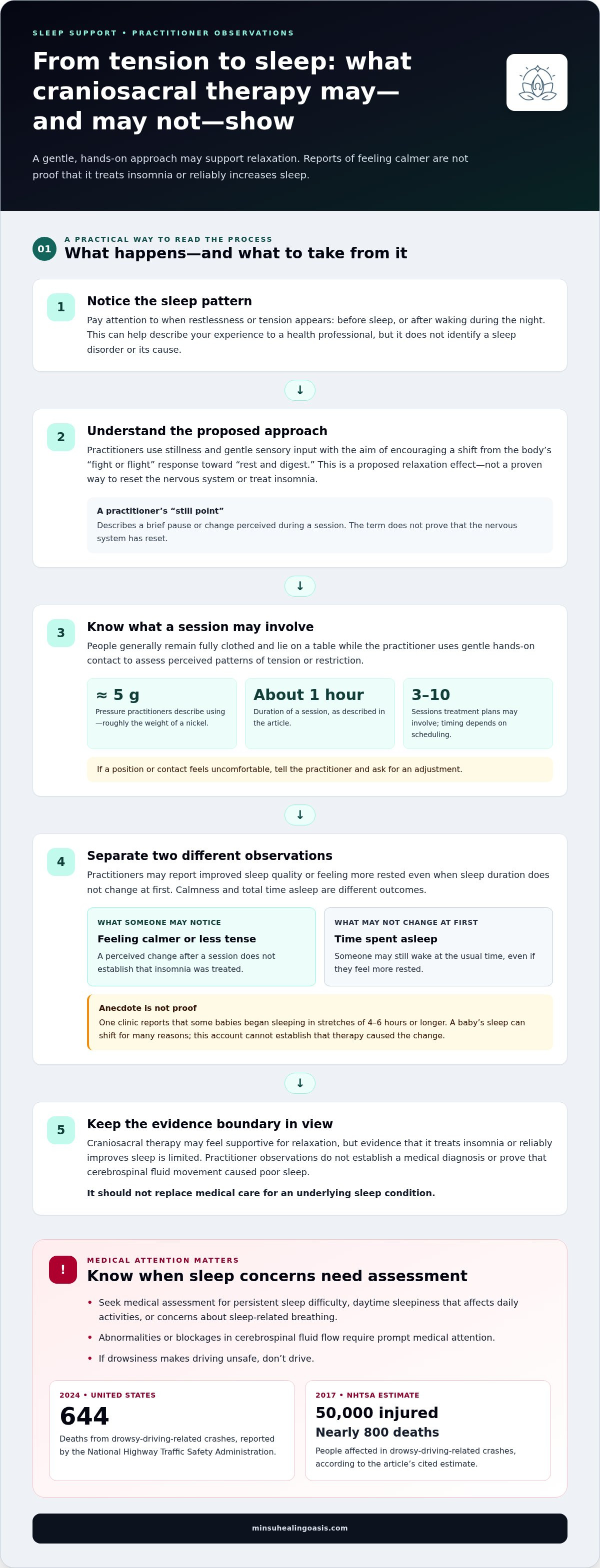
The fight-or-flight response prepares the body to respond to stress, while the rest-and-digest response supports settling and recovery. If you lie awake feeling tense or alert, these responses help explain why winding down can be difficult. Craniosacral therapy aims to encourage rest and digest through stillness, a sense of safety, and gentle sensory input, rather than forcefully changing the body.
Practitioners may describe this as supporting the body’s natural settling process. This framing can help you notice whether stress or muscle tension accompanies difficulty falling asleep, including during ongoing sleep disruption. It does not identify the cause of a sleep disorder.
Proposed Relaxation Effects
The proposed effect is that gentle touch in a quiet setting may ease tension and support relaxation. Practitioners may use “still point” to describe a brief pause or change they perceive during treatment. The term does not prove that the nervous system has reset; it describes an experience during the session.
For example, someone who arrives feeling keyed up may leave calmer, even if that feeling does not lead to longer sleep. Relaxation may be valuable, but it should not be taken as proof that the therapy treats insomnia. Notice changes in both your sense of ease and your sleep pattern.
Autonomic Activity and Sleep-Wake Cycles
The autonomic nervous system regulates involuntary functions and is connected with the body’s sleep-wake cycles. Craniosacral therapy is described as working with this system by encouraging a shift from sympathetic “fight or flight” toward parasympathetic “rest and digest.” This proposed connection is relevant because difficulty settling can occur alongside heightened alertness or tension.
Notice when restlessness arises, such as before sleep or after waking during the night. This can help you describe your experience to a health professional. On its own, it cannot identify a sleep disorder or show that nervous-system activity is the only cause.
The CranioSacral System and Cerebrospinal Fluid
The cranioSacral system refers to the membranes and cerebrospinal fluid surrounding and protecting the brain and spinal cord, which together form the central nervous system. Cerebrospinal fluid circulates around the brain and spinal cord.
Craniosacral practitioners use gentle touch to assess areas they perceive as restricted or strained. The approach links ease and relaxation with the body’s wider systems, but does not prove that a fluid-flow problem causes insomnia. Abnormalities or blockages in cerebrospinal fluid flow require prompt medical attention.
How much does craniosacral therapy cost in the United States, and is it covered by insurance? Price depends on the case and is provided after a quote request; location, session length, and practitioner affect costs. Insurance coverage depends on the specific plan and its terms.
How many sessions are typically used for sleep, and how long does treatment take? Treatment plans may involve between 3 and 10 sessions, and a session lasts about an hour. The timing of a course depends on how sessions are scheduled.
When should someone with sleep problems consult a doctor or sleep specialist? Seek medical assessment for persistent sleep difficulty, daytime sleepiness that affects daily activities, or concerns about sleep-related breathing. The National Highway Traffic Safety Administration reports 644 deaths from drowsy-driving-related crashes in 2024; for 2017, it estimated that these crashes led to 50,000 people injured and nearly 800 deaths. If drowsiness makes driving unsafe, don’t drive.
Practitioner observations about sleep quality
Practitioners describe sessions focused on stillness and rhythmic balance as potentially supportive of sleep quality. They also report that sleep duration may initially remain unchanged, even when someone feels more rested. Perceived calm and total time asleep are different observations. For example, you might feel less tense after a session but still wake at your usual time.
People generally remain fully clothed during treatment, lying on a table while the practitioner uses gentle hands-on contact. Practitioners may use about five grams of pressure, roughly the weight of a nickel. This light touch is intended to notice patterns of tension and tissue restriction, not force movement. Tell the practitioner if a position or contact feels uncomfortable and ask for an adjustment.
Reports about babies should be understood as practitioner observations, not proof of a predictable result. One clinic reports that some babies receiving craniosacral therapy began sleeping in stretches of 4-6 hours or longer. A baby’s sleep can shift for many reasons, so that account cannot establish that treatment caused the change. For adults, observations may include feeling calmer or noticing less tension at bedtime.
Practitioners do not treat diagnoses directly. They assess patterns of restriction, strain, and nervous-system tone that may relate to a person’s experience. Some describe working with cerebrospinal fluid or bodily responses linked with stress and trauma, but these descriptions do not establish a medical diagnosis or prove that fluid movement caused poor sleep. Their observations can contribute to understanding how a person feels, but do not replace assessment of a sleep condition.
Slow breathing can offer a separate, practical way to settle before bed. Dr. James Cima recommends inhaling for a count of five, then exhaling for a count of ten. Repeat gently, without straining or forcing a deeper breath. Notice whether the longer exhale feels comfortable, and stop if the exercise makes you feel unwell. This practice gives your attention a simple rhythm to follow.
How can you find a qualified therapist and assess credentials? Upledger states that CranioSacral Therapists practice in all 50 U.S. states and more than 60 countries. Look for documented craniosacral training and relevant professional credentials, then ask how the practitioner’s scope applies to your needs.
If gentle hands-on care feels relevant to your goals, explore craniosacral therapy as one option for supporting relaxation.
Evidence and risks of cranial sacral therapy
Evidence for sleep benefits is limited, so distinguish reported experiences from established treatment effects. This can help you weigh gentle care alongside options that directly address insomnia.
Evidence for Insomnia and Research Limitations
Evidence for craniosacral therapy’s effectiveness remains limited. A reported U.S. study involving football players found average sleep duration increased by up to 4 hours per night within less than three months. That result is notable, but it doesn’t establish the same effect for people with insomnia. One study finding cannot settle how well an approach works across different sleep problems.
Research limitations matter because insomnia can have varied contributors, including stress, pain, or another health condition. A practitioner’s observation of relaxation or release in spinal and surrounding tissues is not the same as a measured change in sleep. Track practical outcomes, such as how long it takes to fall asleep and how rested you feel, while continuing medical care for underlying conditions.
Sleep Disorders Studied
Craniosacral therapy is described as a possible approach for insomnia and disturbed sleep cycles. A report involving football players considered sleep duration, but the available description does not identify a specific sleep-disorder diagnosis among the participants. This distinction helps avoid treating a change in sleep hours as proof that the therapy works for a particular condition.
Sleep-related breathing concerns require a different approach. Craniosacral therapy does not remove the need to address breathing issues with appropriate dental, medical, and behavioral expertise. If snoring or disrupted breathing accompanies poor sleep, relaxation alone cannot explain or assess the breathing pattern.
How does craniosacral therapy compare with CBT-I, medication, and other insomnia treatments? These approaches differ: CBT-I focuses on thoughts and behaviors connected with sleep, while medication takes a pharmacological approach. Craniosacral therapy centers on gentle hands-on care and relaxation, and evidence for insomnia is limited.
Do medical guidelines recommend craniosacral therapy for sleep disorders? Craniosacral therapy should not be presented as an established, guideline-backed treatment for sleep disorders. Given the limited evidence, it is best understood as complementary care, not a replacement for necessary medical treatment.
What sleep disorders have been studied with craniosacral therapy? The described topics include insomnia and disturbed sleep cycles. A reported study involving football players examined sleep duration, but the description does not identify a specific diagnosed sleep disorder.
Risks deserve equal attention. Mild discomfort after a session typically fades within 24 hours. Craniosacral therapy should not replace necessary medical treatment for an underlying condition, and it is not appropriate for everyone. Avoid it with a severe bleeding disorder, a diagnosed aneurysm, or a recent traumatic head injury that may involve cranial bleeding or skull fractures. Acute trauma requiring medical stabilization, active central nervous system infections, and unstable neurological conditions are also cautions.
Mental health care remains important when distress or anxiety affects sleep. Craniosacral therapy may complement other approaches by addressing physical aspects of stress, but it does not replace mental health care. A thoughtful decision considers the sleep concern, relevant medical conditions, and the limits of the evidence.
Conditions listed for cranial sacral therapy
Craniosacral therapy is described for concerns involving physical tension, headaches, nighttime teeth grinding, and some post-concussion recovery plans. These uses involve gentle hands-on care and areas of strain, not treatment for every condition or a replacement for medical assessment. Whether it is worth considering depends on the symptoms and whether urgent medical concerns have been addressed.
For headaches or nighttime jaw clenching, practitioners may focus on tension around the suboccipital region, neck, and shoulders. These areas may feel tight after a day leaning toward a screen or when you wake with a sore jaw. A session may use subtle touch to assess restricted areas and support relaxation. The aim is to address your experience of tension, not to claim that a particular physical finding causes every headache.
Consider what happens around a symptom before deciding whether this approach is relevant. For example, note whether jaw tightness appears at bedtime, neck discomfort interrupts rest, or headaches occur alongside shoulder tension. These details help you describe the concern clearly. They do not establish a diagnosis and should not delay medical evaluation when symptoms are new, severe, or otherwise concerning.
After a concussion, craniosacral therapy is sometimes used as part of a broader recovery plan, but only after acute medical concerns have been addressed. The order matters: possible serious injury requires appropriate medical attention first; complementary care may be considered later as part of recovery. Craniosacral therapy is not a substitute for concussion assessment or care, and should not be used to manage an acute head injury on its own.
Practitioners assess patterns of restriction, strain, and nervous-system tone rather than treating diagnoses directly. This distinction can clarify what a session is intended to do. A practitioner may use gentle contact around the head, neck, or shoulders while you describe how the area feels. A perceived release or change in tension is an observation during care, not proof of healing or a guaranteed improvement in sleep.
For a practical discussion, bring a concise description of your symptoms to the appointment: where discomfort occurs, when it appears, and how it affects sleep. If headaches accompany jaw grinding, mention both. If neck tension follows a concussion, explain the injury and medical assessment already completed. These details keep the conversation grounded in your physical experience and help clarify whether complementary care fits alongside the broader plan.
Keep the purpose specific. Gentle craniosacral work may be considered for tension around the suboccipital region, neck, or shoulders, and sometimes within post-concussion recovery after acute concerns are addressed. It should not be presented as a universal treatment for headaches, teeth grinding, concussion, or sleep problems.
Cranial sacral therapy and sleep cycles or insomnia
Cranial sacral therapy is sometimes considered for insomnia and disturbed sleep cycles, but its proposed role differs from direct insomnia treatment. If you are exploring cranial sacral therapy for sleep disorders, the key question is whether gentle hands-on care could support settling when tension, pain, or anxiety makes falling asleep difficult. This possibility must be considered in light of limited evidence for sleep benefits.
Sleep problems can involve difficulty falling asleep, waking during the night, or feeling unrefreshed. These experiences do not necessarily share a cause. For example, pain that keeps someone awake calls for a different assessment than snoring or disrupted breathing. Craniosacral therapy is described as complementary care that may support relaxation, not a way to identify a sleep disorder.
The proposed connection involves the autonomic nervous system, which helps regulate involuntary functions and sleep-wake cycles. Practitioners aim to encourage a more settled state through stillness and gentle sensory input. If you feel physically tense at bedtime, quiet hands-on care may feel calming. Feeling calmer, however, does not establish that your sleep cycle has changed.
Before choosing an approach, consider what seems to keep you awake. If neck or jaw tension accompanies bedtime restlessness, note when it appears and whether it also occurs during the day. If you experience breathing pauses, loud snoring, or marked daytime sleepiness, prioritize medical assessment. Relaxation support and evaluation of a breathing-related sleep problem serve different purposes.
An estimated 50-70 million adults in the United States have a sleep disorder. This estimate includes varied conditions; it doesn’t mean cranial sacral therapy for sleep disorders has been studied or shown effective for all of them. A broad estimate describes the reach of sleep concerns, not the effectiveness of one method.
One reported client, Lori, said she slept 11 hours after receiving craniosacral therapy for pain that had kept her awake. Her account suggests one possible pathway: easing discomfort may make rest easier. It remains an individual report, not proof that treatment changes sleep cycles or resolves insomnia. If pain disrupts your sleep, consider both the discomfort and its underlying cause with appropriate care.
Define your goal clearly: easing tension, addressing pain, and evaluating persistent insomnia are different aims. Track symptoms such as time spent awake and daytime effects, then share that pattern with a health professional. For gentle, whole-person support, explore support for rest and relaxation.
Minsu’s Healing Oasis: Physiotherapy and Manual Therapy
Minsu’s Healing Oasis offers physical and manual therapies for people seeking support with physical tension that may interfere with rest. If discomfort, restricted movement, or muscle tightness contributes to your sleep difficulty, these therapies offer a hands-on approach focused on your physical concerns. Myofascial release and cranial sacral therapy are also available as complementary options for those exploring gentle, whole-person care.
Consider this support when you want to address tension alongside appropriate medical care, rather than use complementary therapy instead of evaluation or treatment for a sleep disorder. Share how discomfort affects your nights and daily life so the conversation stays focused on your needs.
For a calm next step, contact Minsu’s Healing Oasis or visit minsuhealingoasis.com.
Choose a Restorative Next Step
Your next step can begin with noticing what makes rest difficult. Is tension keeping your body alert, or does worry make it hard to settle? Bringing that distinction into a care conversation can help keep your goals personal and grounded. Cranial sacral therapy for sleep disorders may be one complementary option to discuss alongside appropriate medical or mental health care.
At Minsu’s Healing Oasis, physical and manual therapies, myofascial release, and energy healing and alternative therapies offer different ways to explore physical comfort and whole-person well-being. The right conversation starts with what you are experiencing, what support you already have, and what you would like to address next.
If you’d like to explore a thoughtful path forward, contact Minsu’s Healing Oasis. You deserve care that honors your needs and helps you move toward rest with patience and clarity.
Frequently Asked Questions
How does it work?
Practitioners use gentle touch to assess areas they perceive as restricted or strained, then work with those tissues through light contact. The intended effect is to encourage relaxation and a calmer bodily state, rather than force physical change. For example, if you notice jaw tension at bedtime, describe when it occurs and whether it affects your ability to settle. These observations can guide the session, but do not establish why sleep is disrupted.
How is CST performed?
A session commonly begins with a detailed history and a structural examination, followed by gentle hands-on techniques. Before treatment starts, you can explain your sleep concerns, relevant health conditions, and areas of discomfort. Practitioners generally work with you fully clothed, using light touch rather than forceful manipulation. Sharing what feels comfortable during the session helps make the experience responsive to your needs.
What can you do to improve your sleep?
Start with a simple, repeatable bedtime routine: keep your sleep space calm, set aside stimulating activities, and note what seems to disrupt your rest. One suggested bedtime technique uses two tennis balls taped together; lie on them for 1-3 minutes, and stop if new pain occurs. A brief sleep log can help you notice whether discomfort, stress, or another pattern regularly precedes a difficult night.
Why is my sleep disturbed?
Sleep can be disrupted by different factors, so the pattern matters. Pain may make it hard to settle, while stress or anxiety can leave you alert at bedtime. Snoring or interrupted breathing points to a different concern than waking with neck tension. Note when symptoms occur, what accompanies them, and how they affect your daytime functioning. Persistent disruption or breathing concerns warrant medical evaluation.
What is craniosacral therapy and how is it claimed to help sleep disorders?
Craniosacral therapy is a gentle, hands-on method practitioners use to assess and support the craniosacral system, which involves membranes and fluid around the brain and spinal cord. Practitioners claim that gentle touch and stillness can ease tension and encourage relaxation. For sleep, the proposed benefit is support with settling when stress or physical discomfort contributes to restlessness, not direct correction of every sleep disorder.
What clinical evidence supports craniosacral therapy for insomnia or other sleep disorders?
Evidence for sleep benefits remains limited. A reported study involving football players found average sleep duration increased by up to 4 hours per night within less than three months of therapy. That result doesn’t establish the same effect for people with insomnia or other diagnosed sleep disorders. Current evidence should be weighed carefully, and the reported finding shouldn’t replace an appropriate assessment or established care.
What are the risks, side effects, and contraindications of craniosacral therapy?
Mild discomfort after treatment typically fades within 24 hours. Craniosacral therapy should not replace necessary medical care, and it’s cautioned against with severe bleeding disorders, a diagnosed aneurysm, or recent traumatic head injuries that may involve cranial bleeding or skull fractures. Acute trauma needing stabilization, active central nervous system infections, and unstable neurological conditions are also cautions. Share relevant health history before considering hands-on treatment.



Comments