




Physiotherapy for Childhood Developmental Delay: A Guide
Updated: 6 days ago
What if progress isn’t about matching every milestone on a set timeline, but helping your child move with greater comfort and confidence in everyday life? If you’re unsure whether a movement difference needs attention, it’s understandable to have questions. Childhood developmental delay physiotherapy can support functional movement while respecting your child’s strengths, needs, and pace.
You may be wondering whether physiotherapy could help or what an assessment and therapy session might involve. A thoughtful, child-focused approach starts by understanding what your child already enjoys and can do, then considers practical next steps without losing sight of the person behind the milestones.
In this guide, you’ll learn how physiotherapy may support movement, what a therapist might observe and ask during an assessment, and how playful everyday activities can create opportunities to move. You’ll also find ways to share observations and questions so professional guidance connects with family routines. At Minsu’s Healing Oasis, physiotherapy and specialized children’s programs address individual therapeutic needs.
Table of Contents
What Does Childhood Developmental Delay Mean for Movement?
Children grow and learn at different rates. A milestone that hasn’t appeared yet can raise questions, but one missed milestone alone doesn’t establish a diagnosis. To understand development, look at the broader picture: how your child moves, communicates, learns, and takes part in daily life.
A developmental delay describes slower-than-expected progress in one or more areas. These may include movement, speech and language, thinking and learning, social and emotional skills, or everyday activities such as feeding and dressing. Movement includes gross motor skills, which use large muscle groups for actions like rolling, sitting, crawling, standing, and walking. Fine motor skills involve smaller, more precise movements. The overview of Developmental delay offers further background on the term and its different forms.
A developmental concern is an observation that a child may need closer attention; it is not, by itself, a confirmed diagnosis. This distinction can make room for curiosity rather than alarm. Childhood developmental delay physiotherapy focuses on movement and everyday function. A diagnosis, by contrast, is determined through appropriate clinical assessment.
Which movement milestones might parents notice?
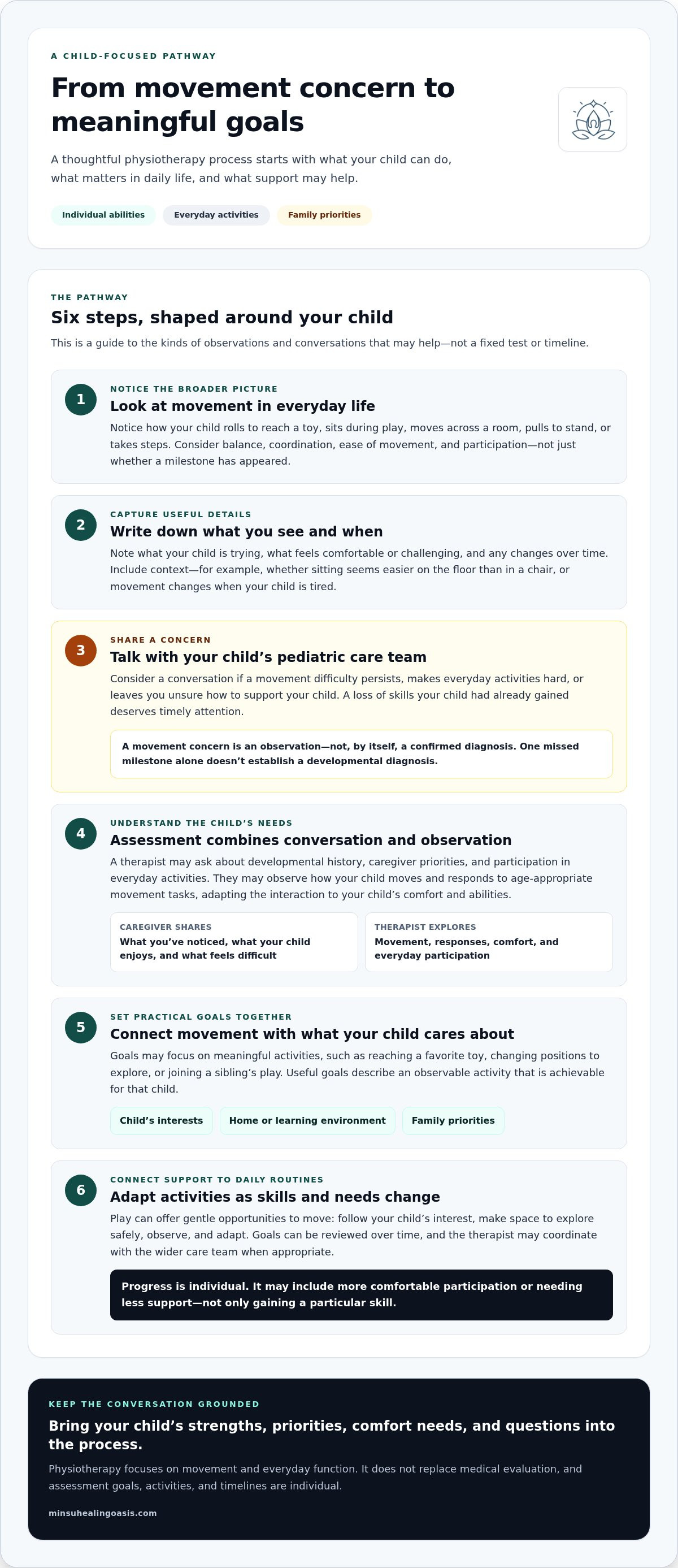
Milestones are general reference points, not rigid deadlines or diagnostic tests. Notice how your child rolls to reach a toy, sits while playing, crawls or moves another way across a room, pulls to stand, or takes steps. How a skill happens matters too. Consider balance, coordination, ease of movement, and whether your child can join activities they enjoy, not only whether a particular action has appeared.
Specific observations are more useful than a milestone list alone. Note what your child is trying, what seems comfortable or challenging, and whether you’ve noticed a change over time. Include context: does sitting seem easier on the floor than in a chair, for example, or does your child move differently when tired? These details can give an assessment a clearer starting point.
When is a movement concern worth discussing?
Discuss a concern with your child’s pediatric care team if a movement difficulty persists, makes everyday activities hard, or leaves you unsure how to support your child. A loss of skills your child had already gained deserves timely attention. This doesn’t mean every difference signals a disorder. It means your observations are worth sharing and can help guide next steps.
Before the conversation, write down what you’ve seen and when it happens. Include your child’s strengths, movements they avoid or find tiring, and any changes that concern you. If you’re exploring childhood developmental delay physiotherapy, these examples can help connect professional guidance to your child’s needs, routines, and pace.
How Can Physiotherapy Support a Child with Developmental Delay?
Physiotherapy considers how a child moves through the world and what might make everyday movement easier to explore. It may focus on posture, strength, balance, coordination, and functional participation, such as changing position, moving across a room, or joining a game. The aim isn’t to compare a child with others. It’s to understand their abilities and the movement challenges that matter in daily life.
Physiotherapy supports a child’s movement and participation by shaping practical goals around their individual abilities and everyday experiences. Goals may reflect a child’s interests, home or learning environment, and family priorities. For example, if a child wants to reach toys during play, a goal might focus on movement that helps them access those toys more comfortably. The focus is meaningful practice, not a fixed set of tasks or a promised outcome.
Physiotherapy can be one part of broader developmental care. It doesn’t replace medical evaluation, and it may complement other supports if a child has needs involving communication, learning, or daily living. The APTA Academy of Pediatric Physical Therapy offers information about pediatric physical therapy and its role in supporting children. When several supports are involved, keeping goals connected to a child’s daily routines can help make them easier to understand and use.
What may happen during a physiotherapy assessment?
An assessment may begin with questions about developmental history, caregiver priorities, and the child’s participation in everyday activities. The therapist may observe how the child moves and responds to age-appropriate movement tasks, adapting the interaction to the child’s comfort and abilities. You can describe what you’ve noticed, what your child enjoys, and what feels difficult. Then you can discuss observations, possible goals, and whether further evaluation may be helpful.
How are goals made meaningful for a child?
Useful goals connect movement with activities a child cares about, such as reaching for a favorite toy, changing positions to explore, or joining a sibling’s play. Goals are easier to track when they describe an observable activity that is achievable for that child. They can be reviewed as skills and needs change. Caregivers can explain what works in daily routines, and the therapist may coordinate with the wider care team when appropriate.
With childhood developmental delay physiotherapy, progress isn’t measured only by whether a child gains a particular skill. It may also involve how comfortably they participate, how much support an activity requires, or how movement fits into routines that matter to the family. At Minsu’s Healing Oasis, physiotherapy and specialized children’s programs are shaped around individual therapeutic needs. If you’re considering individualized support, learn about physiotherapy for your child and start with the activities they most want to explore.
What Does the Evidence Say About Early Physiotherapy and Development?
Early support is best understood as a way to learn what a child needs and consider helpful next steps, not as a promise that therapy will remove a delay or lead to a particular milestone. A movement concern can prompt a closer look at a child’s strengths, daily challenges, and opportunities to participate. That information can help families make informed decisions without turning development into a race.
Evidence should be interpreted in context. A 2025 narrative review has been referenced in discussions of early rehabilitation, but its findings can’t be applied to every child without considering the full text, the children and interventions included, the methods, and the limitations. Reviews may bring together different groups and approaches, so their conclusions don’t automatically predict how one child will respond to physiotherapy.
Outcomes can vary with a child’s individual needs and health, opportunities to practise, and support in their environment. Everyday routines, suitable play, and caregiver involvement may affect how movement goals fit into a child’s life. This is why childhood developmental delay physiotherapy should be considered individualized support, not a guaranteed pathway or a substitute for wider care.
Why does early support matter without creating milestone pressure?
Timely attention gives families a chance to ask questions, understand a child’s movement, and consider relevant supports. It isn’t about catching up by a fixed date. Children develop along different pathways, and their rate of progress may change over time. One observation can start a conversation, but it can’t predict a child’s future or define their potential.
Families can focus on what helps now: comfort, participation, and activities a child is ready to explore. If needs change, goals can change too. This patient approach leaves room for progress without making every new skill a test.
How does physiotherapy fit with other developmental supports?
Movement is one part of development. A child may also need support related to communication, learning, self-care, or social participation, and physiotherapy alone isn’t designed to address every area. When several professionals are involved, family-centered coordination can help connect their perspectives and keep goals relevant to the child’s everyday routines.
Caregivers can help make that connection by sharing what they notice across settings: which activities feel manageable, where extra support seems useful, and what matters most to their child and family. For families exploring wider disability support networks and long-term daily living care, providers like Paramount Care Solutions highlight how coordinated services can complement specialized therapeutic plans. With the family’s involvement, professionals can work toward compatible goals while respecting each area of expertise. The aim isn’t to promise a particular outcome, but to make practical support easier to understand and adapt as the child’s needs evolve.
How Can Families Support Movement Through Everyday Play?
Play doesn’t need to look like a therapy session to offer useful opportunities to move. A familiar toy, a shared song, or a favorite game can invite a child to reach, shift position, or explore at their own pace. Everyday play creates gentle opportunities to practise functional movement within activities that already feel meaningful to a child.
Try this flexible framework, adapting it to your child’s age, abilities, and comfort:
Follow their interest. Notice what catches your child’s attention, then use that toy, sound, or activity as an invitation to engage.
Create a safe opportunity. Set up a clear, supervised space and place an engaging object where your child can comfortably see or reach it.
Observe. Give your child time to respond. Notice how they move, what they try, and whether they seem comfortable.
Adapt. Make the activity easier, change the position, or pause if your child loses interest or seems tired.
What kinds of play can invite movement practice?
During supervised play, a favorite toy within comfortable reach may invite a child to reach or shift position. Floor play can provide room to explore. A supported position change may also be an option when it suits the child’s age and abilities. These are general examples, not prescribed exercises. Follow your child’s interests and energy, and keep the experience comfortable. If an activity seems unsafe or causes distress, stop and seek individualized guidance.
How can caregivers notice and share progress?
Look for practical changes: a new attempt to reach, a different way of changing position, or more participation in a familiar routine. A brief note can help you remember what happened and the context, such as the activity or time of day. If a short video would help with a care discussion, protect your child’s privacy and share it only with the appropriate people.
These observations add context to an assessment or care discussion. Share what your child enjoys, what seems challenging, and what has changed. Childhood developmental delay physiotherapy connects more closely with family life when movement goals relate to activities a child wants to explore, rather than turning every moment into practice.
At Minsu’s Healing Oasis, physiotherapy and specialized programs for children address individual therapeutic needs. To explore physiotherapy support for your child, start with the movements and play experiences that matter most in your family’s day.
What Can Parents Expect from Childhood Developmental Delay Physiotherapy?
Starting therapy can bring hope, questions, and uncertainty. What happens next depends on your child. Goals, session activities, and timelines are shaped by an individual assessment and may change as your child’s skills, comfort, and needs evolve. There isn’t one schedule or sequence for every family, and progress doesn’t have to follow a straight line.
Caregivers can share what feels important throughout the process: how their child communicates, what helps them feel at ease, which daily activities matter most, and what questions remain. These details help keep care responsive to the child and family, rather than focused only on a list of skills.
How can families prepare for an initial conversation?
A little preparation can help you feel more grounded. Write down the movements or routines you’re concerned about, relevant developmental or health history, and examples of how your child participates at home or during play. Add family priorities and questions about goals, comfort, and how progress may be discussed. You don’t need a perfect demonstration or every answer ready.
Your child may move differently in a new setting, feel tired, or not want to show a skill during a conversation. That’s okay. Your descriptions are valuable too. Notes from daily life can help build a fuller picture of what your child can do and where support might be useful.
How does Minsu’s Healing Oasis approach child-focused support?
Minsu’s Healing Oasis offers physiotherapy and specialized programs designed for children. Its integrative approach attends to individual therapeutic needs and respects each child’s pace and each family’s concerns. The focus is on understanding the child as an individual, rather than assuming one activity, goal, or timeline fits everyone.
Childhood developmental delay physiotherapy can feel more manageable when families can raise questions and discuss comfort and priorities along the way. Share what your child enjoys, what makes participation easier, and what you hope daily life might look like with support. These conversations keep the process connected to your family’s needs without promising a particular outcome.
If you’re considering a next step, explore Minsu’s Healing Oasis physiotherapy support for children. Start with the questions and observations you already have. A thoughtful conversation can help you consider whether individualized support feels right for your child and family.
Let Your Next Step Begin with Curiosity
What might feel like a useful next step for your family today? You don’t need a complete plan before asking for support. One observation, a question about comfort, or a hope for more ease in an everyday activity can be enough to begin a thoughtful conversation.
Choosing childhood developmental delay physiotherapy doesn’t mean placing your child on a fixed path or measuring every moment against a milestone. It can be a way to explore support that respects your child’s needs and your family’s priorities while leaving room for their own pace. Share what you notice, what matters most, and what you’d like to understand. Clear observations can help make the next decision feel more grounded.
Minsu’s Healing Oasis offers physiotherapy and specialized programs for children, with integrative care tailored to therapeutic needs. To explore supportive options, visit Minsu’s Healing Oasis to learn about physiotherapy and children’s programs. Begin with what feels meaningful for your child and family, and take the next step with care and patience.
Frequently Asked Questions
Can physiotherapy help a child with developmental delay?
Yes, physiotherapy may help a child practise movement skills that support everyday participation. For example, a therapist might explore what makes it easier for a child to move between positions during play or join a family activity. The focus of childhood developmental delay physiotherapy depends on the child’s needs and assessment. It can complement medical evaluation and other supports, but it can’t promise a particular milestone or replace care-team guidance.
What are signs that a child may benefit from physiotherapy?
Ongoing concerns about posture, balance, coordination, or moving around during everyday routines may be worth discussing. Notice whether your child avoids certain movements, needs more help than usual to participate, or has difficulty joining activities they enjoy. A single milestone or checklist can’t explain why this is happening. Share specific examples and your concerns with your child’s pediatric care team.
What happens during a developmental-delay physiotherapy assessment?
An assessment commonly includes questions about your child’s history and your family’s priorities, along with observation of movement and suitable activities. You might be asked how your child manages transitions, such as moving from the floor to a chair, or what helps them feel at ease. The practitioner can discuss observations and possible goals with you. The process varies, so bring questions and explain what you hope to understand.
Will physiotherapy make my child catch up with developmental milestones?
No one can guarantee that a child will catch up or set an exact timeline based on one assessment. Development and responses to support vary. Instead of comparing your child with peers, consider changes that matter in daily life, such as taking part in a routine with less assistance or feeling more comfortable trying an activity. Discuss these observations with the care team, which can review goals as your child’s needs change.
How can I support my child’s movement at home?
Offer supervised play that suits your child’s interests and the available space. For example, you might make room for floor play or invite your child to reach toward a familiar object, provided the position feels comfortable and safe. Stay close, let your child set the pace, and stop if they seem distressed. If an idea feels uncertain, bring it up with your child’s care team rather than treating online advice as a therapy plan.
How long does physiotherapy for developmental delay usually take?
There isn’t a standard duration or session schedule that fits every child. The plan may depend on your child’s goals, needs, response, and family circumstances, and it can be adjusted over time. Ask how progress will be reviewed, what signs will inform next steps, and when goals might be revisited. These questions can help you understand the plan without relying on a fixed number of sessions or expecting a guaranteed timeline.



Comments