




Pediatric Craniosacral Therapy: A Guide for Parents
What if supporting your child’s comfort begins with understanding what each approach can and can’t offer? If you’re exploring pediatric craniosacral therapy, you may be wondering what happens during a session, whether your child will feel at ease, and how this gentle manual approach differs from sensory integration therapy.
Those questions deserve thoughtful answers. Craniosacral therapy may be considered as one complementary part of a child’s broader care, not a stand-alone solution or a replacement for pediatric medical evaluation. Research on its effectiveness remains limited and mixed, so clear expectations matter alongside a calm, child-centered approach.
This guide explains what pediatric craniosacral therapy involves, how it compares with sensory integration approaches often used in occupational therapy, and what to consider around comfort, safety, and evidence. You’ll also learn what respectful care can look like: a practitioner who follows your child’s cues, adapts to their comfort, and includes your concerns in the conversation. With a clearer picture, you can consider your options at a pace that suits your child and family.
Table of Contents
What Parents Need to Know About Craniosacral Therapy
Are you wondering whether a gentle, hands-on approach might help your child feel more at ease? It makes sense to gather clear information before exploring a new kind of care. Parents deserve to understand what a session may involve, what practitioners propose, and what the evidence can and cannot tell us. Hope and careful judgment can go together.
A concise definition: Craniosacral therapy is a light-touch manual approach in which a practitioner uses gentle contact around the head, spine, or other areas of the body. Pediatric craniosacral therapy is not a diagnostic method or a guaranteed treatment. It may be considered as complementary support within a broader care conversation, rather than as a substitute for a child’s pediatric evaluation.
Practitioners may describe the approach using ideas about subtle movement or rhythms in the body. These are part of the therapy’s proposed framework, not established medical facts. For a general account of its origins, claims, and scientific reception, see the Craniosacral Therapy Overview.
How Is Pediatric Craniosacral Therapy Described?
In practice, the practitioner makes light contact rather than applying forceful pressure or asking a child to perform exercises. The approach can vary, as can a child’s response. One child may rest quietly; another may move, talk, or signal that they need a pause. A child should not have to stay still or accept touch that feels unwelcome. Comfort and willingness matter throughout.
Why Might Parents Explore This Approach?
Caregivers may be curious about gentle support when they notice changes in settling, sleep, feeding, or general comfort. Those observations are useful questions to discuss, not diagnoses or proof that craniosacral therapy is indicated. A parent might ask, “What could help my child feel supported?” or “Would a complementary approach fit alongside the care we already have?” It is understandable to hope for greater comfort, but no particular change can be promised.
It’s helpful to distinguish personal stories and proposed benefits from clinical evidence. Individual experiences can matter to families, but they don’t establish that a therapy caused a change or that it will help another child. A 2024 systematic review and meta-analysis reported no significant benefit across the conditions it assessed, including infant colic and concerns involving preterm infants. It also noted serious flaws in two studies reporting benefits for children. This points to uncertainty, not a reason to dismiss a family’s questions or treat the approach as proven.
If symptoms are new, worsening, or concerning, seek an appropriate pediatric assessment. Complementary care can be considered thoughtfully alongside that guidance, with your child’s comfort, needs, and broader care plan at the center.
What Happens During a Pediatric Craniosacral Therapy Session?
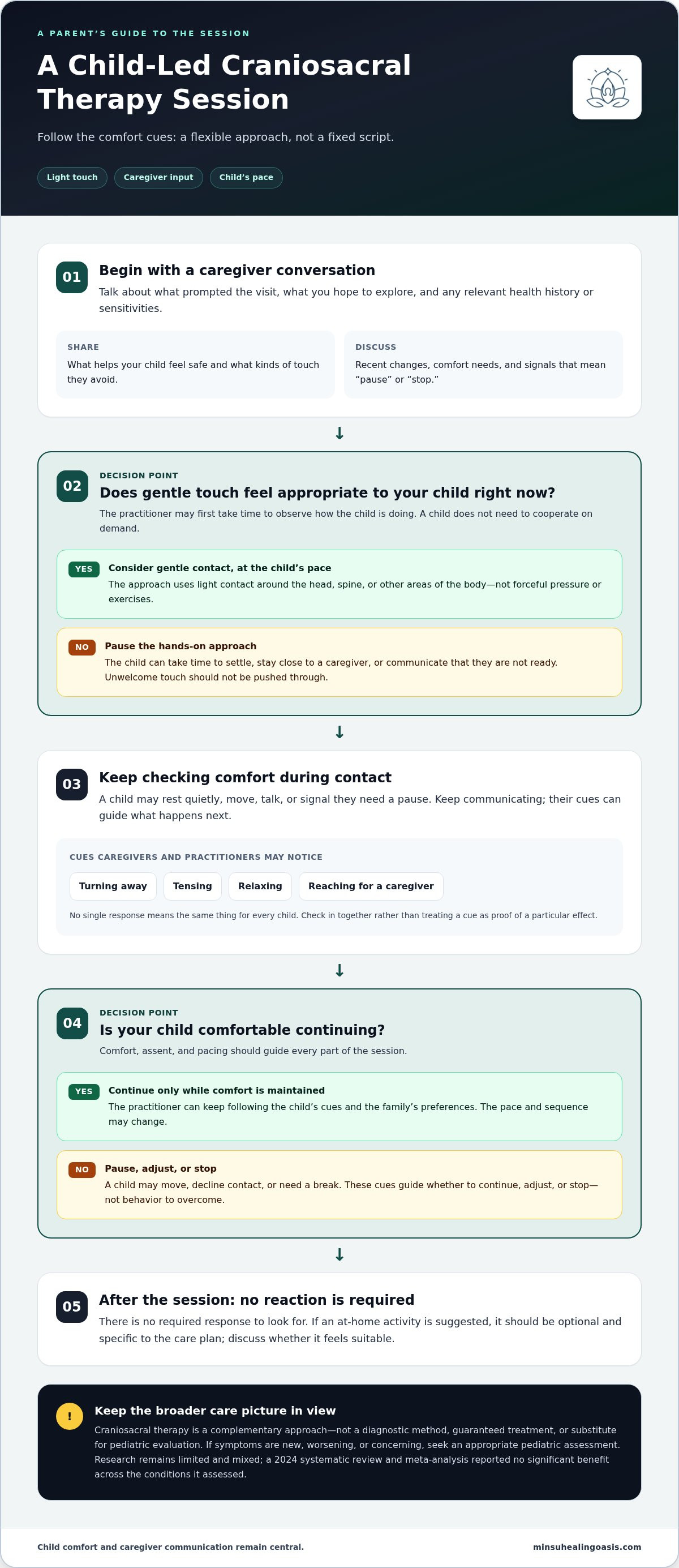
Not knowing what to expect can make trying a new approach feel like a big step. A pediatric craniosacral therapy session is flexible, rather than a fixed script every child is expected to follow. The practitioner may begin by talking with a caregiver, take time to observe the child, and discuss whether gentle touch feels appropriate. The pace and sequence can change according to the child’s comfort and the family’s preferences.
Practitioners may describe their methods differently. For context, the Upledger Institute's Approach to Craniosacral Therapy offers a perspective from an organization that teaches the practice. Its descriptions represent that approach, not a universal session protocol. A clear conversation can help caregivers understand what is being proposed and what choices their child has.
How Does a Child-Led Session Usually Begin?
A caregiver conversation may cover what prompted the visit, what the family hopes to explore, and relevant health history or sensitivities. The practitioner may then take time to notice how the child is doing before considering hands-on contact. A child does not need to cooperate on demand. They can take time to settle, stay close to a caregiver, or communicate that they aren’t ready.
How Can Caregivers Support Comfort During and Afterward?
Your knowledge of your child matters. Share what helps them feel safe, what kinds of touch they avoid, and how they show discomfort. During the session, keep communicating. A child may move, pause, decline contact, or need a break. Those cues can guide whether to continue, adjust, or stop, rather than being treated as behavior to overcome.
Comfort, assent, and pacing should guide every part of the session. For a young child who can’t clearly explain preferences, caregivers and practitioners can pay attention to nonverbal cues, such as turning away, tensing, relaxing, or reaching for a caregiver. No single response means the same thing for every child. Check in together rather than interpreting a cue as proof of a particular effect.
Before the visit, note a few details that may help guide the conversation:
What you hope to understand or support, without assuming a diagnosis.
Health information or recent changes that may affect your child’s comfort.
Touch preferences, sensitivities, and signals that mean “pause” or “stop.”
Whether staying near you or taking breaks would help your child feel secure.
Afterward, there’s no required reaction to look for. If the practitioner suggests an at-home activity, it should be optional and specific to the care plan; you can discuss whether it feels suitable for your family. Craniosacral therapy is complementary care, so it shouldn’t replace pediatric evaluation when symptoms need medical attention. Minsu’s Healing Oasis offers craniosacral therapy and children’s programs.
Pediatric Craniosacral Therapy vs. Sensory Integration Therapy: What Is Different?
These approaches may both be discussed as part of a child’s support, but they aren’t interchangeable. Pediatric craniosacral therapy is a light-touch manual approach. Sensory integration therapy is an active approach commonly associated with occupational therapy, using sensory experiences and purposeful activities. Knowing the difference can help you describe your child’s needs and ask clear questions about what each approach involves.
The table offers a general comparison, not a promise that every practitioner follows the same method. For an overview of craniosacral therapy’s practice and proposed benefits, the University of Minnesota on Craniosacral Therapy provides additional context.
How Do Their Goals and Methods Differ?
One approach centers on gentle touch; the other commonly involves active, sensory-rich tasks. For example, a child might encounter movement or varied textures during an occupational therapy activity, while a craniosacral session may involve light manual contact. The aims and methods differ, and neither approach is right for every child. A family’s care plan may include different supports based on the child’s needs and professional guidance.
It’s also useful to separate a therapy’s proposed goals from evidence that it achieves them. Craniosacral therapy’s clinical evidence and acceptance remain debated; claims should be considered cautiously, not treated as established outcomes. Sensory integration approaches have their own methods and research questions, so the two shouldn’t be ranked as competing versions of the same treatment.
Can Craniosacral Therapy Complement Other Pediatric Care?
Complementary care should sit alongside, not replace, appropriate pediatric evaluation and any prescribed treatment. Keep your child’s pediatric clinician and existing care team informed about approaches you’re considering, your goals, and any changes you notice. Sharing that information can help keep decisions coordinated without assuming one therapy will resolve a concern.
When comparing options, focus on practical fit: what the approach involves, whether your child is comfortable with it, and how it relates to your family’s priorities. A thoughtful plan leaves room for questions and adjustments while keeping the child’s health and daily needs at the center.
How Can Parents Consider Fit, Comfort, and Safety?
How can you tell whether a gentle approach feels right for your child and family? Start with your child’s needs, your goals, and the role this care would play alongside medical guidance. Gentle touch may sound reassuring, but that alone doesn’t make an approach suitable for every child or prove that it will be effective. A thoughtful decision leaves room for questions, changing your mind, and choosing not to proceed.
You can pause or decline any approach that doesn’t feel suitable for your child. Comfort and consent are ongoing, not a one-time decision made before the session. If your child seems distressed or resists contact, respect that response.
What Should Parents Share Before a Session?
You don’t need to interpret or diagnose what your child is experiencing. Describe what you’ve noticed, what concerns you, and what you hope to explore. Sharing relevant health history and current care can put the conversation in context. You can also explain your child’s preferences, sensitivities, and ways of showing that they feel safe or need a break.
A short checklist can make that conversation easier:
Health and current care: Share relevant medical history, recent changes, and care your child is already receiving.
Comfort and sensitivities: Mention touch, sound, movement, or other experiences your child tends to welcome or find difficult.
Communication cues: Explain how your child shows ease, uncertainty, or a wish to stop, including nonverbal signals.
Family goals: Describe what you hope to understand or support, without expecting a particular result.
Boundaries: Name what would help your child feel secure, such as staying near you, taking breaks, or declining contact.
How Can Families Keep Care Thoughtful and Well-Coordinated?
For pediatric craniosacral therapy, consider how the approach fits with your child’s overall care rather than viewing it in isolation. When appropriate, discuss complementary care with your child’s pediatric clinician and keep the existing care team informed. Don’t stop prescribed treatment or delay an assessment to try a manual therapy approach.
Urgent, worsening, or unexplained symptoms need timely medical attention. If you’re unsure whether a concern needs assessment, seek guidance from your child’s healthcare professional. This is especially important before considering hands-on complementary care when your child has a recent injury or a medical concern that could affect whether touch is appropriate.
After a visit, jot down questions and straightforward observations, such as what your child seemed comfortable with or what you’d like to discuss next. A change you notice may be worth sharing, but by itself it doesn’t show that a therapy caused the change. Grounded expectations can help your family make decisions with care and clarity.
Minsu’s Healing Oasis offers craniosacral therapy and children’s programs as part of its child-focused services.
A Nurturing Pediatric Craniosacral Therapy Approach at Minsu’s Healing Oasis
For families considering gentle, complementary support, care should make room for the child as an individual, not present a particular outcome as a promise. Minsu’s Healing Oasis offers craniosacral therapy and specialized programs for children, alongside integrative manual therapy. This whole-person perspective makes space for caregivers’ knowledge of a child’s preferences, routines, and signals, while keeping the child’s comfort central.
Care can be warm and attentive without suggesting that manual therapy diagnoses, cures, or works the same way for every child. Each child’s responses and needs are their own. An open, individualized conversation gives families room to consider whether this complementary approach feels appropriate within the wider picture of their child’s well-being.
How Does a Whole-Person Perspective Support Children and Caregivers?
A whole-person perspective considers physical comfort alongside a child’s cues and a caregiver’s observations. A parent, for example, may share what helps their child feel settled or what kinds of touch they tend to avoid. That information can shape a respectful care conversation, but it isn’t proof of a cause or a promise that therapy will change a concern.
Manual therapy is one possible part of a broader wellness perspective, not a substitute for pediatric evaluation or other appropriate care. A gentle approach may be worth exploring, while its limits and uncertain outcomes still deserve clear attention. If a concern is new, worsening, or unexplained, seek timely medical guidance rather than relying on complementary care alone.
What Is a Gentle Next Step for Families?
You don’t need to arrive with every question answered. Begin by considering what you hope to explore, what would help your child feel comfortable, and how this option relates to the care they already receive. An open conversation about those goals and your child’s cues can help you decide whether to take another step, pause, or choose a different form of support. There’s no need to rush.
Minsu’s Healing Oasis offers craniosacral therapy and child-focused programs in a supportive care setting. Families can learn about these services while keeping their pediatric clinician’s guidance in view, especially when health concerns need assessment. The aim is not to promise a particular result, but to give caregivers space to consider an approach that respects their child’s comfort and the family’s priorities.
Learn about the practice’s child-focused and manual therapy services at Minsu’s Healing Oasis.
Choose a Next Step That Feels Right for Your Child
Exploring pediatric craniosacral therapy doesn’t require an immediate decision. Take time to notice what matters most to your family, consider how your child responds to new experiences, and keep questions open as you learn. A next step might simply be a conversation about your hopes and your child’s comfort, while continuing to follow appropriate pediatric guidance.
Care is most thoughtful when it leaves space for your child to be heard, for caregivers to share what they observe, and for plans to change as needs become clearer. You’re allowed to move slowly, ask questions, or decide that another approach feels like a better fit. There’s no single path every family must follow.
When you’re ready, explore Minsu’s Healing Oasis’s craniosacral therapy and children’s programs to learn more about its child-focused services.
Frequently Asked Questions
What is pediatric craniosacral therapy?
Pediatric craniosacral therapy is a form of complementary manual care that uses gentle touch with infants or children. It is supportive care, not a way to identify the cause of symptoms or guarantee a health change. If you’re exploring it, clarify what you hope to address and how the approach fits with your child’s existing health guidance before making a decision.
Is craniosacral therapy safe for children?
It’s often described as gentle, but that doesn’t mean it’s suitable or risk-free for every child. A child’s health history and current concerns matter. For example, a recent head injury or another significant medical concern calls for pediatric medical guidance before hands-on complementary care. During any session, pause or stop if your child seems distressed, uncomfortable, or unwilling to continue.
Can craniosacral therapy help with sensory processing concerns?
It hasn’t been established as a treatment for sensory processing concerns, so families shouldn’t rely on it to address them or expect a particular result. If your child is overwhelmed by noise, clothing textures, or busy environments, note which situations are difficult and discuss them with the child’s care team. Those observations can help guide appropriate evaluation and support, including consideration of occupational therapy.
How is craniosacral therapy different from sensory integration therapy?
Craniosacral therapy centers on gentle manual contact, while sensory integration approaches commonly use active experiences involving movement, play, or sensory input. Sensory integration is often associated with occupational therapy and may relate to participation in everyday activities. The approaches have different methods and aims, so one shouldn’t be treated as a substitute for the other or assumed to suit every child.
Can a child receive craniosacral therapy alongside other care?
It may be considered alongside other care, but coordination helps keep decisions grounded in your child’s overall needs. Tell the pediatric clinician and relevant members of the care team about complementary approaches you’re considering, particularly if your child has ongoing treatment or a new health concern. Don’t stop prescribed care or postpone an assessment to try craniosacral therapy.
What should parents do if a child is uncomfortable during a session?
Tell the practitioner your child needs a pause, and support your child in moving away, declining touch, or ending the session. You don’t need to persuade them to continue. Afterward, consider what felt uncomfortable and whether your child wants to discuss it. If distress continues or you have health concerns, share your observations with the child’s pediatric clinician.



Comments