




Joint Mobilization in Physical Therapy: 2026 Guide
What if hands-on care for a stiff joint didn’t have to mean a forceful adjustment? If you’re curious about joint mobilization physical therapy but unsure what a therapist actually does, or whether it might hurt, those questions deserve a clear answer. Joint mobilization is a skilled technique in which a therapist guides a joint through controlled movements, adapting the approach to your assessment and comfort.
It’s understandable to wonder how mobilization differs from manipulation, stretching, or exercise. Mobilization generally uses slower, graded movements. Manipulation involves a quicker thrust, while exercise asks you to move actively. These approaches aren’t interchangeable, and joint mobilization isn’t a one-size-fits-all adjustment.
This guide explains what the technique involves, how a therapist may adapt its movement and intensity, and what to expect during a session. You’ll also see how mobilization compares with related hands-on care and exercise, so you can discuss an individualized physiotherapy plan that respects your needs and broader recovery goals.
Table of Contents
What Is Joint Mobilization in Physical Therapy?
Stiffness or restricted movement can make ordinary tasks harder, whether you’re turning your head, reaching overhead, or bending a knee. In plain language, joint mobilization is a hands-on technique in which a physical therapist applies controlled movement to a joint after assessing how it moves and what may be contributing to the person’s concern.
Unlike self-stretching, where you move your own body to lengthen or ease tension in an area, mobilization involves a therapist guiding movement at a specific joint. The aim isn’t to force a joint into position. The therapist considers its movement, your symptoms, and your response before deciding whether the technique is appropriate. For a basic overview of manual therapy and its classification, see Joint Mobilization on Wikipedia.
Joint mobilization physical therapy isn’t a universal solution, and it doesn’t replace identifying the reason for pain or limited movement. Joint stiffness can have different contributing factors, so the same hands-on approach won’t suit every person or presentation. A therapist’s assessment helps put the technique in context.
What happens during a mobilization technique?
You’re usually positioned comfortably so the therapist can assess and guide movement at the area being considered. Depending on the joint and your presentation, the therapist may apply a gentle, controlled glide or movement rather than asking you to stretch the whole area yourself. You can stay relaxed and share what you notice as the technique is applied.
The direction, range, and force are adapted to the individual. A therapist may begin with a small movement and adjust based on your response, rather than assuming a particular amount of pressure is right. You might notice pressure, movement, or mild discomfort. Tell the therapist if anything feels uncomfortable or concerning. Comfort is part of the conversation, not an afterthought.
Why might a therapist consider joint mobilization?
Restricted movement or stiffness may prompt a closer assessment of how a joint moves and how that limitation affects daily activities. For example, a therapist might assess shoulder movement if reaching feels restricted, or examine the ankle if bending it is difficult. These examples don’t point to a diagnosis. They show why an assessment considers the individual joint and the task that feels limited.
If appropriate, mobilization may be one part of a broader care plan alongside active movement or other physiotherapy approaches. The plan should reflect your goals, health history, and assessment, with progress reviewed over time. A technique may be worth discussing, but it doesn’t address every cause of pain or limitation on its own. Individualized physiotherapy considers the concern in its fuller context.
How Joint Mobilization Works: Movement, Grading, and Clinical Reasoning
A joint moves through the coordinated relationship of its contacting surfaces and the tissues around it, including the joint capsule, ligaments, and nearby muscles. During mobilization, a therapist applies a specific, controlled force to guide movement at the joint. The choice and effect depend on the joint, the person’s presentation, and the response observed during care.
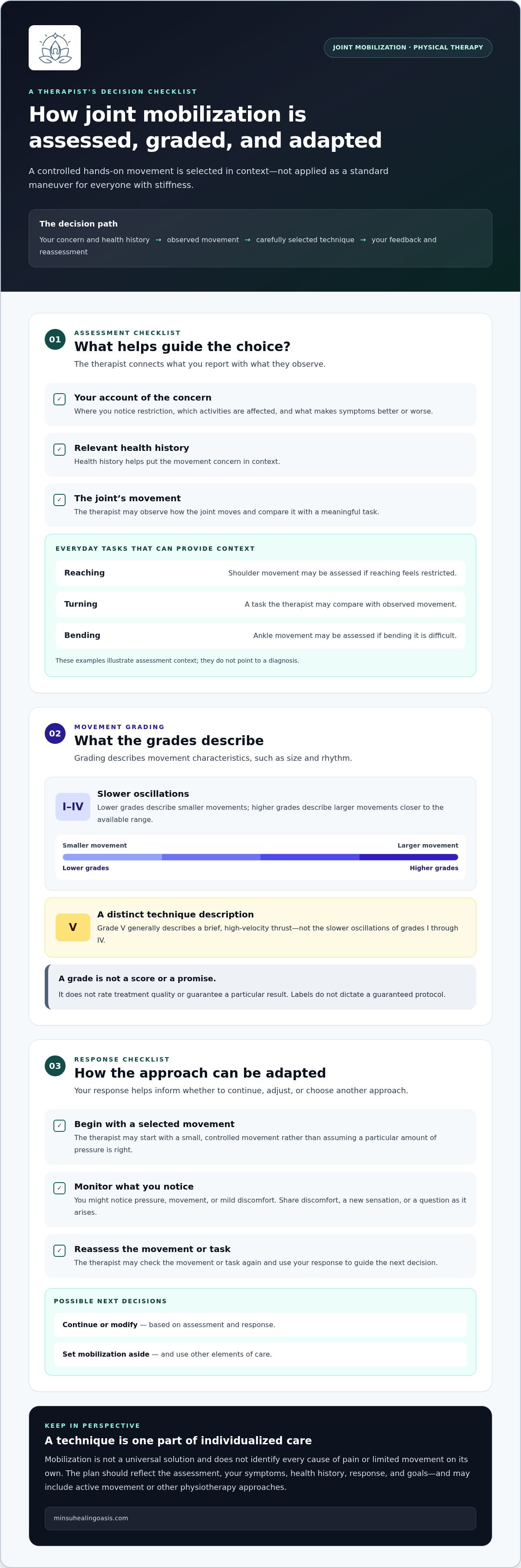
Technique selection depends on assessment and response. In joint mobilization physical therapy, clinical reasoning connects what you report with what the therapist observes. It isn’t a standard maneuver applied to everyone with stiffness. The goal is to choose an approach that fits the situation and adjust it as needed.
What does grading mean in joint mobilization?
Grading describes characteristics such as the size and rhythm of a therapist’s movement. It isn’t a score for treatment quality or a promise of a particular result. In commonly used systems, lower grades describe smaller movements, while higher grades describe larger movements closer to the available range. Grade V generally describes a brief, high-velocity thrust, distinct from the slower oscillations of grades I through IV.
A therapist may choose smaller, gentler movements or more sustained movement based on the clinical aim and your tolerance. These labels describe a technique, but they don’t dictate a guaranteed protocol. The grade is considered alongside the joint, your symptoms, and your response, not chosen by number alone.
How does a physiotherapist assess movement and response?
Assessment starts with your account of the concern: where you notice restriction, which activities are affected, and what makes symptoms better or worse. Relevant health history also helps put the movement concern in context. The therapist may observe how the joint moves and compare that with a meaningful task, such as reaching, turning, or bending.
If hands-on movement is considered, the therapist can monitor your feedback and reassess the movement or task afterward. That comparison provides information about your response in the moment; it doesn’t prove that a change will last. Share discomfort, a new sensation, or a question as it arises. Clear communication helps the therapist decide whether to continue, adjust the movement, or use another approach.
For example, if raising an arm feels limited, the therapist may consider the shoulder’s available movement, your reported symptoms, and how the arm responds to a carefully selected technique. That information can guide the next decision, but it doesn’t establish a diagnosis by itself. The assessment may support continuing or modifying mobilization, or setting it aside for other elements of care.
This individualized process considers movement, health history, and personal goals together. Minsu’s Healing Oasis provides professional physiotherapy and manual therapy with a whole-person perspective. Explore integrative physiotherapy and manual therapy as part of an approach shaped around the individual.
Joint Mobilization vs. Manipulation, Stretching, and Exercise
Hands-on care and exercise can both have a place in physiotherapy, but they aren’t the same. The main differences are who creates the movement, how it’s delivered, and what the clinician is addressing. This comparison can help you understand the options without assuming one approach is better than another.
Approach
Movement and participation
Typical context
Joint mobilization
A therapist guides controlled movement at a joint; you’re generally supported and can share feedback.
May be considered when assessment identifies a joint movement concern.
Manipulation
A clinician applies a brief, quick thrust to a joint; the person is generally positioned and relaxed.
A distinct hands-on approach considered according to assessment and individual circumstances.
Stretching
A person lengthens a muscle or related soft tissue, independently or with assistance.
May address flexibility or ease of movement in a particular area.
Exercise
The person actively moves, contracts muscles, or practices a task.
Can build movement practice around personal and functional goals.
How is mobilization different from manipulation?
Mobilization generally involves slower, controlled movement that a therapist can vary in direction and range. Manipulation is usually distinguished by a brief, high-velocity thrust. The terms describe different delivery styles, not a ranking of care. A sound may sometimes accompany manipulation, but it isn’t required to define the technique or show what result it produced.
Neither approach is right for everyone. A clinician considers the assessment, health history, movement concern, and your preferences before deciding what may be appropriate. If hands-on care is discussed, ask what the technique involves and share any concerns before it begins.
How does mobilization relate to exercise and stretching?
During mobilization, the therapist guides movement at a joint. With stretching or exercise, you contribute more actively, using your muscles to move or hold a position. These approaches can serve different roles: hands-on care may address a movement concern during a session, while active practice lets you work on movements and tasks relevant to daily life.
Exercise doesn’t replace an individualized assessment, just as a hands-on technique doesn’t replace active movement goals. Depending on the assessment and your priorities, a physiotherapist may combine joint mobilization physical therapy with stretching or exercise, or choose another plan. The mix should suit your needs, not follow a fixed formula.
What to Expect: Comfort, Safety, and Questions to Discuss
It’s natural to want to know what will happen before agreeing to hands-on care. In joint mobilization physical therapy, you can help shape the experience by sharing what you’re feeling, what matters to you, and what you’re comfortable with. A clear conversation gives the clinician useful context and helps you feel prepared.
Before a session, organize the details you’d like the clinician to know:
Describe your symptoms. Share where you notice discomfort or stiffness, which movements feel difficult, and when the concern began or changes.
Share relevant health history. Mention recent injuries or surgery, significant changes in your health, and any unusual symptoms.
Discuss your goals. Explain which movements or everyday activities you’d like to work toward, and raise any concerns about hands-on techniques.
Pressure and sensation can vary with the technique and the individual. You can ask for a movement to be adjusted, slowed, or paused at any time. Consent and clear communication belong throughout hands-on care, not just before it begins.
Who should discuss individual precautions first?
Share relevant health changes before hands-on care, particularly a recent injury, surgery, or unusual symptoms. This information helps the clinician understand your situation and decide whether a technique is appropriate. This isn’t an exhaustive list of precautions; suitability depends on individual assessment. If symptoms are severe, sudden, or concerning, seek prompt professional evaluation rather than relying on mobilization to explain or address them.
What questions can help someone feel prepared?
Ask what the technique is intended to address, what sensations you might notice, and how the clinician will assess your response. You can also ask about alternatives and how to signal discomfort. Sharing your preferences before treatment begins makes the plan a conversation, not something you have to simply endure.
For example, you might say, “I’m comfortable trying this, but I’d like to know how I can ask you to stop,” or, “Could we begin gently and check in as we go?” You don’t need technical terms to clarify expectations. If a sensation feels unexpected, speak up. The clinician can pause, explain what’s happening, or reconsider the approach.
A thoughtful session makes room for your feedback before, during, and after a technique. The clinician’s assessment guides care, while your experience helps show how it feels to you. You don’t need to minimize discomfort or agree to a technique that doesn’t feel right. Discussing concerns is part of individualized care.
If you’re ready to discuss movement concerns and personal preferences as part of a tailored care plan, explore individualized physiotherapy and manual therapy at Minsu’s Healing Oasis.
Joint Mobilization Within an Integrative Physiotherapy Plan
A hands-on technique is one possible part of physiotherapy, not a plan by itself. A thoughtful approach considers how you move, which activities matter to you, and what feels comfortable as care unfolds. Joint mobilization physical therapy may be considered alongside active movement when an assessment suggests it fits your needs, but its role is individual rather than automatic.
How can hands-on care fit alongside active recovery?
Manual approaches and functional movement can serve different purposes within a care plan. Hands-on care involves a clinician guiding movement or working with the body, while active movement involves your direct participation, such as practicing a movement related to a daily task. A physiotherapist may consider both, one, or other approaches according to the assessment and your goals.
For instance, if turning or reaching is a concern, a care conversation might explore how that movement feels and what you hope to do more comfortably in daily life. This isn’t a prescription for a particular exercise or a promise that a specific technique will change the movement. It connects treatment choices with meaningful activities and provides a basis for reviewing whether they remain appropriate over time.
Care choices shouldn’t follow a fixed formula. Your preferences, comfort, health history, and response can all inform whether a hands-on approach is considered and how it fits alongside movement practice. The aim is to make the plan relevant to you, rather than treating a joint in isolation from your day-to-day experience.
What can a whole-person physiotherapy conversation include?
A whole-person conversation can begin with what you’ve noticed, which movements feel limited, and how the concern affects your routines or goals. It can also include your questions, past experiences with hands-on care, and comfort preferences. These details help shape an individualized discussion without assuming one technique is right for everyone.
Minsu’s Healing Oasis offers professional physiotherapy and manual therapy with a whole-person perspective. Depending on your needs, a conversation about integrative care can consider movement concerns alongside manual approaches such as myofascial release or cranial sacral therapy. Not every modality belongs in every plan.
Red light therapy is another modality offered at Minsu’s Healing Oasis. It is distinct from joint mobilization and is a separate option within the broader range of integrative care, not a substitute for physiotherapy assessment or a guaranteed solution to a movement concern. Any care choice should connect with your circumstances and goals.
You deserve a plan that makes space for clear explanations, personal priorities, and thoughtful choices. Learn about integrative physiotherapy and manual therapy at Minsu’s Healing Oasis.
Take the Next Step Toward Movement That Matters
Your next step doesn’t have to be deciding which technique you need. Start with the movement or activity you’d like to understand better, and bring that goal into a conversation about care. This gives physiotherapy a personal focus shaped by what matters in your daily life, rather than by a technique alone.
At Minsu’s Healing Oasis, professional physiotherapy and manual therapy are considered within a whole-person approach alongside specialized manual therapies. If you’re curious whether joint mobilization physical therapy might have a place in an individualized plan, explore care with room for your questions, preferences, and broader recovery needs.
Explore integrative physiotherapy and manual therapy at Minsu’s Healing Oasis to discuss an individualized approach to your movement goals.
Frequently Asked Questions
Does joint mobilization hurt?
The sensation varies from person to person, and discomfort isn’t something you have to silently tolerate. You might notice pressure or stretching, or a movement may feel uncomfortable because of your symptoms. Tell the clinician what you’re experiencing. If pain becomes severe or worsens, say so and ask to stop; the clinician can reassess and discuss whether another approach is more suitable.
How is joint mobilization different from manipulation?
Joint mobilization generally refers to therapist-guided movement, while manipulation is commonly associated with a quicker movement. Terminology can vary, so ask what a clinician means by either term in relation to the specific technique. You can ask whether it involves a quick thrust, what its intended purpose is, and what alternatives may fit your situation. The name alone doesn’t determine which approach is appropriate.
How many physical therapy sessions are needed for joint mobilization?
There isn’t a set number of visits that applies to everyone. A plan may be shaped by the activity you want to work toward, how your movement responds, and whether other care approaches are relevant. Ask how progress will be reviewed and when the plan might be reconsidered. The treating clinician can discuss next steps in light of your goals and ongoing assessment, rather than relying on a preset count.
Is joint mobilization safe for everyone?
No. A hands-on technique isn’t automatically suitable for every person or situation. Before care, share relevant health information, including recent injury or surgery and unusual changes in symptoms. The clinician can use that context to assess whether the technique is appropriate or whether another approach should be considered. If symptoms are sudden, severe, or concerning, seek prompt medical attention rather than trying to manage them with self-treatment.
Can joint mobilization improve range of motion?
It may be considered when limited movement is part of your concern, but individual results vary and can’t be promised. To make progress easier to discuss, identify a specific movement that matters to you, such as turning your head while reversing a car. A physiotherapist can consider that task during assessment and follow-up, then discuss whether the care plan remains aligned with your goals.
What should I tell a physical therapist before joint mobilization?
Describe where symptoms occur, what activity brings them on, and what movement you’d like to make easier, such as reaching behind your back to fasten clothing. Mention relevant health history, recent procedures, and any changes you’ve noticed. It can also help to share previous experiences with hands-on care and your preferences about pressure or positioning. Ask how to signal that you’d like the movement paused or adjusted.



Comments