




Does Cranial Sacral Therapy Work? What the Evidence Says
What if the most helpful answer to “does cranial sacral therapy work” isn’t a simple yes or no? It’s understandable to feel hopeful about a gentle, hands-on approach while also wondering whether its claims are stronger than the science. Research findings are mixed, and the evidence isn’t strong enough to promise that cranial sacral therapy will resolve a condition.
You deserve a clear picture, not a cure-all promise. This article explains what current research can and can’t tell us, what a session may involve, and how to weigh this therapy as a possible complement to your wider care. The goal is to help you make a thoughtful choice that respects both your wish for relief and your need for reliable medical guidance.
We’ll look at the limits of the evidence, describe the gentle touch often used in cranial sacral therapy, and cover practical safety questions. At Minsu’s Healing Oasis, cranial sacral therapy is offered alongside physiotherapy and manual therapy. It isn’t a substitute for medical assessment or appropriate treatment, but understanding its possibilities and limits can help you decide whether it belongs in your care plan.
Table of Contents
Does cranial sacral therapy work? What it claims to do
Some people report feeling better after cranial sacral therapy, but the available evidence doesn’t support guaranteed results. To answer “does cranial sacral therapy work,” separate an individual’s experience from what research can show about reliable effects. Cranial sacral therapy (CST) is gentle hands-on care focused around the head, neck, back, and sacrum, the triangular bone at the base of the spine.
A concise definition: CST is a gentle, touch-based approach. The proposed explanations for how it works are not established proof that it produces specific clinical benefits. Practitioners may describe working with connective tissue, also called fascia, or with the movement of cerebrospinal fluid around the brain and spinal cord. These ideas form part of the therapy’s rationale, but a proposed mechanism alone doesn’t demonstrate improved symptoms or function. A general discussion of the approach and its scientific criticisms appears in Craniosacral therapy on Wikipedia.
What happens during cranial sacral therapy?
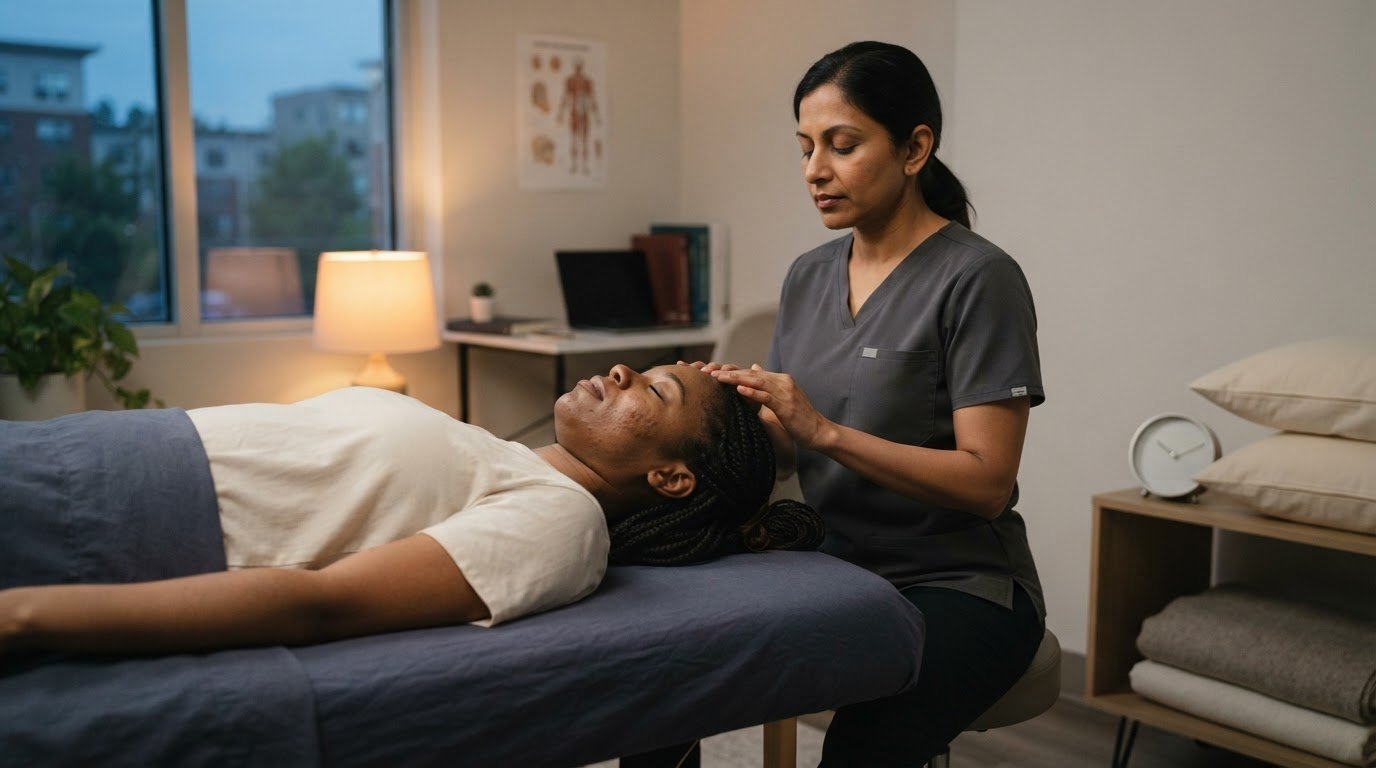
CST typically involves light, non-forceful touch rather than forceful manipulation. The practitioner may place their hands around the head, neck, back, or sacrum. The approach can vary according to the person’s needs and the practitioner’s method, so there isn’t one universal sequence. People also respond differently. Some find a session calming, while others notice little or no particular sensation. Neither response, by itself, confirms whether the therapy is effective.
What does “work” mean when judging a therapy?
“Work” can mean different things. You might feel more comfortable during or soon after a session, notice a change in a symptom, or experience lasting improvement in daily activities. These outcomes matter, but they aren’t interchangeable. Temporary ease is different from sustained functional change, such as moving more comfortably through ordinary tasks over time.
A positive personal experience is real and worth respecting. It may reflect a meaningful change for that individual, but it can’t establish that CST caused the change or that the same result is likely for everyone. Symptoms can shift for many reasons, and individual stories don’t provide a controlled comparison. Recognizing that distinction doesn’t dismiss someone’s relief. It helps keep expectations grounded while considering the broader research.
Before trying a hands-on approach, choose a goal you can recognize and revisit. For example, track whether a specific activity feels easier or whether a symptom changes in a way that matters to your day. Keep the goal realistic, and consider how long a change lasts, not only how you feel immediately afterward. This gives you a clearer basis for deciding whether the experience is useful as part of your wider care.
What does the research say about whether cranial sacral therapy works?
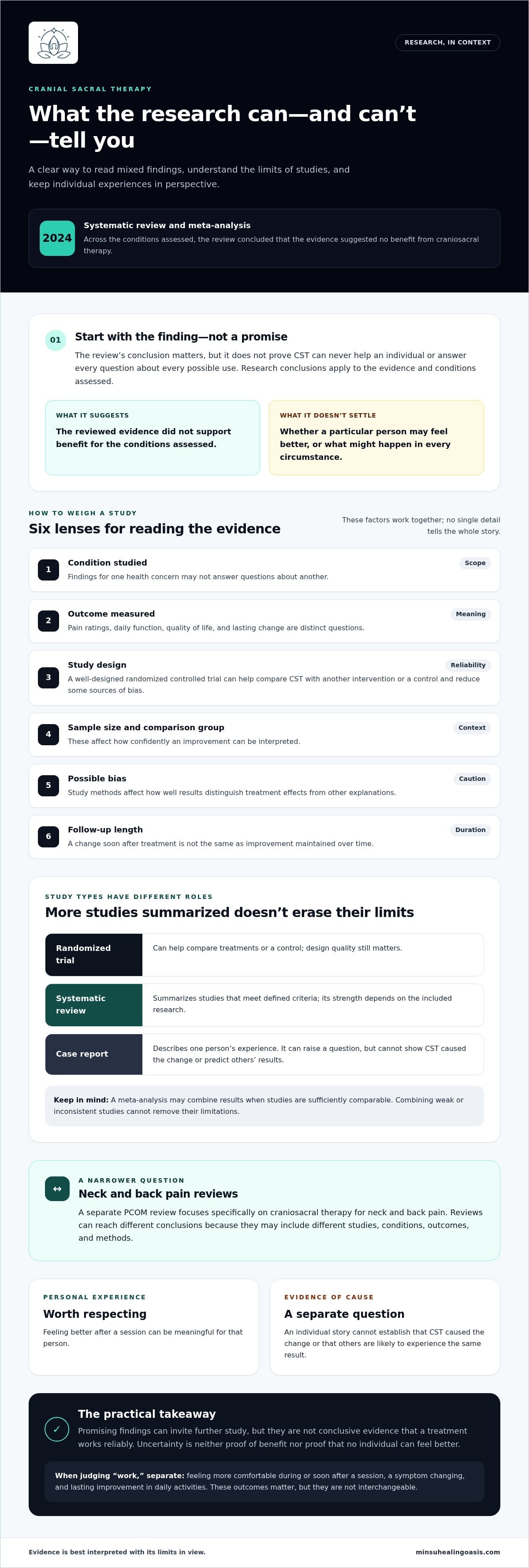
To answer “does cranial sacral therapy work,” look beyond testimonials and consider the quality and consistency of the research. A 2024 systematic review and meta-analysis assessed studies of craniosacral therapy across a range of conditions. It concluded that the evidence suggested no benefit for the conditions assessed. That finding matters, but it doesn’t prove CST can never help an individual or answer every question about every possible use.
A separate review focused on neck and back pain offers a narrower perspective. The PCOM review on craniosacral therapy for neck and back pain examines evidence for those concerns specifically. Reviews may reach different conclusions because they include different studies, conditions, outcomes, and methods. The practical message is measured: Promising findings can invite further study, but they aren’t conclusive evidence that a treatment works reliably.
What a systematic review can, and can’t, tell us
A systematic review searches for studies that meet defined criteria, then evaluates and summarizes their findings. A meta-analysis may statistically combine results when studies are sufficiently comparable. Neither approach tests a single session or guarantees that the included research is strong. Combining weak or inconsistent studies can’t remove their limitations, and a review’s conclusion applies to the evidence it assessed, not every person or circumstance.
Study types also carry different weight. A well-designed randomized controlled trial can help compare CST with another intervention or a control, reducing some sources of bias. A systematic review can provide a broader view across trials, but its strength depends on the quality of those trials. A case report describes one person’s experience. It can raise a question worth studying, but it can’t show that CST caused the change or that others should expect it.
Why study quality and outcomes matter
Research findings can differ by condition, outcome, and study design. A study measuring pain ratings may not tell us whether someone regained function, experienced a better quality of life, or maintained a change over time. Those are distinct questions. Sample size, comparison groups, possible bias, and follow-up length also affect how confidently results can be interpreted. An improvement is more informative when the study design helps distinguish treatment effects from other explanations.
Uncertainty is neither proof of benefit nor proof that no individual can feel better. It means the research doesn’t support confident, universal claims. Minsu’s Healing Oasis offers CST alongside physiotherapy and manual therapy, so it can be considered in the context of wider care rather than as a replacement for medical evaluation or established treatment.
Cranial sacral therapy versus other care: how to weigh possible benefits
To decide whether cranial sacral therapy belongs in your care, start with the concern you want to address, the strength of evidence for each option, and whether medical assessment is needed. CST may be considered as gentle supportive care if you value hands-on approaches, but it shouldn’t replace evaluation or established treatment. No single approach is best for every condition.
Approach
Intended role
Evidence certainty
Practical burden and oversight
Cranial sacral therapy
A gentle hands-on complement, guided by personal comfort goals.
Uncertain; findings don’t establish reliable benefits across conditions.
Requires arranging sessions. Discuss it with your healthcare professional if you have a condition or ongoing treatment.
Established care
Assessment and treatment informed by the specific health concern.
Varies by treatment and condition; evidence-based options have supporting research for defined uses.
May involve appointments, follow-up, or other treatment steps. Medical oversight may be important, depending on the concern.
Supportive self-management
Everyday steps, such as pacing activity or following an agreed home plan.
Depends on the approach and the condition; it isn’t a substitute for needed assessment.
Can fit into daily routines, though some plans benefit from professional guidance.
When might CST be considered as supportive care?
If your goal is modest, such as exploring whether gentle touch feels comforting, CST may be an option to discuss as one part of broader care. Consider it alongside, not instead of, appropriate clinical care. Before a session, identify what you hope to notice, such as ease during a particular activity. Afterwards, consider whether any change lasts and matters in daily life. Don’t assume benefit in advance.
When is another form of care the priority?
New, severe, worsening, or unexplained symptoms call for medical assessment rather than trying complementary care first. If symptoms seem urgent, seek timely medical help and don’t delay it for CST. This isn’t about dismissing a preference for a gentle approach. It’s about ensuring a qualified professional can assess what may be causing the concern and guide appropriate next steps.
If you’re weighing “does cranial sacral therapy work” for your situation, compare its possible supportive role with the care your concern may require. Your priorities, clinical needs, and response over time can help shape an informed decision, without asking CST to do more than the evidence supports.
How to approach cranial sacral therapy safely and set realistic expectations
A thoughtful approach starts with your health needs, not a promise about what a session will do. Cranial sacral therapy can be considered as complementary care, but the evidence doesn’t establish a standard number of sessions or a predictable timeline for results. Use this sequence to protect your wellbeing and make any change easier to evaluate.
Identify the concern. Be specific about what you’d like support with, when it began, and how it affects daily life. If the concern is new, severe, worsening, or unexplained, prioritize medical assessment.
Check for red flags. Don’t use a complementary session to wait out symptoms that may need prompt attention. If a symptom feels urgent, seek appropriate medical help without delay.
Discuss your care. Share relevant medical conditions, recent procedures, and current treatments with your healthcare professional and the practitioner. This context can help inform whether gentle hands-on care is appropriate alongside your existing plan.
Define a realistic goal. Choose something you can notice, such as whether a usual daily activity feels easier. Treat this as an observation, not an expected result.
Reassess. Pay attention to comfort and changes in your chosen goal after care. If symptoms worsen or meaningful progress doesn’t occur, pause and revisit the plan with a healthcare professional.
Questions to consider before a session
What would you hope to notice, and how would you tell whether it mattered? Consider whether your goal is short-term comfort or a change in an everyday activity. If you have health risks, a recent procedure, or ongoing treatment, discuss CST with a qualified healthcare professional. You can also ask what touch may be used, explain what feels comfortable, and request an adjustment or stop at any time.
Feeling relaxed, noticing a sensation, or experiencing no obvious change are all possible individual responses. None should be treated as proof of a particular effect. Keep the focus on your comfort and personal goal, while allowing uncertainty to remain part of the decision.
How to assess whether the approach is helping
Before care, note your chosen symptom or activity in simple terms. Afterwards, record whether anything changed, how long it lasted, and whether it made a practical difference. For instance, if your goal concerns an everyday movement, observe whether it feels different during that activity, not only immediately after a session. Don’t infer a lasting result from a brief change.
Keep recommended treatment and follow-up appointments in place. Cranial sacral therapy should complement, not displace, appropriate assessment and care. If you’re considering CST as part of a broader plan, explore cranial sacral therapy at Minsu’s Healing Oasis as one possible element of individualized support.
What cranial sacral therapy looks like within whole-person care
How might cranial sacral therapy fit into care that considers more than one part of your experience? At Minsu’s Healing Oasis, CST is offered alongside physiotherapy and manual therapy. This allows a gentle hands-on approach to be considered in the context of your stated needs and wider care, without treating the therapy as proof of a diagnosis or a guaranteed solution.
Whole-person care means taking your goals, concerns, daily life, and ongoing care into account. It doesn’t mean every approach is right for every person, or that combining therapies automatically leads to better results. The evidence for CST remains uncertain, so an integrative perspective should support thoughtful choices, not overstate what research has established. Medical assessment and appropriate evidence-based care remain important when health concerns call for them.
How CST can sit alongside manual therapy
A practitioner can consider what you hope to address and how CST may fit alongside your broader care. Minsu’s Healing Oasis also offers myofascial release as a manual therapy approach. It shouldn’t be assumed to be part of every CST session or to improve results when combined with it. The useful question is how each option relates to your needs, comfort, and existing care plan.
Before a discussion, you might make a few notes to help communicate clearly:
The concern or daily activity you’d like support with.
What you hope to notice, and what would count as a meaningful change.
Relevant medical conditions, recent procedures, and current treatments.
Any concerns about gentle touch or preferences you’d like respected.
These details can help keep the conversation grounded in your circumstances. They also make it easier to consider CST as one possible supportive option, rather than a substitute for assessment or treatment your health needs require.
Choose an informed next step
As you decide, weigh three things: your goal, the uncertainty in the evidence, and your comfort with gentle hands-on care. You can bring questions about how a session may relate to your needs and how you’ll reflect on your experience afterwards. If the approach doesn’t feel right, choosing not to try it is valid. Your care should leave room for informed consent, honest expectations, and personal choice.
If you’d like to learn more about this gentle option within a broader care context, explore cranial sacral therapy at Minsu’s Healing Oasis. Take time to reflect on what matters to you and make a decision that feels considered, comfortable, and aligned with your wider care.
Choose a next step that feels right for you
What would help you feel confident about your next step? The question “does cranial sacral therapy work” may not have a simple answer for every person, but your decision can still be thoughtful: grounded in what matters to you, open about uncertainty, and connected to the care your health needs.
You don’t have to decide everything at once. You might begin by naming the change you hope for, considering whether gentle hands-on care feels comfortable, and keeping space for medical guidance when needed. If you choose to explore CST, let your questions and preferences shape the conversation. If you decide it isn’t right for you, that’s a valid choice too.
At Minsu’s Healing Oasis, cranial sacral therapy is offered within manual therapy, alongside physiotherapy and myofascial release. Explore cranial sacral therapy at Minsu’s Healing Oasis and take the next step at a pace that feels considered and supportive. Whatever you choose, you deserve care that respects your experience, honors your choices, and leaves room for hope without promising more than it can deliver.
Frequently Asked Questions
Does cranial sacral therapy work for chronic pain?
Cranial sacral therapy isn’t established as a reliable treatment for chronic pain, though some people report feeling better after care. Research findings vary by condition and by what a study measures, such as pain ratings or everyday function. If you’re considering CST, discuss it as a possible complement to appropriate care, not a replacement. A useful personal measure might be whether a meaningful daily activity changes, rather than expecting pain to disappear.
Is cranial sacral therapy scientifically proven?
No, current research doesn’t conclusively prove that cranial sacral therapy works across conditions. A 2024 systematic review and meta-analysis concluded that evidence suggested no benefit for the conditions it assessed. That conclusion reflects the studies included and doesn’t settle every question about every individual experience. Research interest and positive reports can justify further study, but they aren’t the same as strong, consistent proof of a dependable clinical effect.
Can cranial sacral therapy help with headaches?
Cranial sacral therapy has been studied and discussed for headache-related concerns, but the evidence doesn’t establish it as a dependable headache treatment. Headaches can have different causes, so a new, severe, unusual, or worsening headache should be medically assessed rather than addressed with CST alone. If you already have a care plan for recurring headaches, discuss any complementary approach with your healthcare professional and keep recommended follow-up in place.
Is cranial sacral therapy safe for everyone?
No single hands-on approach is suitable for everyone. CST is generally described as gentle, but your health circumstances, current symptoms, and recent procedures matter when considering any therapy. Share relevant medical information with your healthcare professional and practitioner, and seek guidance if you’re unsure whether touch-based care is appropriate for you. Don’t use a session to postpone assessment of concerning symptoms or delay treatment recommended for a health problem.
How many cranial sacral therapy sessions might someone need?
There’s no research-established session schedule that applies to everyone, and no standard timeline for results. If you decide to try CST, consider agreeing on a personal goal and reviewing whether it feels worthwhile before making further plans. For example, note whether a particular routine or movement changes. Reassess with your healthcare professional if symptoms worsen, your needs change, or you’re uncertain about continuing.
Can cranial sacral therapy be used during pregnancy?
Whether CST is appropriate during pregnancy depends on individual circumstances, so a general description can’t establish personal safety. Discuss the idea with your prenatal healthcare professional before proceeding, especially if you have health concerns, pregnancy complications, or treatment restrictions. Share that you’re pregnant with the practitioner as well. This keeps any decision connected to your prenatal care, rather than relying on broad claims about what is safe for everyone.
What does cranial sacral therapy feel like?
Cranial sacral therapy uses gentle hands-on contact, but there isn’t one sensation everyone should expect. You might notice the practitioner’s light touch, feel restful, or experience no distinct change during the session. Your comfort matters more than matching someone else’s description. Before care begins, say if a particular area feels sensitive. During the session, you can request an adjustment or ask to pause or stop at any time.


Comments