




Does Auriculotherapy Really Work? What the Evidence Says in 2026
What if auriculotherapy is neither a cure-all nor something to dismiss outright? If conflicting claims have left you wondering, “does auriculotherapy really work?”, you’re not alone. Research can be difficult to interpret because studies examine different conditions, techniques, and treatment plans, and their findings don’t always align.
A careful answer is that auriculotherapy may be worth considering for some concerns, but its usefulness depends on what’s being treated and how it’s used. Promising findings don’t establish that it works for everyone or that it can replace established care, especially for chronic or serious conditions. Clear guidance matters when you’re deciding whether to add another therapy to your care.
This article explains what current research can and can’t tell us, where the evidence appears promising, and why some claims call for caution. You’ll also learn how auriculotherapy may fit as a complementary option within a broader approach to wellness. Minsu’s Healing Oasis offers auriculotherapy alongside physiotherapy and manual therapy.
Table of Contents
Does auriculotherapy really work? Start with what “work” means
Research suggests auriculotherapy may offer benefits, but its effectiveness isn’t established equally for every use. So, does auriculotherapy really work? The most useful answer depends on the concern, the method, and what a study measures. That nuance can feel frustrating when you want clear guidance, but it helps separate a possibility from a promise.
“Working” can mean a change in a symptom, such as less discomfort, or a practical improvement, such as finding daily activities easier. A study might instead measure sleep quality, stress, or another specific outcome. These measures aren’t interchangeable. A change in how someone feels doesn’t automatically show that an underlying disease has been treated.
A promising signal suggests a therapy may be worth studying; it isn’t proof of reliable clinical benefit for every person or condition. Keeping that distinction in view leaves room for hope while grounding decisions in what the evidence can actually show.
What counts as auriculotherapy?
Auriculotherapy is an umbrella term for approaches that stimulate points on the ear. Ear seeds apply gentle, sustained pressure. Acupressure uses pressure from fingers or another tool. Auricular acupuncture uses needles, while electroacupuncture adds electrical stimulation through needles. Because these methods stimulate the ear differently, evidence about one doesn’t automatically establish that another works the same way.
The ear-point approach uses therapeutic maps that associate specific ear areas with parts or functions of the body. These maps are part of the treatment model, not settled proof that the ear provides a verified map of the whole body. For general background on the history and differing approaches, see Auriculotherapy. This overview can provide context, but it isn’t a substitute for clinical evidence.
Why a simple yes-or-no answer can mislead
Results can vary with the condition studied, the stimulation method, the participants, and how outcomes are measured. The comparison matters too. A study may compare treatment with usual care, a different intervention, or a control procedure. Each design answers a different question, and a finding from one group or protocol may not apply to another.
For example, reporting less pain is different from demonstrating that the cause of the pain has been treated. Symptom relief can still matter to comfort and daily life, but it doesn’t establish that auriculotherapy cures a disease or replaces standard care. If you’re weighing it as an option, first name the change you hope to notice. Then consider whether that outcome matches what research has measured. This makes the evidence easier to interpret and your expectations more grounded.
What research says about auriculotherapy for pain, sleep, and other concerns
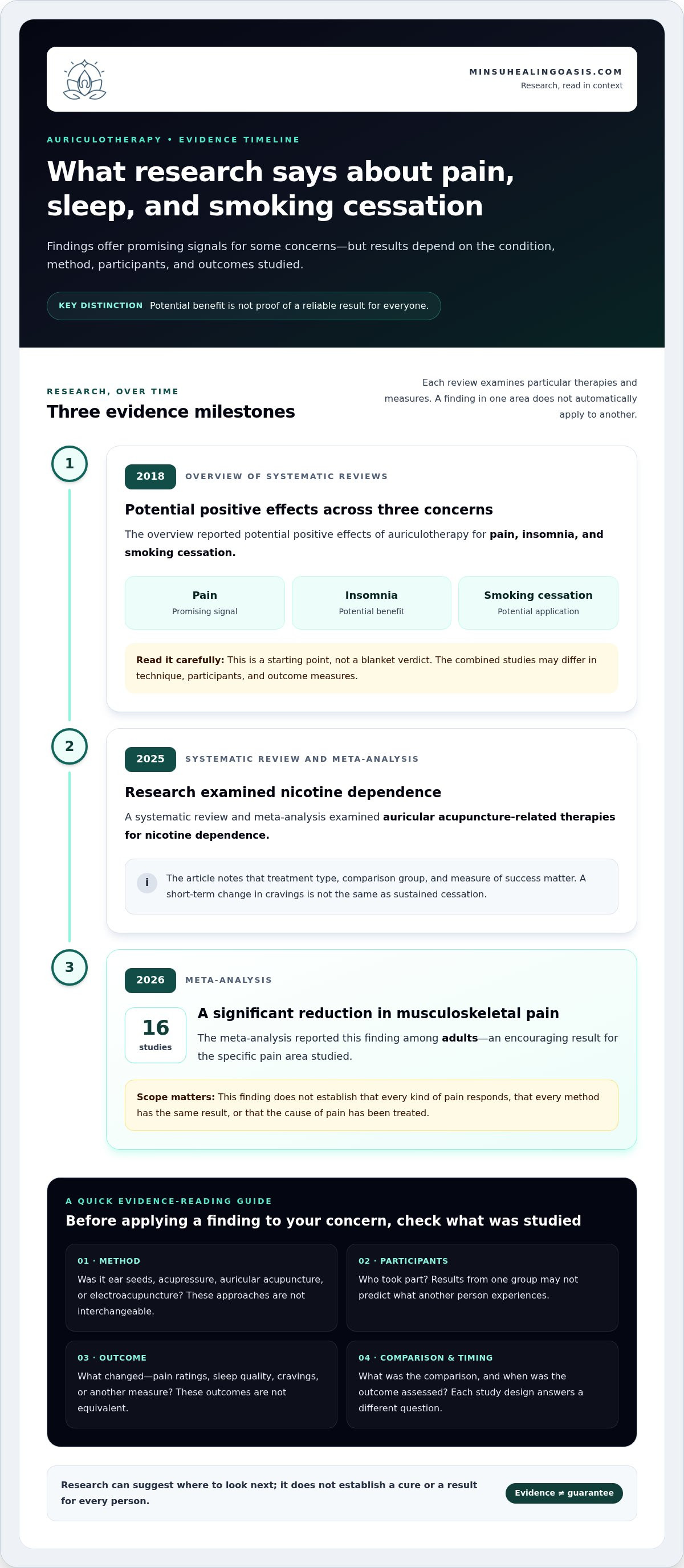
A 2018 overview of systematic reviews reported potential positive effects of auriculotherapy for pain, insomnia, and smoking cessation. That’s a useful starting point, not a blanket verdict. Reviews combine studies that may use different ear-stimulation techniques, participants, and outcome measures. To understand what the findings mean for your concern, look at each area separately and note what researchers actually measured.
Pain: a signal that depends on the type of pain
The 2018 overview identified pain as an area with promising signals. More recent research adds to the picture: a 2026 meta-analysis of 16 studies reported a significant reduction in musculoskeletal pain among adults. That finding is encouraging, but it doesn’t establish that every kind of pain responds or that every auriculotherapy method produces the same result. Musculoskeletal pain, pain after surgery, and other pain conditions involve different populations and circumstances. Results in one group may not predict what another person will experience.
It also matters whether researchers measure pain ratings, pain-related function, or another outcome, and when they assess it. A change in a reported pain score can be meaningful, but it doesn’t by itself show lasting relief or treatment of the cause.
Insomnia: promising does not mean universal
The 2018 review overview also described potential benefits related to insomnia. However, “sleep improvement” can mean different things, from a person’s perception of sleep to a specific measure used in a study. A result tied to one population, treatment protocol, or sleep measure shouldn’t be assumed to apply to everyone with difficulty sleeping. The finding offers a reason for further study, not proof that auriculotherapy reliably resolves insomnia.
Smoking cessation and newer research
Smoking cessation was another potential application identified in the 2018 overview. A 2025 systematic review and meta-analysis examined auricular acupuncture-related therapies for nicotine dependence, showing that research in this area is continuing. The treatment, comparison group, and measure of success all matter. A short-term change in cravings, for example, isn’t the same as sustained cessation. Findings about one outcome shouldn’t be expanded into broad claims about emotional or whole-body healing.
Newer reviews through 2026 have also examined outcomes such as musculoskeletal pain and subjective stress. Growing research interest is not the same as settled evidence. Evidence for one condition cannot establish effectiveness for another. For any result, ask what method was tested, who took part, what changed, and whether the study compared that change with an appropriate control. These questions keep hope connected to the limits of the evidence.
Minsu’s Healing Oasis offers auriculotherapy as a holistic alternative modality alongside physiotherapy and manual therapies. You can explore auriculotherapy as a care option as part of a wider conversation about your wellness goals, without assuming a particular outcome.
Why auriculotherapy studies can reach different conclusions
Research findings can appear inconsistent because studies don’t always test the same intervention in the same way. One trial might examine ear seeds for a particular symptom, while another tests auricular acupuncture in a different group and measures a different outcome. These differences don’t prove that auriculotherapy works or doesn’t work. They mean you need to look beyond a study’s headline to see what was actually tested.
What changes from one study to another?
Technique, treatment schedule, practitioner approach, and participant characteristics can all vary. The comparison group matters too. Results may differ depending on whether treatment is compared with usual care, another therapy, or a control procedure. Even the outcome measure can change the picture. A pain rating, a functional assessment, and a sleep questionnaire capture different experiences, so their results aren’t directly interchangeable.
These approaches shouldn’t be treated as one uniform therapy. A result for one method, population, or outcome may not transfer to another. That limits comparison, but it isn’t automatic evidence for or against the treatment.
How to read evidence quality without a science degree
A systematic review uses a planned, structured process to find and summarize studies addressing a defined question. An overview of reviews takes this a step further by examining existing systematic reviews. The 2018 overview described in the research literature selected reviews based on methodological quality assessed with AMSTAR, a tool that checks how carefully a review was conducted. It evaluates the review process, not whether auriculotherapy itself works.
That distinction matters. A review can be methodologically careful and still summarize studies with mixed results, different techniques, or limited comparability. Positive study findings are easier to interpret when review quality and consistency are considered alongside them.
Newer research adds evidence to consider, but it doesn’t erase those questions. A 2026 meta-analysis of 16 studies reported a significant reduction in musculoskeletal pain among adults. A 2025 systematic review and meta-analysis examined auricular acupuncture-related therapies for nicotine dependence, drawing on nine randomized controlled trials involving 1,032 patients. Those findings concern specific outcomes and related methods. They don’t establish a general effect across all auriculotherapy techniques or conditions.
So, does auriculotherapy really work? A more useful question is whether studies of the same method, for the same concern, show consistent results measured in a meaningful way. This careful approach helps you weigh emerging evidence without dismissing its potential or assuming it guarantees a benefit.
How to approach auriculotherapy with realistic expectations
Considering a complementary therapy can bring both hope and questions. A grounded approach helps you explore whether auriculotherapy fits your needs without placing the weight of recovery on one treatment. Start with a clear goal, understand what the session involves, and leave room to reassess based on your experience and ongoing care.
Questions that clarify your goal
Before beginning, consider what you hope might change and how you would recognize that change. Is your goal less discomfort, easier movement, or a shift in another specific symptom? Share relevant health history, current treatments, and any concerns about the method. An open conversation supports shared decision-making and helps set expectations without promising a particular result.
Use this four-step reflection process to make your decision specific and easier to revisit:
Define the goal. Choose one main concern and describe what a meaningful change would look like in everyday life.
Understand the method. Clarify whether the approach uses pressure, ear seeds, acupuncture, or electrical stimulation. These methods aren’t interchangeable, so be clear about which one you’re considering.
Set expectations. Treat auriculotherapy as a possible complementary option, not a guaranteed solution. It shouldn’t replace prescribed treatment or established care, and changes may vary from person to person.
Plan a review. Decide what you’ll observe and when you’ll reflect on whether the approach feels useful. If your goal or health situation changes, revisit the plan with your care team.
How to notice change without overinterpreting it
A simple record can help you notice patterns without treating each good or difficult day as a verdict. Before starting, note a baseline for the concern you want to address, such as a daily symptom rating or a specific activity that feels challenging. Use the same measure consistently and review it over time rather than relying on memory alone.
Keep brief notes about other treatments, changes in routine, stress, sleep, or activity that could also affect how you feel. If movement is your focus, for example, record how a chosen daily task feels as well as any discomfort. This creates a fuller picture, not a controlled scientific test.
A personal change may matter to you, but by itself it can’t show that auriculotherapy caused it. Symptoms can shift for many reasons, and one person’s experience doesn’t establish effectiveness for others. Tracking is still useful: it can help you describe what you notice, consider whether your goal is being met, and have a more informed discussion about next steps.
To explore this complementary approach within a broader wellness plan, learn about auriculotherapy at Minsu’s Healing Oasis.
Auriculotherapy at Minsu’s Healing Oasis: a whole-person next step
After weighing what research can and can’t tell us, you may still be wondering whether auriculotherapy has a place in your care. Minsu’s Healing Oasis offers auriculotherapy as a holistic, non-invasive alternative modality alongside integrative physiotherapy and manual therapies. It can be considered within a wider view of wellbeing, where your physical concerns, personal goals, and sense of comfort all matter.
A holistic perspective that keeps evidence in view
A whole-person perspective makes space for how someone experiences their health, including physical symptoms and emotional wellbeing. It doesn’t assume that one causes the other or that one therapy can address every part of a person’s experience. Research findings are one kind of information; an approach to care is another. A compassionate philosophy can guide how needs and preferences are considered, but it shouldn’t be presented as proof that a treatment works.
That distinction lets you hold two ideas together: auriculotherapy may feel worth exploring, and its effects aren’t guaranteed. The research discussed here points to areas of potential while leaving questions about how findings apply across methods, concerns, and individuals. Your decision can reflect both the available evidence and what matters to you, without treating either as a promise.
Choosing a next step that feels informed
Before a session, name the concern you hope to address and the change you’d like to notice. You might also prepare questions about the approach, how it fits alongside your existing care, and what would help you feel comfortable. Sharing relevant health history and current treatments can support a thoughtful conversation about your goals and expectations.
You don’t need to arrive with certainty. It’s reasonable to ask for a clear explanation, take time to reflect, and decide whether the approach feels right for you. If you choose to explore auriculotherapy, consider it as one possible part of a broader care plan, not a substitute for prescribed treatment or established care. Keep noticing how you feel, while remembering that personal experience can inform your choices without proving what caused a change.
Does auriculotherapy really work? The evidence offers reasons for interest, not a guarantee of a particular outcome. At Minsu’s Healing Oasis, auriculotherapy is part of a whole-person approach that keeps individual goals and realistic expectations in view. To learn more about the clinic’s approach, explore Minsu’s Healing Oasis.
Take a thoughtful next step toward care that fits
Choosing a therapy doesn’t require certainty about every possible outcome. Start with a clearer sense of what matters to you, the questions you want answered, and the kind of care that feels supportive. If you’re still asking, “does auriculotherapy really work?”, let the evidence inform your decision rather than letting a broad claim decide for you.
Minsu’s Healing Oasis offers auriculotherapy within a holistic approach that also includes integrative physiotherapy and manual therapy. These modalities offer different ways to consider wellbeing, while your goals, comfort, and wider care needs remain central. Take time to reflect, keep expectations grounded, and choose a next step that feels right for you.
Explore Minsu’s Healing Oasis to learn about its approach to holistic care. Your path forward can be thoughtful, personal, and open to possibility.
Frequently Asked Questions
Is auriculotherapy scientifically proven?
No single body of evidence proves auriculotherapy works for every condition or person. If you’re asking, “does auriculotherapy really work,” current evidence is developing and condition-specific. A 2018 overview of systematic reviews reported positive signals for pain, insomnia, and smoking cessation, but newer research and review quality matter. Findings tied to one method and measured outcome can’t establish universal effectiveness. Consider what the studies actually tested.
Can auriculotherapy help with anxiety?
It’s not possible to promise that auriculotherapy will help with anxiety. The findings summarized in this article focus on pain, insomnia, and smoking cessation, so they don’t establish an anxiety benefit. Anxiety-related research should be considered directly, including the technique, participants, and outcomes measured, before drawing conclusions. If anxiety affects your daily life, don’t use ear stimulation instead of appropriate mental-health care. Discuss complementary options with the clinician supporting you.
How long do ear seeds stay in?
There isn’t one wear time that applies to every ear seed. Timing can depend on the specific product and the instructions provided for its use, so follow those directions rather than extending wear based on a general rule. Ear seeds use pressure and aren’t the same as acupuncture, which uses needles. If the instructions are unclear, seek guidance before deciding how long to leave them in.
Is auriculotherapy the same as acupuncture?
No. Auricular acupuncture is one ear-based method within the broader term auriculotherapy. Other approaches can include ear seeds, acupressure, and electroacupuncture, which deliver stimulation differently. For example, ear seeds apply pressure, while acupuncture uses needles. Evidence about one approach shouldn’t automatically be applied to another. When considering a research claim, check which method was studied and what outcome the researchers measured.
Can auriculotherapy be used alongside medication?
It may be considered as a complementary approach, but it doesn’t automatically replace medication or other established care. Before adding it to your care plan, discuss your current treatments with the clinician responsible for them, especially if you’re thinking about changing a medication. Don’t stop, reduce, or adjust a prescribed medicine based on an auriculotherapy session alone. A shared plan can help keep your care coordinated and expectations clear.
What happens if ear seeds cause discomfort or skin irritation?
If an ear seed causes irritation, stop using it and follow the product or practitioner instructions. Don’t keep wearing it in the hope that discomfort will pass. If the irritation or discomfort persists, worsens, or concerns you, seek appropriate clinical guidance. Ear seeds don’t use needles, but that doesn’t mean they’re risk-free or suitable for everyone. Pay attention to how your skin feels and respond promptly to discomfort.



Comments