




Cranial Sacral Therapy for Infant Torticollis Guide
Could cranial sacral therapy for infant torticollis be a supportive option while your baby follows a pediatric care plan? A persistent head tilt or a baby who seems to turn more easily one way can understandably raise questions. It’s natural to look for gentle options, and just as important to understand what’s known before deciding what to explore.
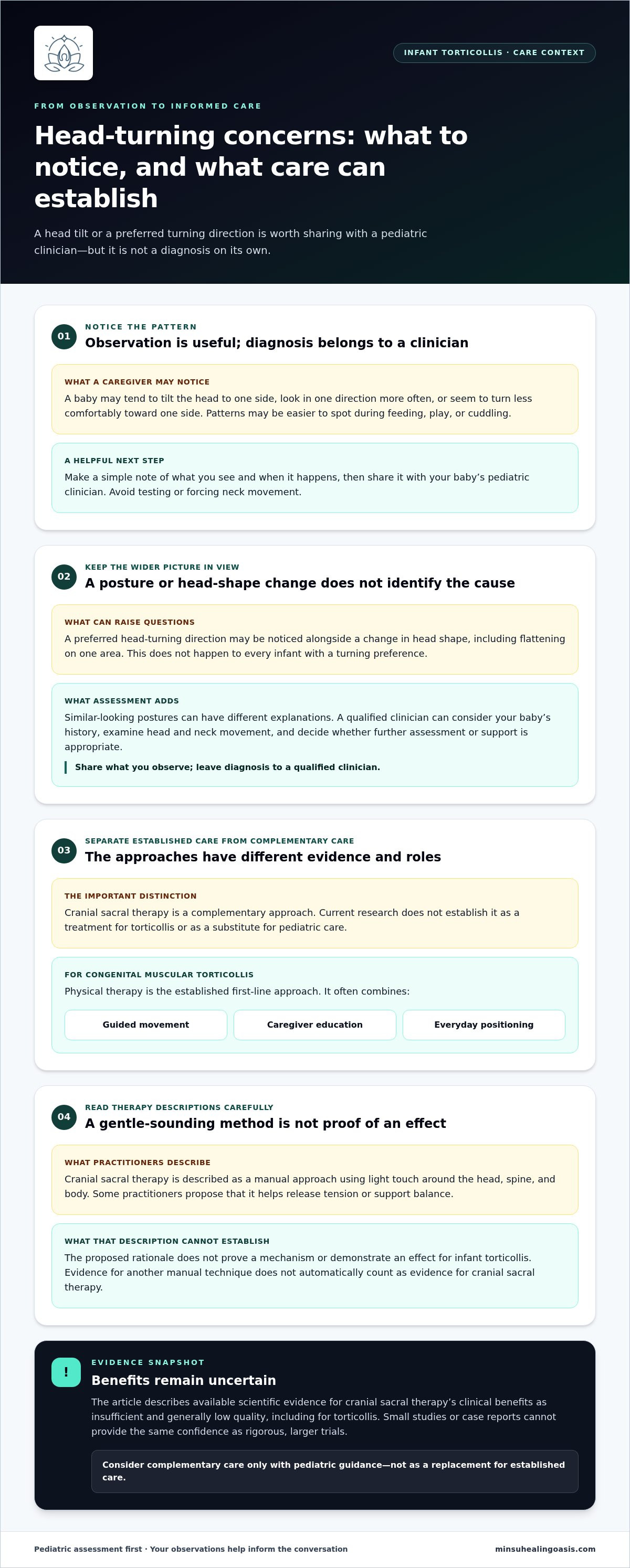
Torticollis can have different causes, so a pediatric assessment is an important first step. For congenital muscular torticollis, physical therapy is the established first-line approach, often combining guided movement, caregiver education, and changes to everyday positioning. Cranial sacral therapy is a complementary approach, but current research doesn’t establish it as a treatment for torticollis or a substitute for pediatric care.
This guide explains what infant torticollis may look like, why timely assessment matters, and what cranial sacral therapy generally involves. It also reviews the evidence and offers practical ways to discuss supportive care within a whole-person approach, with your baby’s safety and pediatric guidance at the center.
Table of Contents
What infant torticollis means, and what parents may notice
In brief: Torticollis describes a head position in which the head tilts to one side and the chin may turn toward the other. In infants, a similar-looking posture can have different explanations. Only a qualified clinician can assess your baby and determine whether torticollis is present.
Noticing an uneven posture can bring a rush of questions. Your observations are useful, but a position or movement pattern alone can’t identify the cause. A pediatric clinician can consider your infant’s history, examine head and neck movement, and decide whether further assessment or support is appropriate.
What does torticollis look like in an infant?
Caregivers may notice that a baby tends to tilt the head to one side or looks in one direction more often. The chin may appear to point the other way. Turning toward one side may seem less comfortable, or your baby may settle more readily in one position. These are observations to share with a clinician, not proof of torticollis.
Patterns can be subtle or easier to spot during feeding, play, or cuddling. If you notice them, make a simple note of what you see and when it happens, then bring it to your infant’s pediatric clinician. Avoid trying to test or force neck movement. A calm, clear description helps the clinician understand your concern without putting the burden of diagnosis on you.
Why can head position and head shape raise questions?
When an infant rests with the head turned in a preferred direction for extended periods, caregivers or clinicians may also notice changes in head shape, including flattening on one area. This is sometimes discussed alongside torticollis, but it doesn’t happen to every infant with a head-turning preference, and head shape alone doesn’t establish a diagnosis. The wider overview at Torticollis on Wikipedia describes the term and its different forms.
A head-position pattern is an observation to share, not a diagnosis to make. Describe what you’ve noticed and let a qualified clinician assess your infant in context. This distinction can make the next step feel clearer and more manageable.
The words congenital and acquired describe when a condition is present or develops, not a cause parents can determine by watching at home. Congenital muscular torticollis is present at or shortly after birth and involves a neck muscle; acquired torticollis develops later and may have other explanations. These terms provide useful background, but they can’t tell you what is happening for your individual baby.
Note which way your baby usually turns their head.
Share any differences in comfortable movement or preferred positioning with the pediatric clinician.
Mention any head-shape changes you’ve observed, without assuming they have a single cause.
These details can also help you prepare for later conversations about care, including questions about cranial sacral therapy for infant torticollis. An individual assessment comes first, so that any supportive options can be considered with your baby’s needs clearly in view.
What cranial sacral therapy involves, and what it does not establish
Parents exploring cranial sacral therapy for infant torticollis may encounter reassuring descriptions of gentle, hands-on care. Understanding what the approach is said to involve can help you assess those descriptions thoughtfully. A calm or gentle-sounding method, however, isn’t by itself evidence that the method treats torticollis or changes an infant’s clinical condition.
How is a cranial sacral session generally described?
Cranial sacral therapy is a manual approach in which practitioners describe using light touch and focusing on areas around the head, spine, and body. Some practitioners propose that this helps release tension or support balance. These descriptions explain the approach and its rationale, but they don’t prove a mechanism or a demonstrated effect for infant torticollis.
Session details can vary, so a general description shouldn’t be taken as a promise about what a particular session involves. It also can’t establish whether the approach is suitable for an individual baby. Those questions belong in a conversation grounded in the infant’s assessment and current care recommendations.
How should parents read claims about gentle manual care?
Consider two separate questions: what a therapy proposes to do, and whether research shows that it improves outcomes for the condition being discussed. Words such as “gentle,” “balancing,” or “releasing tension” may describe a practitioner’s intention or a family’s experience. They don’t answer whether cranial sacral therapy changes neck movement or treats torticollis.
Evidence for one manual technique does not automatically establish evidence for cranial sacral therapy. Studies involving another intervention, such as neural or visceral manipulation, can’t be treated as studies of cranial sacral therapy unless the methods are genuinely the same and the research supports that comparison. Similar-sounding hands-on approaches may differ in technique, rationale, and the outcomes researchers measure.
For cranial sacral therapy, the available scientific evidence for clinical benefits is insufficient and generally low quality, including for torticollis. Small studies or case reports may suggest possible effects, but they can’t provide the same confidence as rigorous, larger trials. The proposed concept of a palpable craniosacral rhythm also isn’t scientifically established. A caring account or appealing explanation deserves a respectful hearing, but it shouldn’t be mistaken for strong clinical evidence.
If you’re considering this approach, keep the distinction clear: it may be explored as complementary support, but it should not replace pediatric assessment or established care discussions. Ask what claims are based on research, whether the evidence concerns this exact therapy and infant condition, and how the approach fits with recommendations from your child’s clinician. Minsu’s Healing Oasis takes a whole-person perspective, and a conversation about supportive care can help you consider those questions in context.
Cranial sacral therapy for infant torticollis: evidence, expectations, and comparisons
How can you compare care options without treating them as equally established? Start by asking what each approach is meant to do, what evidence applies to it, and where it fits in your baby’s care. For infant torticollis, pediatric assessment helps guide decisions. Established care and complementary approaches have different roles.
What evidence can and cannot tell parents
The most relevant research would study infants with torticollis and the exact intervention being considered, using clear methods and meaningful outcomes. A study of a different hands-on technique cannot, by itself, show that cranial sacral therapy has the same effects. Neural and visceral manipulation, for example, is a distinct intervention. Its results should not be attributed to cranial sacral therapy without verifying the original study, its methods, and whether it applies.
Available scientific evidence for cranial sacral therapy’s clinical benefits is insufficient and generally low quality, including for torticollis. There isn’t a strong research basis to present it as an established treatment. This also doesn’t allow a confident conclusion that every possible use has no effect. The careful interpretation is that effectiveness for infant torticollis hasn’t been established, so claims should remain measured and expectations grounded.
By contrast, the APTA Academy of Pediatric Physical Therapy’s clinical practice guidance identifies physical therapy as a first-choice approach for congenital muscular torticollis. Care discussions may include guided movement, strengthening, caregiver education, and adaptations to the infant’s environment. Your child’s clinician can help determine what is appropriate for your baby; no general summary can replace an individual assessment.
How complementary care differs from pediatric-led assessment
A complementary approach may be considered alongside a pediatric-guided plan, but it doesn’t perform the same function as assessment or replace prescribed care. The table below separates these roles so you can weigh them without assuming they offer equivalent evidence or clinical direction.
If you’re exploring cranial sacral therapy for infant torticollis, share your child’s current recommendations with everyone involved in their care. Ask whether a claim is based on research about this exact intervention and condition, rather than a related technique or an individual story. That distinction helps you stay open to supportive possibilities while keeping clinical guidance at the center.
How parents can explore supportive care with confidence
Considering supportive care doesn’t require you to settle every question at once. A steady process can help you move from what you’ve noticed to an informed conversation, while keeping your infant’s pediatric guidance at the center. Take these steps at your own pace.
Write down what you observe. Note when you tend to see a head-turning preference or tilt, such as during feeding, play, or rest. Describe what seems different in your own words. You don’t need to interpret the cause, measure movement, or keep a formal tracking record.
Discuss your observations with your infant’s pediatric clinician. Share what you’ve noticed and ask what assessment or care is appropriate. Mention any changes that concern you, including differences in comfortable movement or head positioning. The clinician can consider the whole picture and explain the next steps for your baby.
Bring the care guidance into any complementary-care discussion. If you’re exploring cranial sacral therapy for infant torticollis, tell the practitioner what recommendations your child has received and what care is already underway. This helps everyone stay aligned and makes space for a clear discussion about how supportive care might fit.
What should caregivers note before a conversation?
Keep it simple and specific. You might say, “I often notice the head turned toward the same side during play,” or, “My baby seems less comfortable turning one way.” If you’re unsure when a pattern happens, describe the moments you have noticed rather than trying to make the observation sound clinical. Your everyday perspective is useful; diagnosis belongs to a qualified clinician.
You can also note questions as they arise, so you don’t have to remember everything in the moment. There’s no required form or observation period. A few plain-language examples are enough to begin a thoughtful conversation.
What questions help clarify a complementary approach?
Clear questions can help you understand the proposed approach without feeling pressured to decide immediately. Consider asking:
How would this approach fit alongside my infant’s existing care plan?
What is within your professional scope, and what concerns should go back to my child’s pediatric clinician?
What evidence relates specifically to this approach and infant torticollis, rather than to a different manual technique?
How will you take my child’s current recommendations into account?
Share any answers that raise questions with your infant’s pediatric clinician, especially before changing or setting aside recommended care. A complementary approach should be considered in context, not treated as a replacement for assessment or prescribed support. Take time to listen, ask, and reflect. There’s no need to decide before you feel clear.
If you’d like to discuss supportive care within a whole-person approach, book a free consultation with Minsu’s Healing Oasis.
How Children Programs and Physical and Manual Therapies fit into whole-person care
Supporting a child means seeing more than a single posture or concern. It also means making room for a caregiver’s questions, the child’s individual needs, and guidance already provided by their pediatric clinician. Minsu’s Healing Oasis takes a whole-person approach to well-being, considering body, mind, and soul. That perspective can offer a compassionate setting for discussing support while keeping medical assessment and recommendations in their proper place.
What does whole-person support mean for a family?
Children Programs and Physical and Manual Therapies are part of the care offered at Minsu’s Healing Oasis. These services provide ways to explore support through a child-focused and physical-care lens. They should not be understood as diagnosing or curing torticollis, or as a replacement for pediatric assessment and care recommended by a clinician.
For a family considering cranial sacral therapy for infant torticollis, whole-person care starts with clear communication rather than assumptions. Bring your questions, explain what your pediatric clinician has recommended, and discuss your hopes for supportive care. Being heard and having the context understood can help you consider options calmly, without treating a complementary approach as a proven medical treatment.
This approach also recognizes that caregivers are part of a child’s circle of support. You may be balancing observations, appointments, and different descriptions of therapy. A thoughtful conversation can help organize your questions and clarify how supportive care relates to your family’s goals, while your child’s clinician remains the guide for diagnosis and medical recommendations.
What is a gentle next step for caregivers?
Before a conversation, gather the questions that matter most to your family. For example, ask how a supportive service relates to your child’s current recommendations, what the service is intended to offer, and how information from the pediatric clinician can inform the discussion. You don’t need to arrive with a diagnosis or decide on a particular approach in advance.
Keep your infant’s pediatric assessment and care recommendations central.
Share those recommendations when discussing supportive services.
Use the conversation to clarify your questions and care goals, without expecting a guaranteed outcome.
A consultation is an opportunity to talk through supportive care in context. It does not take the place of an infant’s medical assessment, and it should not lead you to set aside guidance from your child’s clinician. Take the time you need to understand the options and choose your next step with care.
ARE YOU READY TO BE THE BEST VERSION OF YOU?
Book a free consultation to discuss your questions and care goals.
Take your next step with clarity and care
As you consider cranial sacral therapy for infant torticollis, let your next step be guided by thoughtful questions rather than pressure to choose a particular path. Your child’s needs are individual, and decisions about care can remain grounded in pediatric guidance while you explore what feels supportive for your family.
Minsu’s Healing Oasis brings a whole-person perspective to care for body, mind, and soul. Its Children Programs and Physical and Manual Therapies offer ways to discuss family support within that broader philosophy, without taking the place of your infant’s clinical assessment. Bring your questions and care goals to a conversation, and keep your child’s clinician informed as you consider options.
Book a Free Consultation to talk about supportive care in context. There’s no need to have every answer today. With clear guidance, open conversation, and care for your family’s pace, you can move forward with greater confidence.
Frequently Asked Questions
Is cranial sacral therapy effective for infant torticollis?
Current evidence doesn’t establish cranial sacral therapy as an effective treatment for infant torticollis. Research about another hands-on method, such as neural or visceral manipulation, can’t be assumed to apply to this therapy. If you’re weighing a claim, ask what outcome was studied and whether the research involved infants with torticollis receiving that exact approach. Your baby’s pediatric clinician can help put the evidence and your child’s care needs in context.
Can cranial sacral therapy replace pediatric care for torticollis?
No. Cranial sacral therapy should not replace assessment by your infant’s pediatric clinician or care recommended for your child. If you’re interested in exploring it, let the clinician know and discuss whether it could fit alongside the existing plan. Before making any change to your baby’s care, clarify which recommendations should continue and who to contact with new concerns.
What are common signs of torticollis in a baby?
Caregivers may notice a repeated head tilt, a tendency to look toward one side, or apparent differences in comfortable head movement. You could note whether the pattern seems to appear during feeding, play, or rest and describe what you see in everyday language. These observations can help start a conversation, but they don’t confirm torticollis or explain its cause. A qualified clinician must assess your infant.
When should I talk with a pediatrician about my baby’s head tilt?
Raise a persistent head tilt, consistent one-sided preference, or movement concern with your infant’s pediatric clinician rather than relying on an online description to decide what it means. Share when you first noticed the pattern and whether it appears during particular activities. If you’re also considering supportive therapies, mention that interest so the clinician can discuss it in relation to your baby’s care.
What happens during cranial sacral therapy for an infant?
There isn’t one session format that can be assumed for every practitioner or infant. Cranial sacral therapy is generally described as a manual approach, but that broad description doesn’t establish a specific infant procedure, sensation, or benefit. Before considering it, discuss your baby’s care plan with the pediatric clinician. You can also seek a clear explanation of the proposed approach and how it relates to your child’s individual needs.
Is cranial sacral therapy the same as physical therapy for torticollis?
No. They are different approaches, and evidence about one shouldn’t be used to make claims about the other. Pediatric physical therapy is an established first-line care approach for congenital muscular torticollis; cranial sacral therapy is generally described as a manual approach, with insufficient evidence to establish its effectiveness for the condition. Your infant’s clinician can explain the role of recommended care and help you understand how the approaches differ.
Can torticollis affect an infant’s head shape?
Head position and head shape may be considered together during an infant’s assessment, but a head-shape difference doesn’t by itself confirm torticollis or identify its cause. Not every baby with a head-turning preference develops a change in head shape. If you notice flattening or another change, describe what you’ve observed to your pediatric clinician, who can assess your infant and explain whether further attention is appropriate.



Comments