




Complementary Therapies for Fibromyalgia: 2026 Guide
Updated: 7 hours ago
What if exploring complementary therapies for fibromyalgia didn’t mean choosing between hope and evidence? When symptoms persist, it’s understandable to be drawn to new possibilities and wary of claims that sound too certain. Conflicting advice can make even a gentle therapy feel like another decision to carry.
You deserve a thoughtful path that respects your experience and the care you already receive. This guide explains what complementary approaches may offer, why evidence varies, and how to explore an option at a manageable pace. No therapy is presented as a cure or a replacement for medical care.
We’ll compare approaches with stronger evidence with options that have more modest or preliminary support, then cover practical ways to discuss therapies and monitor your response. You’ll also learn how movement, behavioral support, and hands-on modalities such as myofascial release or cranial sacral therapy may fit into an individualized plan, with safety and your overall well-being in view.
Table of Contents
What Are Complementary Therapies for Fibromyalgia, and What Can They Offer?
Which Complementary Therapies for Fibromyalgia Have Evidence Behind Them?
Are Complementary Fibromyalgia Therapies Safe, or Could They Replace Medical Care?
How Can You Try a Complementary Therapy for Fibromyalgia Thoughtfully?
How Minsu’s Healing Oasis Approaches Complementary Care for Fibromyalgia
What Are Complementary Therapies for Fibromyalgia, and What Can They Offer?
When pain, fatigue, and disrupted sleep become part of daily life, looking into another therapy can feel hopeful and exhausting at the same time. You may hear that an approach changed someone’s life, then wonder whether research supports it or whether it is safe alongside your existing care. A useful starting point is to separate what a therapy aims to support from what studies have shown.
Complementary care means supportive approaches used alongside appropriate healthcare, not in place of diagnosis, medical advice, or prescribed treatment. The word “complementary” describes how an approach fits into care. It doesn’t establish that the approach works or is risk-free. For a general overview of symptoms, diagnosis, and treatment, see Fibromyalgia on Wikipedia.
What does complementary care mean in a fibromyalgia care plan?
Complementary approaches are considered in addition to medical care. By contrast, “alternative” care is used instead of conventional healthcare. The distinction matters if symptoms change or another condition needs attention. You might explore a supportive option while continuing to work with your healthcare professional on diagnosis, medication, movement, or other parts of your care plan. Keeping that professional informed can help identify relevant precautions and whether an approach fits your circumstances.
People may describe feeling calmer or more comfortable after a therapy, and those experiences are worth hearing. But one person’s account does not show that others are likely to get the same result. A proposed explanation for how something might help is also different from a demonstrated clinical effect. Research offers a broader view, though it cannot predict exactly how one person will respond.
Which goals can a person explore without expecting a cure?
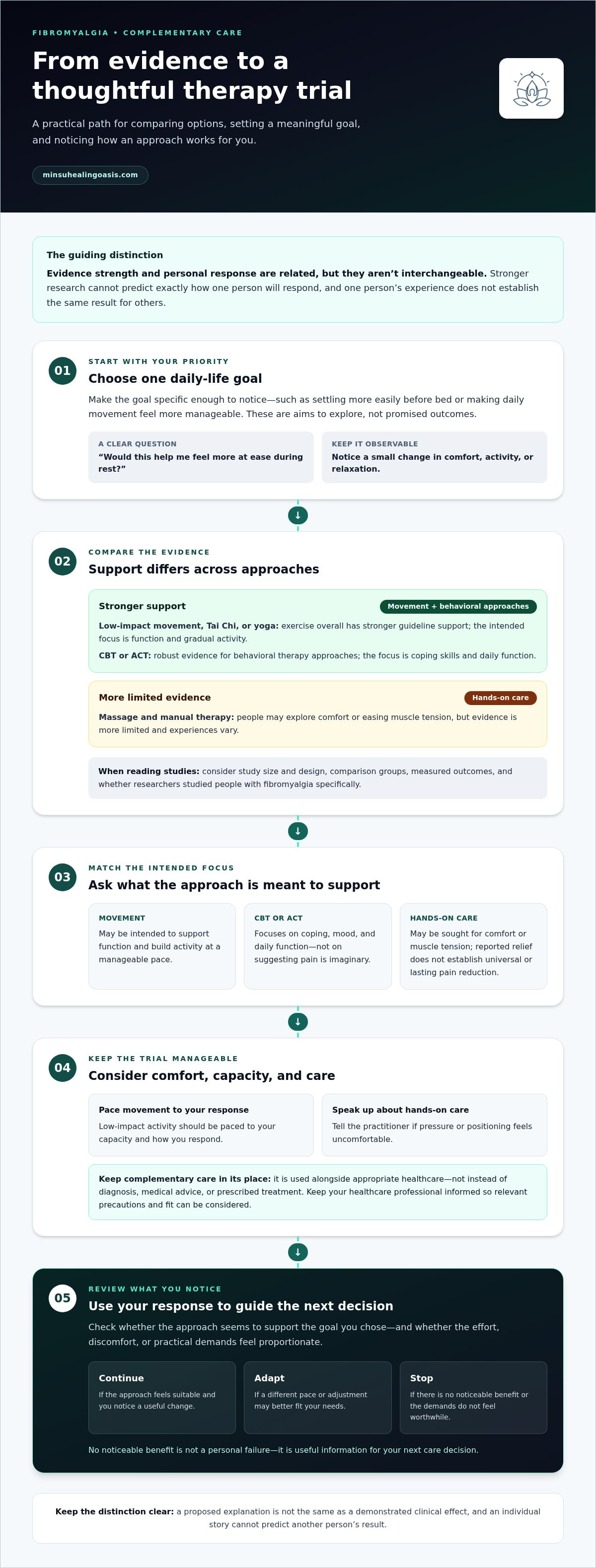
Make your goal specific enough to notice. Instead of “feel better,” ask, “Would I like to settle more easily before bed?” or “Would I like daily movement to feel more manageable?” Then consider whether the effort, discomfort, or practical demands feel proportionate to that aim. A small, clearly observed change can help you decide whether to continue, adapt, or stop. If there’s no noticeable benefit, that isn’t a personal failure. It’s useful information for your next care decision.
Which Complementary Therapies for Fibromyalgia Have Evidence Behind Them?
Evidence can help you compare options, but it can’t tell you exactly how a therapy will feel in your body. Current guidance gives stronger support to regular, appropriately paced movement and behavioral approaches such as cognitive behavioral therapy (CBT) than to many hands-on or emerging modalities. The Mayo Clinic's Guide to Fibromyalgia Treatment provides context on treatment options. When considering complementary therapies for fibromyalgia, ask what outcome was studied, how strong the research is, and whether the approach suits your needs.
Evidence strength and personal response are related, but they aren’t interchangeable. A therapy with stronger research won’t help every person, and a meaningful personal experience doesn’t prove that others are likely to get the same result.
How should readers interpret studies and patient stories?
Look beyond a headline. Study size, design, comparison groups, and chosen outcomes all affect how confidently results can be interpreted. Check whether researchers studied people with fibromyalgia specifically or a different group whose experience may not apply. Patient stories can show what an approach felt like for one person, but they don’t establish a likely result for others. A proposed mechanism is not the same as a measured clinical benefit.
How do therapy categories differ in their intended focus?
Movement approaches, including low-impact aerobic activity and mind-body practices, are often intended to support function and help people build activity at a manageable pace. CBT and acceptance and commitment therapy (ACT) focus on coping, mood, and daily function. They don’t suggest that pain is imaginary. Hands-on care may be sought for comfort or muscle tension, but reports of relief don’t establish universal or lasting pain reduction. For those exploring gentle bodywork primarily for rest and stress relief, wellness providers like Calm Manila offer tailored massage and reflexology treatments, emphasizing that pressure and comfort should always be guided by the client.
This comparison is a guide, not a ranking for every person. For background on the modality itself, explore this red light therapy guide. Minsu’s Healing Oasis offers physiotherapy and manual therapy alongside holistic modalities as part of an individualized approach.
Are Complementary Fibromyalgia Therapies Safe, or Could They Replace Medical Care?
Could a therapy described as “natural” or “gentle” still need careful thought? Yes. Complementary doesn’t mean risk-free, proven, or medically equivalent to diagnosis and treatment. Different approaches have different considerations: hands-on care may cause discomfort, devices have their own instructions and precautions, and supplements can affect medicines or other aspects of health.
Complementary care may support a person’s well-being alongside medical treatment, but it doesn’t diagnose fibromyalgia or replace care from a qualified healthcare professional. Keeping both parts of your care connected can help you make decisions with a clearer picture of your health, rather than feeling you must choose between conventional and complementary approaches.
What should someone discuss before starting a new approach?
Before beginning a therapy, share relevant health information with the professional involved in your care. This gives them context to consider your circumstances, identify questions that may need follow-up, and make the plan more responsive to your needs.
Share your diagnoses, current medicines, supplements, and any relevant health changes.
Describe what you hope to explore, such as comfort, movement, or relaxation, and what would feel manageable.
Mention concerns about pressure, positioning, sensory discomfort, mobility, or access so these can be considered.
Ask what precautions apply to the specific therapy, device, or supplement, and what to do if you feel worse or notice an unexpected response.
Precautions depend on both the approach and the individual. A hands-on technique, red light device, and ingestible supplement don’t share one universal safety checklist. Before trying a particular modality, seek current, authoritative guidance on its specific contraindications and instructions, and discuss questions with your healthcare professional. Don’t assume advice about one therapy applies to another.
Why should complementary approaches not replace established care?
Fibromyalgia care can involve ongoing assessment and adjustments as symptoms and needs change. Replacing prescribed medication or recommended care without discussion may disrupt that coordination or leave important health concerns unaddressed. If you’re considering changing or stopping a treatment, speak first with the clinician responsible for it. That conversation can help you weigh your reasons, understand possible effects, and consider how a complementary approach might fit alongside your existing plan.
There’s room for curiosity without pressure. You can value a supportive practice while staying attentive to medical guidance, and pause an approach that feels uncomfortable or no longer suits you. Thoughtful safety means sharing information, checking relevant precautions, and keeping decisions connected to the care you already receive.
How Can You Try a Complementary Therapy for Fibromyalgia Thoughtfully?
Trying an approach doesn’t need to become another demanding project. A simple plan can help you stay focused on what matters, notice how you respond, and adjust without expecting perfect results. Where practical, introduce one substantial change at a time. If several things change together, it can be harder to tell what may be affecting your experience.
How can you set a realistic goal and track your response?
Choose one priority rather than trying to measure every symptom. Before starting, note how that area feels during an ordinary day, then return to the same observation regularly. A few words are enough. Include relevant context, such as activity, rest, or an unusually difficult day, so you can interpret patterns with compassion rather than treating each fluctuation as a verdict.
Name a goal. Choose something personal and observable, such as making a familiar movement feel more manageable or creating time for relaxation.
Discuss the option. Share your goal and relevant health information with your healthcare professional. Talk through the approach, possible precautions, and how it fits alongside your current care.
Plan a manageable trial. Consider the practical effort, comfort, and access involved. Set a check-in point that feels reasonable, without assuming you must continue if the approach doesn’t suit you.
Record your response. Briefly note your priority, your experience, and useful context such as sleep, activity, and rest. Keep the record simple enough to maintain.
Review and decide. Consider whether the approach felt tolerable and aligned with your goal. You might continue, adapt the plan with appropriate guidance, pause, or choose not to pursue it further.
When should you pause or revisit the plan?
Pause and seek appropriate advice if you experience a new, severe, or concerning reaction. Revisit the plan if an approach feels uncomfortable, difficult to access, or no longer connected to your original goal. If you’re considering changing prescribed treatment, discuss it with the clinician responsible for your care rather than adjusting it on your own.
There’s no need to push through simply because you began. Your observations can help shape a gentler next step, whether that means changing the approach with guidance or setting it aside. Minsu’s Healing Oasis offers physiotherapy and complementary modalities that can be considered as part of a thoughtful care plan.
How Minsu’s Healing Oasis Approaches Complementary Care for Fibromyalgia
Living with fibromyalgia can affect movement, physical comfort, and the choices that feel manageable day to day. At Minsu’s Healing Oasis, physiotherapy and manual therapy sit alongside holistic modalities, creating different ways to consider personal wellness priorities. These approaches are not presented as a cure or a substitute for diagnosis and ongoing medical care. They can be part of a wider conversation about what support feels appropriate for you.
What can an integrative approach bring to the conversation?
An integrative approach makes room to discuss physical needs and personal preferences together. You might want to talk about movement, touch, or relaxation, then consider which options feel comfortable and realistic. Complementary therapies for fibromyalgia vary in evidence and may affect individuals differently, so treat a modality as a possible supportive option, not a guaranteed treatment or outcome.
Minsu’s Healing Oasis offers myofascial release, cranial sacral therapy, red light therapy, auriculotherapy, and energy healing. Each has a distinct approach, and modalities and goals can be considered individually rather than assuming one option is right for everyone. A conversation about manual therapy may focus on your comfort with hands-on care, while another may center on your interest in a non-manual modality. Share your preferences and relevant concerns, and keep your healthcare professional informed as part of coordinated care.
For background on one of the practice’s energy-based approaches, the Quantum Healing guide offers an introduction to that modality. Informational material can explain the practice’s perspective, but it should not be taken as evidence that a therapy treats fibromyalgia or as a replacement for medical advice.
What is a gentle next step for exploring support?
Begin by asking yourself what matters most right now. Is it feeling more at ease, exploring movement support, or making room for relaxation? You don’t need to arrive with a complete plan. An open conversation about your priority, existing care, preferences, and concerns can help you consider whether a supportive approach feels like a good fit.
Your pace matters. It’s reasonable to ask questions, take time to reflect, or decide that an option isn’t right for you. Keep diagnosis and ongoing healthcare coordination central, and treat any change in your experience as something to discuss rather than a result to expect.
Choose a Next Step That Feels Right for You
What would feel like a worthwhile next step today: learning more, talking through an option with your healthcare professional, or giving yourself time to decide? You don’t need to pursue every possibility at once. Let your priorities, comfort, and current care guide the pace. Exploring complementary therapies for fibromyalgia can be gradual, shaped by curiosity and honest reflection rather than pressure to find a quick answer.
Minsu’s Healing Oasis brings physiotherapy and manual therapy together with holistic modalities, including myofascial release, cranial sacral therapy, red light therapy, and auriculotherapy. These options can be part of an individualized conversation, with realistic expectations and your ongoing healthcare kept in view.
If you’re ready to explore what kind of support may fit your needs, connect with Minsu’s Healing Oasis to discuss an individualized, whole-person approach to care.
Frequently Asked Questions
Can complementary therapies cure fibromyalgia?
No. Complementary therapies aren’t cures for fibromyalgia, and no approach should be treated as a guaranteed solution. One person may find a relaxation practice calming, while another notices little change or doesn’t enjoy it. Use evidence to inform your expectations, not to predict your personal response. Before starting a program or making a treatment change, consider what you hope to gain and discuss significant decisions with a qualified healthcare professional.
Is fibromyalgia an autoimmune disease?
Fibromyalgia is generally described as a chronic pain condition, not an autoimmune disease. That distinction doesn’t make the pain, fatigue, or other symptoms any less real. Because some symptoms can occur with other health conditions, a clinician can assess your health history and determine whether further evaluation is appropriate. Don’t rely on a self-test or a complementary therapy to confirm a diagnosis, especially if symptoms are new or changing.
Can stress make fibromyalgia symptoms worse?
Stress may coincide with changes in symptoms or coping for some people, though experiences differ. This doesn’t mean symptoms are imagined or caused only by stress. If you notice that a demanding period affects your rest or daily routines, you could mention the pattern at a healthcare appointment. Relaxation or mind-body practices may be options to discuss if they feel comfortable, but they aren’t a substitute for clinical assessment or appropriate care.
Are supplements safe to take with fibromyalgia medication?
Not necessarily. Supplements can cause side effects or interact with prescription and over-the-counter medicines, and products may differ in ingredients and quality. Before adding one, bring its name, brand, and dose to your clinician or pharmacist, including products you use only occasionally. This gives them clearer information to assess your circumstances. Don’t stop or alter prescribed medication because of a supplement claim. Discuss possible treatment changes with the prescriber.
Does insurance cover complementary therapies for fibromyalgia?
Coverage depends on your plan, the specific service, practitioner credentials, and current policy terms, so don’t assume a therapy is covered. Look up the service by its exact name in your benefits information, including exclusions and any referral or documentation requirements. If the terms aren’t clear, ask your insurer how it classifies that service and what costs may be your responsibility. Coverage is a separate question from whether an approach is suitable for your health needs.
Can I combine complementary therapies with prescription treatment?
Complementary approaches may sometimes be considered alongside prescription care, but suitability depends on the therapy and your individual circumstances. Tell the clinicians involved in your care about planned treatments, devices, and supplements, including how often you expect to use them. That information can help them consider interactions or other precautions. If you’re unsure how an option fits your plan, discuss it with the relevant professional, and don’t stop, delay, or change prescribed treatment without speaking with its prescriber.



Comments