




Auriculotherapy: How Ear-Based Therapy Works and What to Expect
Could focusing on a small point in the ear complement your wider path to wellbeing? If you’re curious about auriculotherapy, you may be wondering what happens in a session, how it differs from acupuncture or ear acupressure, and what research can tell you. These are useful questions when you’re weighing a complementary approach alongside care for your physical and emotional wellbeing.
Auriculotherapy is a complementary practice that stimulates selected points on the external ear. This guide explains the approaches a session may involve, what it might feel like, and how to interpret research and safety information without assuming the practice is a cure. You’ll also find practical questions to consider when deciding whether auriculotherapy fits your preferences and broader care.
Table of Contents
What Is Auriculotherapy? A Clear Introduction to Ear-Based Therapy
How Auriculotherapy Is Thought to Work, and What a Session May Involve
Auriculotherapy Benefits and Evidence: What Can You Realistically Expect?
Is Auriculotherapy Right for You? Comfort, Safety, and Practical Questions
Auriculotherapy at Minsu’s Healing Oasis: A Whole-Person Path to Care
What Is Auriculotherapy? A Clear Introduction to Ear-Based Therapy
Auriculotherapy is a complementary practice that stimulates selected points on the external ear. Practitioners use different methods, and those methods shouldn’t be treated as interchangeable. The practice draws on the idea that areas of the ear correspond with parts or functions of the body. These associations provide a framework some practitioners use to select points during a session.
Ear maps and traditions differ. They are guides used within the practice, not diagnostic charts, and they can’t determine what condition you have or replace a medical assessment. For a neutral overview of its history and theoretical background, see Auriculotherapy. If you have a new, persistent, or concerning symptom, seek appropriate medical evaluation rather than relying on ear stimulation to identify its cause.
How Is Auriculotherapy Different From Acupuncture?
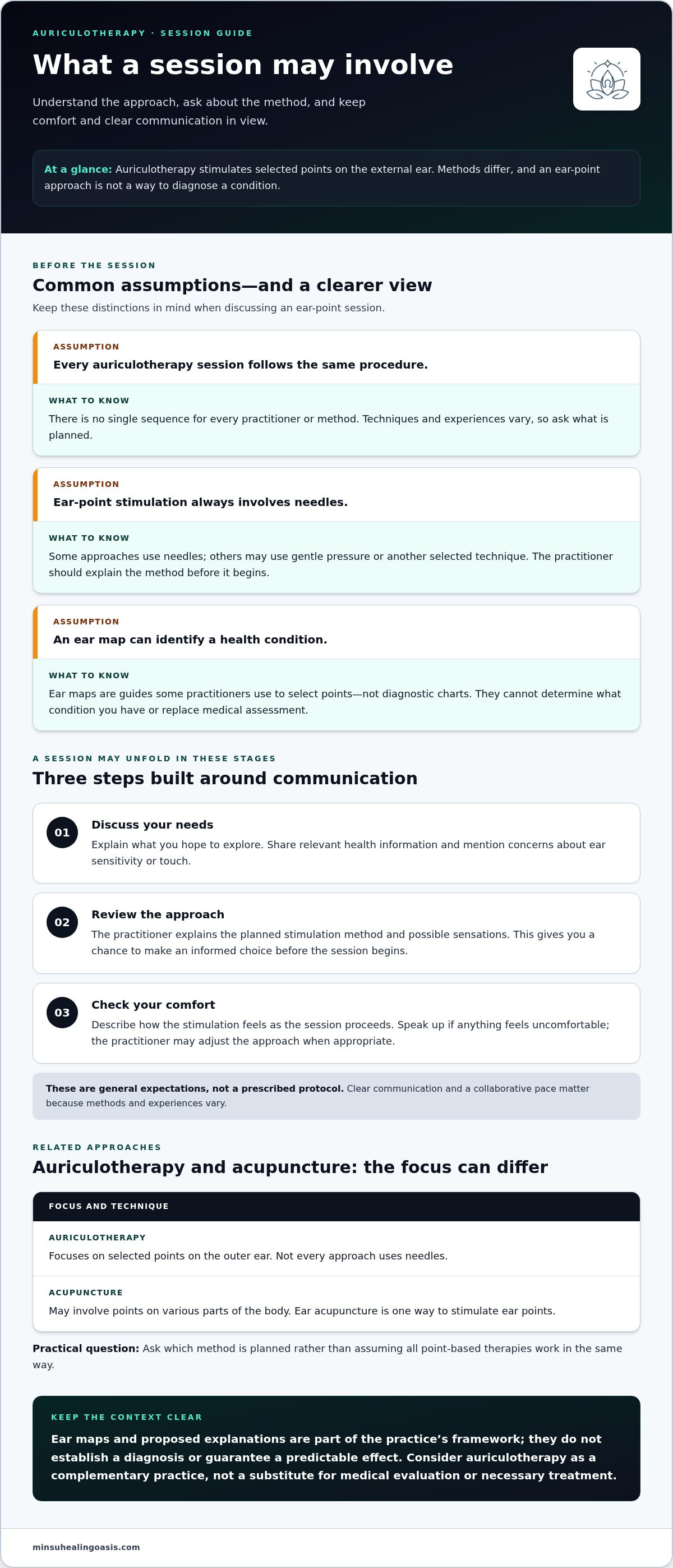
Both approaches may involve stimulating selected points, but their focus and techniques can differ. Acupuncture may involve points on various parts of the body, while auriculotherapy focuses on the outer ear. The terms can overlap: ear acupuncture is one way to stimulate ear points, but not every auriculotherapy approach uses needles. Before a session, ask which method is planned rather than assuming all point-based therapies work in the same way.
What Happens During Ear Point Stimulation?
The method depends on the practitioner and the session. Stimulation may involve gentle pressure or another selected technique. Some approaches use needles, while others don’t. The practitioner should explain the method before it begins, including what sensations you might notice, so you can raise concerns or mention sensitivities first.
In brief, auriculotherapy stimulates selected points on the external ear as a complementary practice. It isn’t one uniform procedure, and choosing a point or stimulation method doesn’t establish a diagnosis. Consider it as one possible element of whole-person care, not a substitute for medical evaluation or necessary treatment. Understanding the planned method and your own comfort can help you decide whether it fits alongside your broader care.
How Auriculotherapy Is Thought to Work, and What a Session May Involve
Auriculotherapy draws on ear maps that some practitioners use to guide point selection. These maps offer a treatment framework, not a diagnostic tool, and they don’t establish that a particular point reliably corresponds to an organ or condition. Why someone may feel a change after stimulation remains a question for careful research, rather than proof of one universal mechanism.
Some explanations refer to nerve pathways or the body’s responses to sensory input. These are proposed models, not guarantees of how or why an individual may respond. Keep traditional explanations distinct from research-based hypotheses. Cleveland Clinic’s patient-friendly overview of What Is Auriculotherapy? offers additional context on ear seeds, one approach to ear-point stimulation.
A Typical Auriculotherapy Session, Step by Step
There’s no single session sequence for every practitioner or method. An initial conversation may cover your goals, relevant health context, and comfort. This helps frame the session without treating ear points as a way to diagnose what’s happening in your body.
Discuss your needs. Explain what you hope to explore, share relevant health information, and mention any concerns about ear sensitivity or touch.
Review the approach. The practitioner explains the planned stimulation method and possible sensations, giving you a chance to make an informed choice before the session begins.
Check your comfort. Describe how the stimulation feels as the session proceeds. You can speak up if anything feels uncomfortable, and the practitioner may adjust the approach when appropriate.
These are general expectations, not a prescribed protocol. Techniques and experiences vary, so clear communication and a collaborative pace are important.
What Is the Proposed Connection Between the Ear and the Body?
Some practitioners use ear maps to organize points associated with different areas or functions of the body. Maps and explanations vary. Using them doesn’t mean that stimulating a point confirms a health problem or will produce a predictable effect. Treat these associations as part of the practice’s framework, not as established diagnostic facts.
Research may examine possible explanations, but specific claims about how the practice works need reliable evidence and careful interpretation. You can approach a session with curiosity while recognizing that some questions remain unsettled. To explore how auriculotherapy fits into broader complementary care, learn about whole-person care at Minsu’s Healing Oasis.
Auriculotherapy Benefits and Evidence: What Can You Realistically Expect?
A balanced view separates three things: why people seek ear-based care, what researchers are studying, and what effects are supported by strong, consistent clinical evidence. These categories aren’t interchangeable. A reported use or promising early finding can point to a question for further study, but it doesn’t prove that a method will help a particular person.
What Does Research Say About Auriculotherapy?
Research on ear-point stimulation has examined goals such as pain or stress support, but findings need to be considered in the context of the specific technique and people studied. Studies may differ in point selection, how stimulation is delivered, the comparison method, and the outcomes measured. That makes it difficult to apply a result from one approach to every other approach.
Evidence about acupuncture more broadly also shouldn’t automatically be treated as evidence for ear-focused methods. When reviewing a study, check whether it examines auricular stimulation specifically, whether the comparison is suitable, and whether relevant reviews find consistent results. Without that context, a positive finding can sound more conclusive than it is.
These broad categories aren’t promises of benefit. The table helps put possible goals in context. It isn’t a ranking of conditions auriculotherapy can treat.
Can Auriculotherapy Replace Medical Treatment?
No. Complementary care should not replace diagnosis, prescribed treatment, or medical evaluation when needed. Current evidence for ear-based stimulation varies by technique and health concern, so it can’t establish auriculotherapy as a cure or a dependable substitute for standard medical care. Discuss persistent, severe, or changing symptoms with a qualified clinician, and let them know about complementary approaches you’re considering.
Individual experiences differ, and no outcome can be guaranteed. Weigh the limits of the evidence alongside your needs, comfort, and wider care plan.
Is Auriculotherapy Right for You? Comfort, Safety, and Practical Questions
Before trying auriculotherapy, consider how it might feel and whether it suits your circumstances. Experiences can differ with the stimulation method, the practitioner’s approach, and your individual sensitivity. No complementary therapy is risk-free. A considerate session should leave room for questions, pauses, or a change in method.
Does Auriculotherapy Hurt or Feel Uncomfortable?
Sensation varies. Gentle pressure may feel different from other forms of stimulation, and a method that feels manageable to one person may be uncomfortable for another. There’s no guarantee that every session will be painless. Tell the practitioner if you feel discomfort, tenderness, or unease so they can respond appropriately. You’re an active participant, not someone who needs to silently endure a technique.
What Should You Consider Before a Session?
A conversation beforehand can help the practitioner understand your needs and support a considered experience. Share relevant health history, current treatments, ear or skin sensitivities, and concerns about touch or stimulation. If you’re unsure how a complementary approach fits with your care, discuss it with an appropriate clinician, particularly if you have an ongoing health condition or are receiving treatment.
Be clear about your goal. Describe what you hope to explore without expecting the session to diagnose a condition or guarantee a result.
Speak up about comfort. Ask what sensations to expect, and let the practitioner know if you want to pause or adjust the approach.
Keep medical care in view. Persistent, severe, or worsening symptoms call for appropriate medical attention. Don’t delay evaluation or necessary treatment to try a complementary therapy.
Complementary approaches also differ in their methods and underlying frameworks. If you’re exploring more than one option, the Quantum Healing guide describes that modality as a distinct approach, rather than another form of ear-point stimulation.
A thoughtful session makes space for your health context, comfort, and personal boundaries. Minsu’s Healing Oasis offers auriculotherapy as part of its complementary care. You can learn more about the approach in the section below.
Auriculotherapy at Minsu’s Healing Oasis: A Whole-Person Path to Care
Care can make room for more than one part of your experience. At Minsu’s Healing Oasis, auriculotherapy is one option within a broader range of holistic therapies. It can be considered in light of your goals and preferences, without assuming that one approach suits everyone or promising a particular physical or emotional result.
How Auriculotherapy Fits Into Integrative Care
A whole-person perspective recognizes that physical and emotional wellbeing can both matter when you’re considering care. Auriculotherapy may be considered alongside physiotherapy or manual therapy, rather than as a replacement for those services or other appropriate clinical guidance. Each modality has its own approach, and considering them together doesn’t mean they work in the same way or produce guaranteed outcomes.
Minsu’s Healing Oasis also offers complementary modalities such as Red Light Therapy. The Red Light Therapy guide provides more information about that distinct approach. Learning about different options can help you reflect on what aligns with your needs while keeping expectations grounded.
Integrative care is not a reason to set aside medical evaluation or treatment. Complementary approaches can be considered alongside appropriate clinical care, with open communication about your health context and the support you’re already receiving. Care should feel personal and considered, not like a promise that one modality can solve every concern.
Taking a Gentle First Step
Before beginning, name what you hope to explore. Consider what questions you have, what sensations or methods feel comfortable, and what other care you’re receiving. Sharing these details can make the conversation clearer and help you decide whether auriculotherapy feels like a thoughtful fit for your broader wellness goals.
You don’t need to arrive with every answer. A calm conversation about your goals, relevant health context, and comfort can help you understand the approach and make an informed choice. If symptoms are persistent, severe, or changing, prioritize appropriate medical guidance rather than delaying evaluation for complementary care.
To explore auriculotherapy as part of a whole-person approach, visit Minsu’s Healing Oasis. Let curiosity, clear expectations, and your own sense of comfort guide your next step.
Choose Your Next Step With Clarity and Care
Auriculotherapy focuses on stimulating selected points on the outer ear, but methods and sensations vary. Research doesn’t support treating it as a guaranteed solution, so approach it as complementary care, not a replacement for medical evaluation or necessary treatment.
If you’re considering it, reflect on your goals, comfort, and current care. Minsu’s Healing Oasis offers auriculotherapy within a whole-person approach that also includes physiotherapy and manual therapy. These services can be considered in light of your needs, without promising a particular outcome.
Explore auriculotherapy at Minsu’s Healing Oasis and take a thoughtful first step toward understanding whether this approach feels right for you. Keep expectations grounded and let your wellbeing guide the way forward.
Frequently Asked Questions
What is auriculotherapy?
Auriculotherapy is a complementary practice that stimulates selected points on the external ear. Methods vary, and practitioners may use different forms of stimulation rather than one universal technique. Ear maps may guide point selection, but they aren’t diagnostic charts and can’t identify a medical condition. People explore the approach for different reasons, but it shouldn’t replace medical evaluation or necessary treatment.
Is auriculotherapy the same as acupuncture?
No. The approaches share the idea of stimulating selected points, but they aren’t identical. Auriculotherapy focuses on the outer ear, while acupuncture can involve points on other parts of the body. Some ear-focused methods use needles, but not all do. If you’re considering a session, ask which form of stimulation is planned so you know what to expect and can decide what feels comfortable.
Does auriculotherapy hurt?
It may feel different from person to person, depending on the stimulation method and individual sensitivity. Gentle pressure may feel unlike a needle-based technique, and no approach can be assumed to feel painless for everyone. Tell the practitioner if you notice discomfort, tenderness, or unease. You can ask for an explanation, request a pause, or discuss adjusting the approach so your comfort remains part of the conversation.
What conditions does auriculotherapy treat?
Auriculotherapy shouldn’t be presented as a proven treatment or cure for a specific condition. People may explore ear-point stimulation as complementary support for different wellbeing goals, but proposed uses don’t establish that it can diagnose or treat an illness. If you have a new, persistent, severe, or changing symptom, seek appropriate medical evaluation. Keep any complementary approach alongside, rather than in place of, necessary care.
Is auriculotherapy supported by scientific evidence?
Research on ear-based methods is developing, and evidence can vary by technique, study design, and the concern being examined. Findings about acupuncture broadly don’t automatically prove that ear-focused stimulation has the same effects. Early or mixed results should be viewed as questions for further study, not settled clinical consensus. Individual experiences also vary, so research can’t promise a particular outcome for you.
How many auriculotherapy sessions will I need?
There isn’t one session number that applies to everyone. The approach, your goals, your response, and the practitioner’s method can all affect how care is considered over time. Avoid treating a predetermined number of visits as a guarantee of improvement. Discuss what you hope to explore and how progress would be reviewed, while keeping appropriate clinical guidance and any existing treatment plan in view.
Can auriculotherapy be used alongside other care?
It may be considered as complementary care alongside appropriate clinical guidance, including physiotherapy or manual therapy when those are part of your care. Share relevant health information and current treatments with the practitioner, and discuss complementary approaches with a qualified clinician if you have questions about how they fit your situation. Don’t delay diagnosis or necessary treatment, and seek medical attention for urgent or worsening symptoms.



Comments