




Myofascial Release for Shoulder Pain: A Nurturing Path to Lasting Mobility
What if the persistent heaviness in your shoulders isn't just a simple muscle knot, but a protective layer of "fascial armor" your body has carefully constructed over time? You might feel as though you're carrying an invisible weight, experiencing a tightness that refuses to let go despite your best efforts to stretch, rub, or rest. When traditional methods provide only fleeting comfort, myofascial release for shoulder pain emerges as a nurturing path toward true restoration. This specialized approach seeks to soften, lengthen, and release the dense connective tissues that bind your movement and dim your inner light.
It's exhausting to live with a range of motion that feels restricted, heavy, and stagnant. You deserve to move through your day with a sense of grace, ease, and freedom that feels natural rather than forced. This article explores how we can dissolve these deep-seated restrictions to help you regain fluid movement and emotional clarity. We will look at the profound connection between your stress levels and your fascia, the role of integrative healing, and the gentle steps you can take to invite lasting harmony back into your physical form so you can finally breathe, move, and thrive again.
Table of Contents
What is Myofascial Release for Shoulder Pain?
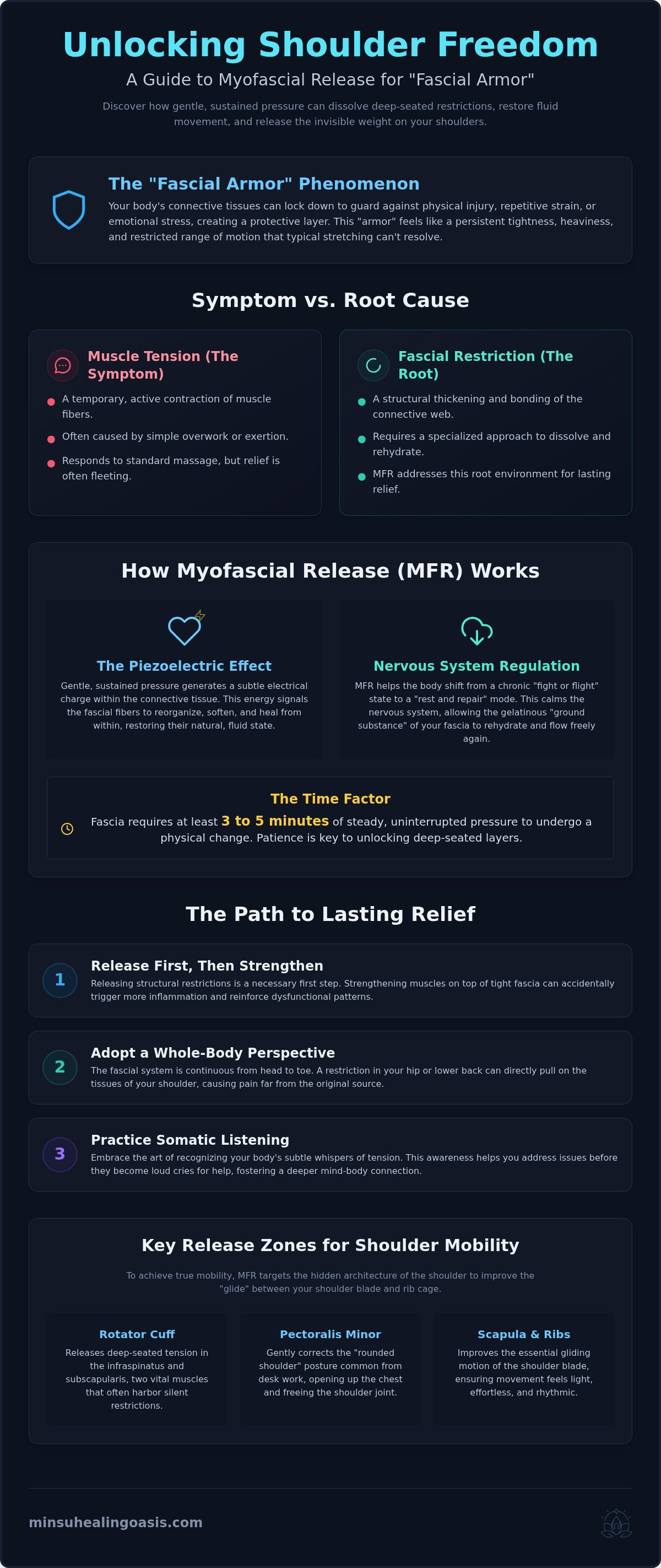
Have you ever felt like your shoulder was encased in a tight, unyielding sleeve that restricts your every move? This sensation is often what we call "fascial armor," a protective state where the body's connective tissues lock down to guard against physical injury, repetitive strain, or emotional stress. When this happens, myofascial release for shoulder pain offers a specialized path to recovery. It's a manual therapy that uses gentle, sustained pressure to melt these deep-seated restrictions. Unlike traditional massage, which often focuses on the rapid manipulation of muscle fibers, this approach is slow, deep, and patient. It honors your body's natural pace, allowing the complex web of connective tissue to soften, lengthen, and release at its own speed.
The Role of Fascia in Shoulder Health
Fascia is the silvery, three-dimensional web that weaves through and around your rotator cuff, scapula, and deltoids. It provides the structural integrity that keeps your shoulder joint stable yet mobile. When this tissue becomes dehydrated or traumatized, it loses its elasticity, leading to that familiar sense of "crunchiness" or clicking during movement. To truly address this, we must respect the biological clock of the tissue. Fascia requires at least three to five minutes of steady, uninterrupted pressure to undergo a physical change. This dedicated time allows the tissue to rehydrate, expand, and reorganize into a healthier state of being.
The Difference Between Muscle Tension and Fascial Restriction
Why does your shoulder tightness often return so quickly after a standard massage? Frequently, it's because the treatment addressed the muscle tension, which is merely a symptom, rather than the fascial restriction, which is the root environment. Imagine pulling on a stray thread in a knitted sweater; the tension travels far beyond the initial point of contact. This is why a "whole-body" perspective is vital for lasting relief.
Muscle tension is a temporary, active contraction of fibers often caused by overwork.
Fascial restriction is a structural thickening and bonding of the connective web that requires a different approach to dissolve.
The whole-body link: Because the fascial system is continuous from head to toe, a restriction in your opposite hip or lower back can actually pull on the tissues of your shoulder.
By utilizing myofascial release for shoulder pain, we look beyond the localized ache. We seek to identify where the web is snagged, allowing your body to rest, recover, and renew its natural alignment. Stretching a restricted joint without first releasing the fascia is like trying to pull a knot tighter; MFR unties the knot so your body can finally find peace.
The Mechanism of Healing: How MFR Dissolves Pain
How does a gentle, steady touch create such a profound physical transformation? The secret lies in a fascinating biological phenomenon known as the piezoelectric effect. When sustained pressure is applied during myofascial release for shoulder pain, it generates a subtle electrical charge within the connective tissue. This energy acts as a catalyst, signaling the fibers to reorganize, soften, and heal. Rather than forcing the body to change, this process invites the tissue to return to its natural, fluid state, providing a foundation for recovery that lasts far longer than a temporary muscle rub.
Beyond the structural shifts, this therapy speaks directly to your nervous system. Many of us live in a state of chronic "fight or flight," where the shoulders are perpetually braced for impact. MFR creates a safe space for the body to transition into a "rest and repair" mode. As the nervous system settles, the "ground substance" of your fascia, the gelatinous fluid that surrounds every cell, rehydrates and flows freely once more. This restoration of internal fluid flow is what truly dissolves the "stuck" feeling that characterizes chronic shoulder issues.
Addressing the Rotator Cuff and Scapula
To achieve lasting mobility, we must look at the hidden architecture of the shoulder. We often target deep-seated restrictions in the infraspinatus and subscapularis, two vital components of the rotator cuff that frequently harbor silent tension. By also releasing the pectoralis minor, we can gently correct the "rounded shoulder" posture that so many of us adopt at our desks. This targeted approach improves the essential "glide" between your shoulder blade and rib cage, ensuring your movement feels light, effortless, and rhythmic. If you're ready to experience this level of structural freedom, you might consider how professional manual therapy can support your unique path.
The Mind-Body Connection in Shoulder Tension
Have you noticed that your shoulders seem to rise toward your ears when you're under stress? We often carry "the weight of the world" in our trapezius muscles, turning emotional burdens into physical blockages. Fascia acts as a recording medium, storing emotional memories and energetic imprints within its web. By integrating Quantum Healing perspectives, we can address these energetic blockages alongside the physical ones. This holistic approach ensures that as your body releases its grip, your spirit also finds a sense of renewal, peace, and internal harmony.
MFR vs. Traditional Physical Therapy: Which is Right for You?
Have you ever spent weeks dutifully performing your physical therapy exercises only to find your shoulder pain stubbornly remains? Traditional physical therapy often focuses on strengthening weak muscles to support the joint. While this is valuable, it can sometimes be counterproductive if the underlying fascia is still tight and restricted. Imagine trying to strengthen a muscle that is already trapped in a straightjacket of tension. When you add load to a restricted joint, you may inadvertently create more inflammation, friction, and frustration. Myofascial release for shoulder pain takes a different path by focusing on releasing these structural barriers first. At Minsu's Healing Oasis, we provide a bridge between clinical precision and holistic care, ensuring your body is truly ready to move before we ask it to be strong.
When to Choose Myofascial Release
When should you listen to the call for a different approach? If you experience a persistent "burning" sensation, chronic stiffness that returns every morning, or if standard therapy has failed to provide relief, your fascia may be the silent culprit. MFR is particularly effective for complex conditions like frozen shoulder, impingement syndrome, and thoracic outlet syndrome. It offers a gentle, non-invasive alternative for those seeking to avoid the harshness of surgery or the temporary mask of injections. It's about honoring the body's need for space, freedom, and deep-seated comfort. By choosing this nurturing path, you allow your body to heal, recover, and realign without the stress of aggressive intervention.
Synergistic Treatments for Shoulder Recovery
True restoration often requires a multi-dimensional strategy that addresses the whole person. We find that Red Light Therapy is a beautiful companion to MFR, as it uses specific wavelengths of light to accelerate cellular repair and soothe the tissues we've just released. To further balance your internal rhythm, we may incorporate Cranial Sacral Therapy to harmonize the upper body or use Energy Healing to clear any lingering blockages. This synergy of manual techniques, cellular support, and spiritual care creates a restorative environment where your shoulder can finally find its way back to lasting mobility. It's a comprehensive vision of well-being that treats you as a whole, vibrant, and interconnected being.
A Nurturing Guide to Somatic Listening and Self-Release
How often do you truly pause to listen to the subtle messages your body sends? Healing begins when we transition from ignoring our discomfort to practicing somatic listening. This is the art of paying attention to the "whispers" of tension in your shoulder before they escalate into the "screams" of chronic pain. By creating a sacred space for your self-care, perhaps with soft lighting or calming music, you invite your body into a state of receptivity. When you approach myofascial release for shoulder pain with this mindset, you aren't just performing a task; you're cultivating a deep, compassionate relationship with your physical and emotional self.
During this practice, the "Softness Rule" is your most vital guide. Many people mistakenly believe that more pressure equals more progress. However, fascia is a highly sensitive, protective tissue. If you push too hard or too fast, the web will instinctively tighten and brace against the intrusion. This is why we prefer using soft, air-filled balls rather than hard foam rollers. The goal is to provide a firm yet yielding surface that encourages the fascia to melt, release, and reorganize without triggering a defensive response. It's a process of invitation, patience, and gentle persistence.
Step-by-Step Self-Release for the Shoulder
To begin your home practice, follow these four gentle steps to address the front of the shoulder, where much of our "fascial armor" resides:
Step 1: Finding the Point. Place a soft ball against a wall and lean your chest, specifically the pectoral area, into it. Move slowly until you find a "hot spot" or a point of tender restriction.
Step 2: The Melt. Apply gentle, static pressure. Close your eyes and use deep, diaphragmatic breaths to invite the tissue to soften under the ball. You aren't rubbing; you're waiting for the "release."
Step 3: Fascial Gliding. Once you feel the tissue begin to give way, slowly move your arm up and down. This encourages the different layers of fascia to glide smoothly over one another again.
Step 4: Integration. This is the most overlooked step. After removing the ball, lie down or sit quietly for at least two minutes. This allows your nervous system to reset and integrate the structural changes you've just initiated.
Maintaining Fascial Health Daily
Lasting mobility requires more than occasional sessions; it asks for a lifestyle of nurturing movement. Hydration is perhaps the most critical factor for fascial health. Think of your fascia like a sponge. When it's dry, it's brittle, stiff, and prone to tearing. When it's well-hydrated, it becomes resilient, bouncy, and fluid. Additionally, try to view posture not as a rigid, static position to maintain, but as a dynamic dance of balance throughout your day. Joining Holistic Fitness Classes can provide the rhythmic movement and professional guidance needed to keep your fascial web healthy and vibrant. If you find that your self-care efforts need a deeper level of expertise, we invite you to experience a professional manual therapy session tailored to your soul’s needs.
Your Journey to a Pain-Free Life at Minsu’s Healing Oasis
Are you ready to step into a space where your pain is met with deep, compassionate understanding? At Minsu's Healing Oasis, your session begins not with a cold clinical checklist, but with a warm conversation that honors your whole being. We listen, observe, and honor the stories your body tells, looking far beyond the immediate ache to find the root cause of your restriction. When you seek myofascial release for shoulder pain within our sanctuary, you aren't just a patient receiving a treatment; you're a partner in a profound process of restoration. Our practitioners act as wise guides, bridging the gap between clinical manual therapy and the quiet needs of your spirit. You'll experience a thorough assessment that considers your physical alignment, emotional stressors, and energetic state to ensure every touch is purposeful and nurturing.
During a professional session, you can expect a calm, restorative environment that mirrors the internal peace we aim to create. The work is slow, methodical, and deeply respectful of your body’s boundaries. As we apply sustained pressure to the fascial web, you may feel a sense of warmth, a subtle pulsing, or a gentle "melting" sensation as the tissues finally let go. This isn't about forcing change; it's about creating the right conditions for your body to heal itself. You'll find that as the physical tension dissolves, a sense of emotional lightness often follows, leaving you feeling balanced, renewed, and whole. By choosing myofascial release for shoulder pain, you're choosing to move beyond the symptom to rediscover your natural state of harmony.
Crafting Your Personalized Healing Plan
Your path to recovery is as unique as your own fingerprint. We don't believe in one-size-fits-all solutions. Instead, we weave together a tapestry of care that might include manual therapy, energy healing, and Red Light Therapy to address your needs on every level. This collaborative approach ensures you're an active participant in your own healing journey. By focusing on long-term wellness rather than a quick fix, we help you prevent future restrictions and maintain the fluid, pain-free movement you've rediscovered. It's about building a foundation of health that supports you today, tomorrow, and for years to come.
Taking the First Step Toward Relief
It's natural to feel a sense of hesitation or even fear when you've lived with chronic pain for a long time. You might wonder if true relief is even possible for you. We're here to tell you that hope is not only possible; it's waiting for you. Our sanctuary is designed to be a place of peace, safety, and transformation where you are fully heard and understood. We invite you to lay down the "fascial armor" you've carried for so long and embrace a life defined by quiet, strength, and movement. Discover the restorative power of Myofascial Release today.
Embrace the Freedom of Fluid Movement
Are you ready to finally lay down the invisible weight you've been carrying? We've explored how your body's "fascial armor" serves as a protective shield that, over time, can become a source of restriction and stagnant energy. By understanding the piezoelectric effect and the power of somatic listening, you now have the tools to begin softening those deep-seated layers. Choosing myofascial release for shoulder pain isn't just about addressing a physical symptom; it's an invitational path toward restoring your body's natural rhythm, balance, and grace.
Our sanctuary combines Professional Integrative Physiotherapy with Advanced Manual Therapy expertise to ensure your care is both clinically precise and deeply restorative. Within our nurturing, holistic environment, we honor the delicate connection between your physical structure and your inner peace. You don't have to navigate this path alone. When you're ready to rediscover the joy of effortless motion, we invite you to begin your restorative journey at Minsu’s Healing Oasis. Your body possesses an incredible capacity for renewal, and we're here to guide you back to your most vibrant, pain-free self.
Frequently Asked Questions
Is myofascial release for shoulder pain painful?
Myofascial release for shoulder pain is designed to be a deeply nurturing experience rather than a painful one. While you may feel a sense of intense pressure or a "melting" sensation as the tissue releases, it shouldn't cross the threshold into sharp pain. We listen to your body's signals and adjust our touch to ensure you feel safe, supported, and heard. This approach allows your fascial web to soften and lengthen without triggering defensive bracing.
How many sessions of MFR will I need to see results for my shoulder?
Every person's journey is unique, but many individuals begin to feel a shift after just one or two sessions. For lasting, structural changes that address chronic restrictions, a series of three to six sessions is often recommended. This duration allows us to peel back the layers of "fascial armor" and establish a new, healthier pattern within your nervous system. We work with you to create a rhythm that honors your body's specific pace of healing and restoration.
Can myofascial release help with a frozen shoulder?
Yes, myofascial release is exceptionally effective for frozen shoulder because it addresses the thickening of the joint capsule and the surrounding connective tissue. By applying sustained pressure, we help to rehydrate the "stuck" layers and invite more space into the joint. This gentle approach is often more successful than aggressive stretching, as it avoids re-inflaming the tissue. Over time, you may find your range of motion returning as the internal restrictions finally begin to dissolve and release.
What is the difference between myofascial release and a deep tissue massage?
While deep tissue massage focuses on manipulating muscle fibers through repetitive strokes, myofascial release targets the three-dimensional web of connective tissue. MFR uses sustained, static pressure for several minutes to achieve a physical release, whereas massage is generally more active and fast-paced. MFR addresses the structural environment that holds the muscles in place. This makes it a more suitable choice for root-cause healing and long-term relief from chronic tightness that traditional massage might miss during a standard session; for those seeking specialized Asian-style bodywork, you can learn more about Pure Massage Spa.
You can certainly support your recovery at home by using gentle self-release techniques with soft tools like air-filled balls. The key is to follow the "softness rule" we discussed earlier, allowing the tissue to melt rather than forcing it to change. While home practice is a beautiful way to maintain your mobility, professional sessions provide the depth and clinical precision needed to reach complex restrictions. Combining both approaches creates a powerful synergy for your ongoing health, vitality, and well-being.
What should I do after a myofascial release session to support my healing?
After your session, it's vital to drink plenty of water to help rehydrate the newly released fascial tissues. We also recommend taking some quiet time to rest, reflect, and allow your nervous system to integrate the structural changes. Gentle, rhythmic movement like a short walk or light stretching can help maintain the "glide" in your shoulders. Avoid high-impact activities or heavy lifting for the rest of the day to give your body the space it needs.
Does myofascial release help with headaches caused by shoulder tension?
Many headaches are actually "referred" pain from restrictions in the shoulders and neck. Because your fascial web is a continuous system, tension in your upper trapezius or pectorals can pull on the tissues surrounding your skull. By using myofascial release for shoulder pain, we can alleviate the structural strain that often triggers tension headaches. This holistic release helps to clear energetic blockages and restore a sense of ease, clarity, and peace to your entire upper body and mind.


Comments