




Choosing a Cranial Sacral Therapy Practitioner: Qualifications, Training, and What to Expect
What if the deep relief your body craves cannot be forced through aggressive adjustments or painful physical therapies? If you have endured inflammatory flare-ups, persistent brain fog, and chronic musculoskeletal pain, you already know that forceful techniques often push an exhausted nervous system into deeper guarding. Finding a dedicated cranial sacral therapy practitioner that seekers can rely on requires looking past brief weekend workshops toward genuine clinical manual therapy mastery.
You deserve compassionate care that listens, supports, and gently unwinds fascial strain without triggering further systemic distress. It's disheartening to encounter the confusion between superficial spa relaxation and legitimate clinical rehabilitation when all you want is authentic autonomic regulation at Minsu’s Healing Oasis. In this guide, you'll discover how to evaluate practitioner certifications, verify anatomical training, and partner with a skilled therapist capable of unlocking true nervous system healing. Ahead, we explore essential credential standards, key questions to ask before booking, and what to anticipate as your body returns to natural mobility, inner stillness, and lasting ease.
Key Takeaways
Understand the subtle physiological rhythms of the meningeal membranes, cerebrospinal fluid, and central nervous system to see how gentle touch initiates profound somatic recovery.
Learn a clear step-by-step framework to evaluate credentials, foundational licenses, and postgraduate certifications when choosing a cranial sacral therapy practitioner Miami residents and national seekers can trust for clinical care.
Discover the critical distinctions between light-touch cranial manual therapy, joint-based chiropractic adjustments, and deep tissue massage to select the right modality for your body's specific thresholds.
Identify how targeted craniosacral protocols safely alleviate persistent conditions like migraine pain, temporomandibular joint (TMJ) tension, and systemic nervous system exhaustion.
Prepare for your clinical session with confidence by knowing what to expect during initial structural assessments, gentle fascial unwinding, and peaceful restorative integration.
Table of Contents
What Is CranioSacral Therapy and How Does It Restore the Nervous System?
Have you ever felt a subtle rhythm beneath your breath, an internal pulse that whispers of deep vitality? As an evolving discipline within manual rehabilitation, craniosacral therapy is a non-invasive manual modality that evaluates and balances the craniosacral system. This vital physiological network encompasses the brain, spinal cord, meningeal membranes, and the continuous circulation of cerebrospinal fluid. Rather than forcing structural alignment through rapid thrusts, a qualified practitioner uses gentle palpatory contact to sense minute hydraulic fluctuations. When you consult an advanced cranial sacral therapy practitioner Miami seekers trust for clinical recovery, the primary goal is dissolving restrictive dural tension to restore balance across your autonomic nervous system.
The Anatomy of the Cranial Rhythm and Cerebrospinal Fluid
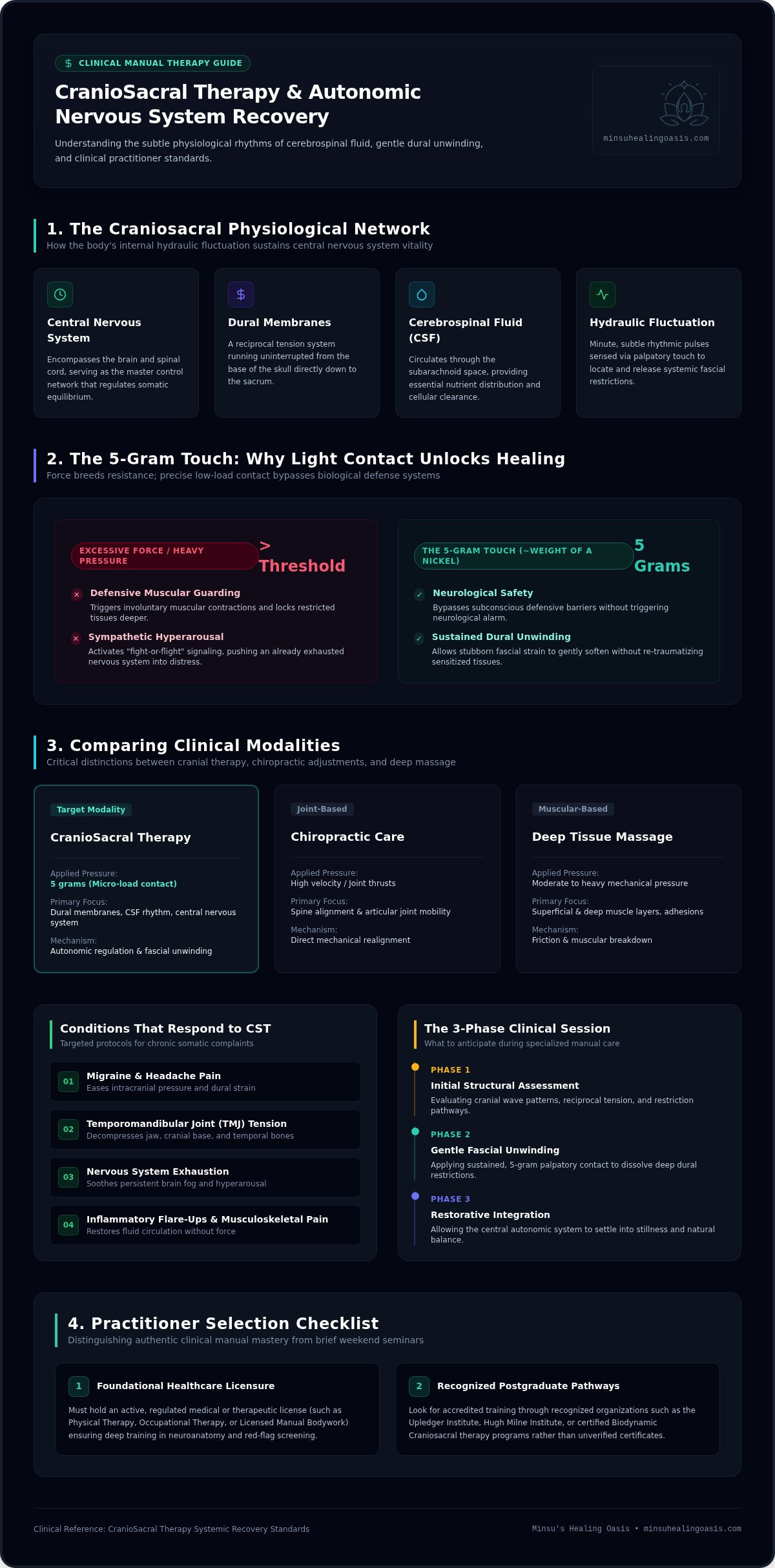
Cerebrospinal fluid pulses steadily within the subarachnoid space, bathing the central nervous system in protective nourishment. The surrounding dural membranes create a reciprocal tension system connecting the base of the skull directly down to the sacrum. When trauma, emotional stress, or postural strain binds these delicate tissues, fluid mobility becomes compromised. This restriction hampers nutrient distribution and cellular clearance, leaving tissues stagnant and irritated. Clinical manual work gently clears these pathways, restoring fluid fluctuation, enhancing vitality, and inviting deep somatic equilibrium.
The Five-Gram Touch: Why Gentle Contact Yields Profound Healing
Why do practitioners use a touch no heavier than the weight of a nickel? Force breeds resistance. When clinical pressure exceeds the body's natural defensive threshold, the nervous system reacts protectively:
Defensive guarding: Heavy pressure triggers muscular contractions and activates sympathetic fight-or-flight signaling.
Neurological safety: Contact weighted at approximately five grams bypasses subconscious muscular resistance.
Sustained release: Gentle intention invites deep dural unwinding, allowing stubborn fascial strain to soften without re-traumatizing sensitized tissues.
Working with an experienced cranial sacral therapy practitioner Miami residents rely on offers a path beyond mechanical friction. By honoring physiological boundaries, this precise manual work calms neurological hyperarousal, releases cranial restrictions, and helps your entire system return to lasting ease.
How to Choose a Qualified Cranial Sacral Therapy Practitioner: A Step-by-Step Guide
How can you discern whether a therapist holds genuine clinical expertise or merely a weekend certificate? Because light-touch modalities rely on exquisite sensitivity, selecting the right professional requires careful verification. As noted in overview resources like the Cleveland Clinic on Craniosacral Therapy, finding a skilled specialist ensures safe, targeted care tailored to your unique anatomical history. Following a clear evaluation process empowers you to partner with a trusted cranial sacral therapy practitioner Miami residents and national clients can feel confident turning to for authentic nervous system recovery.
Foundational Healthcare Licensure vs Standalone Certificates
True clinical manual therapy begins with a regulated medical or therapeutic license. Legitimate practitioners must maintain active credentials in disciplines such as physical therapy, occupational therapy, or licensed manual bodywork. These foundational programs provide years of essential education covering neuroanatomy, systemic physiology, and clinical red-flag screening. A brief weekend seminar cannot replace this extensive anatomical foundation, which is crucial for identifying underlying complications and keeping your care safe.
Recognized Training Pathways: Upledger, Milne, and Biodynamic Institutes
Look for dedicated postgraduate study completed through reputable, accredited educational bodies. Leading institutions maintain rigorous standards through distinct, comprehensive methodologies:
Upledger Institute: Focuses on biomechanical releases, structural cranial mobilization, and standardized ten-step clinical protocols.
Hugh Milne and Biodynamic Models: Emphasize embryological forces, primary respiration, and deep perceptual stillness to calm autonomic strain.
Documented Clinical Hours: Ask therapists about their specific course levels, supervised practicum hours, and accredited testing milestones.
Essential Questions to Ask During Your Initial Consultation
Before scheduling your first table session, take time to speak directly with the therapist. Ask targeted questions that reveal their clinical depth and personal philosophy:
How many hours of hands-on cranial training have you completed through accredited institutions?
What is your clinical background in treating my specific neurological or muscular issues?
How do you integrate gentle cranial work with broader rehabilitative or myofascial therapies?
A compassionate provider listens without rushing, explains their approach clearly, and respects your physical boundaries. If you seek an integrative clinical environment that honors both scientific precision and restorative stillness, explore how our compassionate manual therapists at Minsu’s Healing Oasis personalize care to meet your body's restorative needs.
CranioSacral Therapy vs Chiropractic Care and Deep Tissue Massage
Why do different manual therapies produce such dramatically different responses in your body? Healing modalities are not interchangeable. While chiropractic adjustments focus on bone alignment and deep tissue bodywork kneads tight muscles, craniosacral work operates on an entirely different physiological level. As pioneered by clinical organizations like the Upledger Institute International, craniosacral care uses light touch to release dural tension and soothe the central nervous system. Understanding how these therapies diverge helps you select a qualified cranial sacral therapy practitioner Miami clients can trust to match their body's current neurological tolerance.
Mechanical Force and Nervous System Impact: A Comparison
Each discipline applies force differently, producing distinct physiological responses across your joints, muscles, and nerves:
Chiropractic Care: Relies on high-velocity thrusts to mobilize spinal joints. While effective for structural hypomobility, rapid force can startle a sensitized, hyperreactive nervous system.
Deep Tissue Massage: Uses sustained mechanical friction to break up dense adhesions within gross muscle bellies. In cases of chronic pain, this aggressive friction can trigger defensive inflammatory flares.
CranioSacral Therapy: Applies non-intrusive micro-pressure to quiet the autonomic system, communicate safety to the vagus nerve, and invite organic tissue unwinding.
Why Light Touch Succeeds When Deep Pressure Proves Counterproductive
Can force truly heal a system already overwhelmed by chronic pain? When individuals face conditions like fibromyalgia, persistent trauma patterns, or post-concussive fatigue, their nervous systems exist in continuous neurological wind-up. Aggressive pressure often confirms the brain's perception of threat, locking muscles into tighter splinting and worsening brain fog. High mechanical load simply overstimulates depleted tissues.
Gentle manual contact succeeds precisely because it does not trigger the body's alarm systems. By staying beneath the sensory threshold of pain, a skilled cranial sacral therapy practitioner Miami clients seek out invites spontaneous muscular softening. This respectful contact allows the dura, fascia, and autonomic circuitry to reset naturally without leaving you drained, bruised, or inflamed.
Common Conditions That Respond to Professional CranioSacral Care
Do you feel as though your body is holding onto old injuries, chronic stress, or unyielding exhaustion? Because the craniosacral system encloses your central neurological core, restrictions within these membranes produce diverse symptoms across the entire body. Consulting an experienced cranial sacral therapy practitioner Miami clients trust can help identify the root causes behind persistent head pressure, jaw clenching, and sensory fatigue, guiding you toward genuine nervous system regulation.
Relieving Migraines, Cervical Tension, and TMJ Clenching
Structural tightness at the atlanto-occipital junction can impede normal venous drainage, creating throbbing vascular headaches and chronic neck stiffness. When cranial bones experience strain, the effects cascade through neighboring nerves:
Trigeminal irritation: Compression near the sphenobasilar junction exerts mechanical drag on the trigeminal pathways, often manifesting as stubborn migraine pain or orbital pressure.
Temporal bone fixation: Asymmetrical tension through the temporal sutures alters the mechanics of the temporomandibular joint, contributing directly to bruxism and facial soreness.
Suboccipital decompression: Gentle manual traction unwinds the dura at the base of the skull, restoring ease and fluid flow through compressed cervical nerves.
Post-Concussion Recovery and Autonomic Nervous System Reset
Physical impacts to the skull leave subtle, lingering strain patterns within the falx cerebri and tentorium cerebelli membranes. These internal torque patterns often perpetuate post-concussive brain fog, vestibular disorientation, and cognitive fatigue. By neutralizing abnormal dural tension, therapy supports natural intracranial fluid circulation. To deepen recovery, learn how complementary protocols like red light therapy accelerate cellular brain tissue restoration and mitochondrial vitality.
SomatoEmotional Release: Releasing Emotional Patterns Held in the Tissues
Our tissues often store the energetic and muscular memory of emotional shocks, sudden accidents, or unresolved grief. SomatoEmotional Release provides a quiet, supported space where the body feels safe enough to complete defensive survival responses that were previously interrupted. Discover how our integrative care blends touch with quantum healing modalities for deep spirit-level transformation.
If you're ready to break free from continuous sympathetic overdrive, connect with our skilled practitioners at schedule a restorative session today to experience true somatic ease.
What to Expect During Your CranioSacral Therapy Session
What does a restorative clinical session actually feel like from the moment you lie down? Unlike traditional medical evaluations or disrobed massage treatments, you remain fully clothed while resting comfortably supine on a supportive, cushioned therapy table. Your visit begins with a thorough conversation exploring your physical history, structural challenges, and personal healing intentions. From there, the therapist places hands softly along key listening stations, including your feet, sacrum, torso, and cranial vault. Working alongside an attentive cranial sacral therapy practitioner Miami clients trust creates a serene sanctuary where tissues soften, racing thoughts settle, and your system enters deep restoration.
The Anatomy of a Session: Assessment, Stillpoints, and Unwinding
Your practitioner begins by listening through gentle contact to map restrictive strain across your interconnected fascial web. During treatment, they may initiate a therapeutic stillpoint, a deliberate pause in craniosacral fluid fluctuation that serves as an autonomic reset button for the central nervous system. As the rhythm gently restarts, spontaneous fascial unwinding unfolds. Bound musculoskeletal structures safely release historical tension without any uncomfortable mechanical forcing.
Post-Treatment Integration: Hydration, Rest, and Nervous System Processing
Because subtle manual work triggers profound shifts throughout your neurological pathways, processing continues long after you leave the table:
Somatic shifts: Sensations of profound warmth, sudden emotional clarity, or gentle tiredness frequently accompany deep nervous system reorganization.
Hydration support: Drinking ample pure water nurtures cellular recovery and encourages healthy lymphatic fluid circulation as tissues detoxify.
Restorative pacing: Give yourself permission to rest quietly after sessions, allowing your recalibrated physiology time to settle into its new alignment.
Beginning Your Restorative Healing Journey
Dissolving complex, long-standing tension patterns is an evolving process that requires patience, consistency, and compassionate attention. When you choose to partner with an advanced cranial sacral therapy practitioner Miami seekers rely on, you receive an exceptional combination of clinical precision, loving presence, and holistic manual excellence. Take the first step toward lasting vitality, inner peace, and somatic freedom with Minsu’s Healing Oasis.
Embrace Lasting Ease and Somatic Wholeness
Are you ready to trade chronic pain, physical tension, and nervous system exhaustion for genuine physiological peace? True restorative healing happens when you honor your body's innate wisdom rather than forcing it through aggressive pressure. By verifying foundational healthcare licensure, confirming accredited postgraduate training, and prioritizing gentle manual touch, you protect your recovery process. Choosing a skilled cranial sacral therapy practitioner Miami clients rely on ensures your care remains both structurally grounded and profoundly soothing.
At its core, authentic rehabilitation unites anatomical mastery, quantum healing, and deep cellular renewal. When masterful clinical manual therapy meets compassionate presence, long-standing fascial strains dissolve, mental clarity returns, and your autonomic nervous system finds enduring equilibrium. You don't have to carry systemic tension alone. Begin your journey to restorative calm and schedule an integrative consultation with Minsu’s Healing Oasis, and discover the lasting freedom of a balanced body, mind, and spirit.
Frequently Asked Questions
How do I verify the credentials of a cranial sacral therapy practitioner?
Start by confirming an active, state-regulated medical license in fields like physical therapy, occupational therapy, or licensed massage. Next, check practitioner directories from accredited bodies such as the Upledger Institute or the Biodynamic Craniosacral Therapy Association of North America. An established cranial sacral therapy practitioner Miami seekers or national clients consult will openly discuss their completed classroom levels, supervised clinical hours, and continuous education history.
Is cranial sacral therapy safe for children, infants, and elderly individuals?
Yes, cranial sacral work is exceptionally gentle and safe across all stages of life. Because practitioners apply only light pressure without forceful joint popping, fragile tissues remain protected. Dedicated pediatric programs support infants recovering from birth strain, while seniors find relief for delicate spinal joints and age-related nervous system exhaustion. Skilled therapists adjust their contact to match each client's specific physical vulnerability.
How many cranial sacral therapy sessions will I need to experience lasting relief?
Most individuals notice palpable autonomic shifts within two to three appointments, with lasting structural change developing across four to eight sessions. Acute injuries or recent tension patterns resolve relatively quickly. Severe, long-standing conditions like post-concussion syndrome or complex chronic pain typically require an ongoing, layered treatment plan to help the nervous system steadily integrate new somatic patterns.
What is the difference between biodynamic and biomechanical craniosacral therapy?
Biomechanical models focus on physical structure, utilizing specific manual holds to mobilize cranial bones, membranous reciprocal tension, and cerebrospinal fluid flow. In contrast, the biodynamic approach emphasizes primary respiration, embryological forces, and deep perceptual stillness, allowing the client's inner system to guide the healing process. Many advanced manual therapists fluidly integrate both schools to offer balanced, comprehensive somatic support.
Do I need to undress for a cranial sacral therapy appointment?
No, you remain fully clothed throughout the entire appointment. Simply wear comfortable, loose-fitting attire, such as yoga pants or soft athletic clothing, to allow unrestricted breathing and easy tissue assessment. Because practitioners evaluate fascial mobility through gentle hand contact rather than rubbing muscular friction, oils or skin exposure are completely unnecessary during clinical craniosacral care.
Can cranial sacral therapy worsen my symptoms before they begin to improve?
Temporary therapeutic reactions can occasionally occur as tissues unwind and autonomic patterns recalibrate. You might experience mild fatigue, slight lightheadedness, or brief emotional releases for twenty-four to forty-eight hours following a session. These mild responses reflect your nervous system integrating profound adjustments, and staying well-hydrated helps your body settle into restorative equilibrium.
How does cranial sacral therapy help with chronic TMJ and jaw clenching?
The therapy resolves TMJ pain by relieving membranous restrictions within the temporal bones and sphenobasilar junction. When these cranial plates compress, they place mechanical traction on the trigeminal nerve and adjacent masticatory muscles. A seasoned cranial sacral therapy practitioner Miami clients consult mobilizes the cranial base and cervical spine, relieving localized jaw clenching and rebalancing the bite naturally.
Can cranial sacral therapy be combined with other integrative manual treatments?
Yes, cranial therapy integrates seamlessly with complementary clinical modalities to accelerate cellular recovery. Combining gentle cranial holds with myofascial release loosens dense muscular holdings, while red light therapy provides mitochondrial energy to strained brain tissues. Pairing manual therapy with quantum healing modalities also addresses energetic strain, creating a comprehensive, multi-layered path toward complete nervous system harmony.


Comments