




Cranial Sacral Therapy vs. Myofascial Release: A Guide to Whole-Body Restoration
Does it feel as though your body is speaking a language of tension that traditional massage simply cannot translate? You are likely familiar with the heavy burden of chronic jaw pain, the sharp pull of persistent headaches, and that draining sensation of living in a constant state of high alert. It's common to feel trapped in a cycle of temporary fixes that never quite touch the root of your discomfort. This exploration of cranial sacral therapy vs myofascial release offers a bridge between clinical science, alternative wisdom, and spiritual restoration.
You'll learn how these subtle techniques can quiet your nervous system, soften your structural tissues, and return you to a balanced state of harmony. We will examine how the five gram pressure of a cranial touch, which is roughly the weight of a single nickel, can shift your internal landscape. We'll also look at how the connective tissue web holds your physical history and how combining these methods creates a sacred space for you to heal, breathe, and thrive.
Table of Contents
Understanding the Web of Wellness: An Introduction to MFR and CST
Myofascial Release: Unlocking the Body’s Structural Connective Web
Craniosacral Therapy: Engaging the Nervous System’s Sacred Rhythm
Cranial Sacral Therapy vs. Myofascial Release: Choosing Your Path
A Harmonious Path: Integrating Manual Therapies for Lasting Healing
Understanding the Web of Wellness: An Introduction to MFR and CST
Have you ever felt that your body is holding onto a story it no longer needs to tell? You are more than just a series of joints and muscles; you are an intricately woven system of fluid, bone, and connective tissue. When we explore cranial sacral therapy vs myofascial release, we are looking at two distinct yet complementary entry points into this living system. Myofascial Release serves as the structural release of the body’s fascial web, addressing the physical "glue" that can bind your movements. In contrast, Cranial Sacral Therapy acts as the fluid harmonization of the central nervous system, listening to the subtle pulses and rhythms of life within. While these modalities have different primary focuses, both therapies aim to restore your body’s natural ability to self-heal, balance, and thrive.
The Interconnectedness of Pain
Can a restriction in your foot truly cause a pounding headache? It sounds improbable, yet the fascial lines that wrap your muscles are continuous. A pull in one area creates a ripple effect across the entire map of your body. Traditional "spot-treatment" often fails because it ignores this global connection, treating the symptom rather than the source. Your nervous system also plays a silent role, holding, guarding, and protecting you from both physical and emotional tension. When we address the body as a whole, we finally release the persistent patterns that keep you stuck in a state of discomfort. This holistic view allows for a deeper understanding of how cranial sacral therapy vs myofascial release can work in tandem to resolve these hidden connections.
A Nurturing Approach to Manual Therapy
How do we invite the body to let go? The touch used in these sessions is never forced; it is invitational, patient, and deeply respectful. We believe the practitioner acts as a bridge between your physical symptoms and your inner peace. This work requires a safe, quiet, and restorative environment where your cells feel permitted to soften. By honoring the interconnectedness of your physical and emotional states, we create a space for you to discover, renew, and thrive. It's a steady, calming dialogue with your body that acknowledges your spirit just as much as your structure. This approach ensures that you feel heard, understood, and nurtured throughout your journey toward restoration.
Myofascial Release: Unlocking the Body’s Structural Connective Web
Imagine a thin, elastic web that wraps every muscle, organ, and nerve in your body. This is your fascia. It is a silvery-white connective tissue that provides your essential internal structure. Under healthy conditions, fascia is relaxed and wavy. It has the ability to stretch and move without restriction. However, when you experience physical trauma, poor posture, or chronic emotional stress, this elastic web loses its suppleness. It becomes "glued" and tight. This restriction exerts crushing pressure on sensitive structures, leading to pain that feels like a persistent vice-grip. It's a silent burden that many people carry without realizing the source.
Myofascial Release (MFR) uses sustained, gentle pressure to address these restrictions. Unlike traditional massage, which often slides over the surface, MFR practitioners apply a steady hold that allows the tissue to "melt" and elongate. This process restores the essential "glide" between your tissues, allowing for effortless movement. It also encourages better circulation and lymphatic flow, helping your body flush out toxins and receive vital nutrients. When considering cranial sacral therapy vs myofascial release, think of MFR as the work that clears the physical debris so the deeper systems can find peace.
The Fascial System as a Living Matrix
Does your body remember things your mind has tried to forget? Fascia acts as a structural memory, storing the impact of past injuries and emotional shocks. If you live with chronic pain conditions like fibromyalgia, your tissues may feel perpetually guarded. Aggressive "deep tissue" work often backfires by triggering more inflammation and guarding. MFR is different. It honors the body’s pace. By waiting for the tissue to release on its own time, we avoid the "fight" response and allow for true cellular restoration. This patient approach is a key distinction when comparing cranial sacral therapy vs myofascial release, as both prioritize the body's innate wisdom over force.
The Structural Benefits of MFR
Restoring your postural alignment is about more than just standing up straight; it is about removing the barriers that prevent you from feeling light and free. MFR releases the "vice-grip" of tight muscles that pull your skeleton out of balance. This structural opening is a beautiful way to prepare the body for deeper energy work, such as quantum healing. While MFR addresses the physical web, Craniosacral Therapy focuses on the delicate rhythms of the nervous system. Together, they create a comprehensive path to wellness. If you feel your body is ready to let go of these old patterns, you might consider how a personalized session could help you find your center again at Minsu's Healing Oasis.
Craniosacral Therapy: Engaging the Nervous System’s Sacred Rhythm
Have you ever wondered why a touch as light as a nickel can create a ripple of peace through your entire being? Craniosacral Therapy (CST) is a delicate manual therapy that focuses on the membranes and cerebrospinal fluid surrounding your brain and spinal cord. Trained practitioners listen for the "Breath of Life," a subtle rhythmic pulse that flows through this system. We use approximately five grams of pressure, which is roughly the weight of a nickel, to encourage the body to listen, release, and restore its internal rhythms. This approach is rooted in the understanding that your central nervous system is the master regulator of your health, harmony, and vitality.
While a clinical study comparing CST and MFR highlights how both impact the body's recovery, CST is uniquely positioned to address the neurological roots of tension. It's not about forcing change, but rather inviting your body to remember its natural state of balance. When we contrast cranial sacral therapy vs myofascial release, we see that MFR clears the physical path while CST harmonizes the internal signal. Together, they offer a complete dialogue with the body's structural and fluid systems.
The Difference Between Cranial Massage and Therapy
It's easy to confuse a relaxing scalp massage with the clinical depth of Craniosacral Therapy. While a cranial massage focuses on surface relaxation of the scalp and neck, CST is a precise manual therapy targeting dural membranes and fluid dynamics. It requires specialized training in the anatomy of the skull and spine to feel the minute movements of the cranial bones. This isn't just about comfort; it's a structural and neurological intervention designed for deep, long-term restoration. We look beyond the surface to honor the intricate mechanics of your nervous system.
Cerebrospinal Fluid and the Stillpoint
Your cerebrospinal fluid (CSF) does more than just cushion your brain. It nourishes your nervous system and removes metabolic waste, acting as a vital cleansing agent for your mind and spirit. During a session, you may experience what we call a "stillpoint." This is a moment where the craniosacral rhythm pauses, allowing for a deep physiological reset. The stillpoint is the gateway to profound emotional and physical stillness. It allows your system to move from a state of fight-or-flight into a space of deep, restorative peace where your body can finally begin to heal itself.
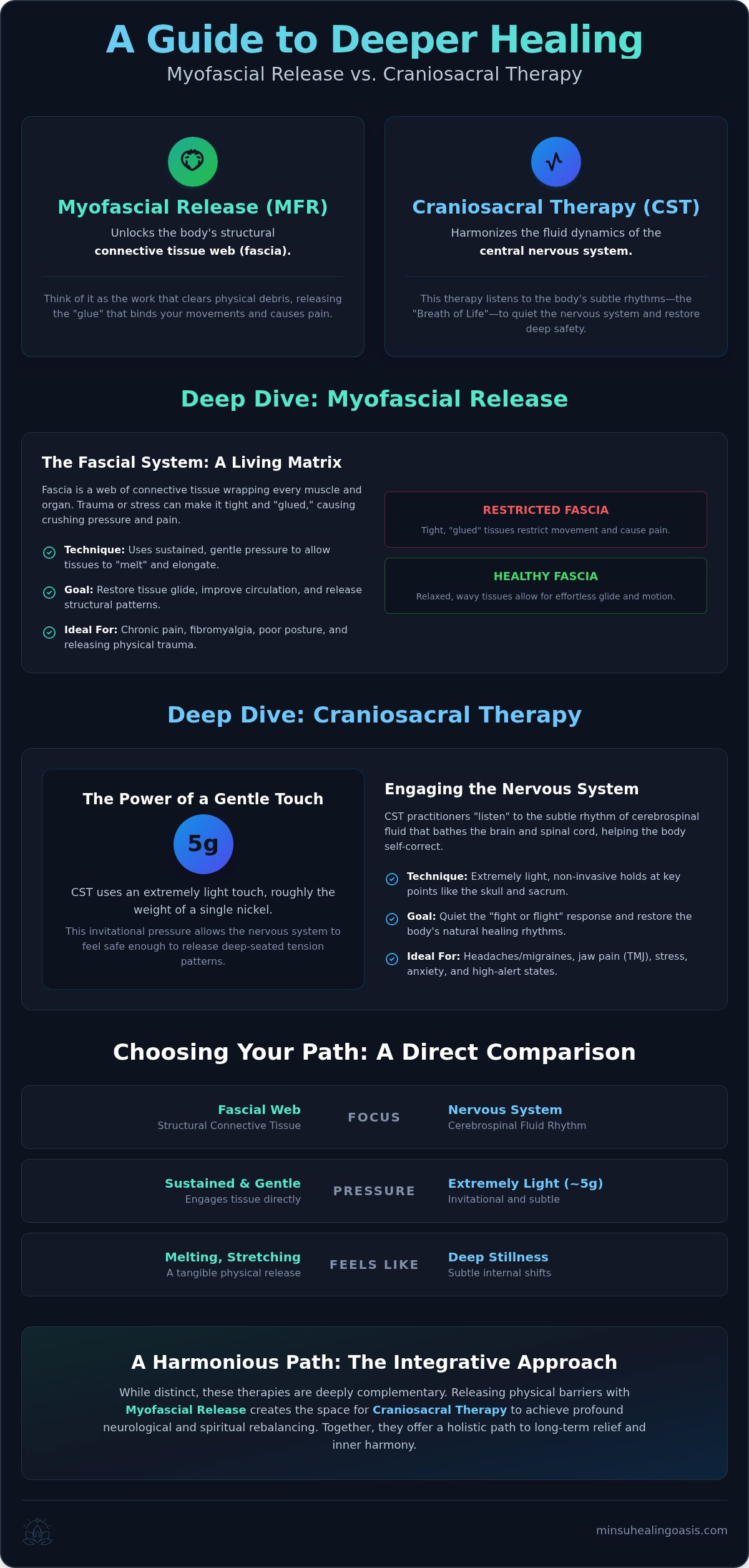
Cranial Sacral Therapy vs. Myofascial Release: Choosing Your Path
Which path calls to you in this moment? Choosing between cranial sacral therapy vs myofascial release is not about finding a single superior treatment, but about listening to the unique language of your own discomfort. While both modalities are gentle and non-invasive, they offer very different sensory experiences. Myofascial Release (MFR) often feels like a slow, deep "melting" or a gentle stretching of the tissues as the practitioner engages the physical web of your fascia. In contrast, Craniosacral Therapy (CST) is frequently experienced as a deep, meditative quiet, a space where time seems to slow down and the mind finally finds rest.
The clinical goals of these therapies also diverge to meet your specific needs. MFR is primarily focused on structural alignment, seeking to remove the physical "glue" that binds your muscles and limits your movement. CST prioritizes neurological regulation, working with the fluid rhythms of the brain to soothe a frayed nervous system. Understanding the nuances of cranial sacral therapy vs myofascial release allows you to advocate for the restorative care that resonates most deeply with your current state of being. You might find that your body requires the structural opening of MFR one week and the quiet harmonization of CST the next.
When to Choose Myofascial Release
Do you feel as though your body is wrapped in a suit that is two sizes too small? MFR is the ideal choice when you are struggling with chronic physical pain, a restricted range of motion, or visible structural imbalances. It is particularly effective for those who feel "tight," "compressed," or "stuck" in their physical frame. By releasing these long-held restrictions, MFR helps you move with a sense of lightness and ease. Many of our clients find that MFR beautifully supports physical recovery when paired with the cellular vitality offered by red light therapy. It is a path of physical liberation, structural renewal, and lasting relief.
When to Choose Craniosacral Therapy
Are you living in a "wired but tired" state of exhaustion where your mind refuses to go quiet? CST is a sanctuary for those battling migraines, anxiety, or insomnia. It is a profound tool for nervous system dysregulation, helping to shift the body out of a persistent fight-or-flight response. This therapy is also a beautiful option for children and infants, offering a gentle way to address developmental challenges or sensory needs without overwhelming their delicate systems. It provides a safe space for emotional release, spiritual harmony, and internal peace. If you are ready to begin your journey toward whole-body restoration, we invite you to schedule a session at Minsu's Healing Oasis today.
A Harmonious Path: Integrating Manual Therapies for Lasting Healing
Why choose between structural stability and emotional peace when your body deserves both? The journey of healing is rarely a straight line; it's a layered process of uncovering, releasing, and renewing. When we look at cranial sacral therapy vs myofascial release, we see a synergistic relationship where the whole is greater than the sum of its parts. Myofascial Release effectively "opens the door" by dissolving the physical barriers and rigid patterns held within your connective tissue. By clearing this structural noise, your system becomes more receptive, allowing the subtle, fluid work of Craniosacral Therapy to reach deeper levels of your nervous system and spirit.
This integrative approach ensures that we aren't just managing symptoms but are fostering a state of lasting harmony. Maintaining this delicate balance requires more than just occasional sessions; it involves a commitment to a lifestyle that honors your body's need for movement and stillness. Engaging in holistic fitness classes can help you integrate these changes into your daily life. It's about creating a "restored life" where the persistent hum of pain is replaced by a profound sense of inner peace, vitality, and grace.
The Synergy of Manual and Energy Healing
How does physical release translate into spiritual renewal? When you release fascial restrictions through MFR, you aren't just loosening a muscle; you are enhancing the flow of internal energy throughout your entire living matrix. This physical opening often serves as a catalyst for emotional releases, as the body finally feels safe enough to let go of stored trauma. In these moments, a wise guide is essential to help you navigate these shifts with compassion, patience, and professional clinical authority. We aim to create a personalized healing sanctuary that honors your unique history while clearing the path for your future self to emerge.
Your Invitation to Deep Restoration
What can you expect when you step into a nurturing center for your first integrative session? You will be met with an environment designed to soothe, ground, and protect your energy. Before you arrive, take a moment to prepare your mind to receive the gentle wisdom of manual therapy. Set an intention to be present, to breathe, and to trust the process of restoration. Whether you are navigating the complexities of cranial sacral therapy vs myofascial release or exploring energy healing, you are taking a courageous step toward yourself. We invite you to stop surviving the day and start thriving through the power of restorative care.
Embrace Your Journey Toward Whole-Body Harmony
Are you ready to release the old patterns that no longer serve your spirit? We have explored how the structural opening of Myofascial Release and the neurological quiet of Craniosacral Therapy work in concert to restore your vitality. Understanding the nuances of cranial sacral therapy vs myofascial release is the first step toward a life defined by ease rather than effort. By addressing both the physical web of your fascia and the sacred rhythm of your nervous system, you create a foundation for lasting peace.
Our integrative physiotherapy expertise provides a bridge between traditional science and alternative wisdom. We act as wise, compassionate guides who honor the needs of your body and your soul within a sanctuary for restorative healing. You don't have to carry the weight of chronic tension alone. It's time to rediscover your natural state of balance, harmony, and vitality. Begin your journey to deep stillness and restoration at Minsu’s Healing Oasis. Your path to a nurtured and renewed self begins with a single, courageous choice to heal.
Frequently Asked Questions
Is craniosacral therapy the same as a head massage?
No, craniosacral therapy is a profound clinical manual therapy that reaches far deeper than a traditional head massage. While a massage focuses on soothing the surface muscles of the scalp and neck, CST targets the delicate dural membranes and the flow of cerebrospinal fluid. We use a gentle five gram touch to listen, evaluate, and harmonize your nervous system. It's a sophisticated practice that requires specialized anatomical training to restore your body’s inner sacred rhythm.
Can myofascial release help with chronic migraines?
Yes, myofascial release is exceptionally effective for those suffering from chronic migraines by addressing the structural roots of the pain. Often, migraines are triggered by restrictive, glued fascia in the neck, shoulders, and upper back that pulls on sensitive nerves. By applying sustained pressure to melt these barriers, we restore blood flow, reduce pressure, and provide lasting relief. This structural liberation allows your body to finally let go of the vice-grip of persistent tension.
Which is better for anxiety: CST or MFR?
While both therapies offer restorative benefits, Craniosacral Therapy is specifically designed to soothe the nervous system and quiet a racing mind. If you feel wired but tired or trapped in a fight-or-flight state, CST provides the deep, meditative stillness needed for emotional regulation. Myofascial release is wonderful for physical grounding, but when comparing cranial sacral therapy vs myofascial release for anxiety, CST’s focus on fluid harmonization often yields the most profound sense of inner peace.
Is it safe to combine myofascial release and craniosacral therapy in one session?
It's not only safe but often highly recommended to integrate these two modalities within a single session. This harmonious approach allows us to address your well-being from multiple dimensions. MFR effectively opens the door by releasing physical, structural barriers in the fascial web, which then permits the gentle work of CST to penetrate deeper into the nervous system. Together, they create a comprehensive dialogue with your body that fosters renewal, discovery, and complete restoration.
How many sessions will I need before I feel a difference?
Many individuals experience a sense of being reset or nurtured after just one session, though long-term healing is a patient journey. For chronic conditions or deep-seated tension, we typically suggest a series of three to five sessions to establish a new baseline of health. Your body needs time to unlearn old patterns, integrate new rhythms, and fully accept the invitation to heal. Every person’s path is unique, and we honor your individual pace throughout this transformative process.
Do I need to undress for these manual therapy sessions?
You don't need to undress for these sessions, as both therapies are traditionally performed while you are fully clothed in comfortable attire. We recommend wearing loose, flexible clothing that allows your body to breathe and move freely. This approach helps maintain a sense of safety, comfort, and professional boundaries, allowing you to focus entirely on the internal shifts occurring. Our goal is to create a peaceful environment where you feel fully supported, heard, and understood.
Can these therapies help with TMJ and jaw tension?
Yes, these therapies are powerful tools for releasing the agonizing vice-grip of TMJ and chronic jaw tension. Myofascial release softens the tight connective tissues around the jaw and neck, while Craniosacral Therapy addresses the delicate bones of the skull and the nervous system's response to pain. By combining these techniques, we can help you find freedom from clicking, grinding, and aching. It's a compassionate path to reclaiming your comfort and restoring your natural facial harmony.
Are there any side effects to releasing deep fascial tension?
As your body releases long-held restrictions, you may experience a gentle healing crisis which can include mild fatigue, emotional release, or a temporary increase in awareness of old sensations. These are positive signs that your system is detoxifying, recalibrating, and letting go of stored stress. We encourage you to drink plenty of water, rest deeply, and be patient with your body as it integrates these changes. This process is a necessary step toward removing barriers and achieving vibrant health.


Comments